
Kaizen Success Stories
Real Manufacturing Results. One Kaizen at a Time
Explore real-world Kaizen success stories showing how manufacturing teams solved critical problems, improved performance, and created sustainable results.
We're Never Going Back!
How a 47-year veteran helped transform a tool room and inspired a team to take ownership of its future.
How a 47-year veteran helped transform a tool room and inspired a team to take ownership of its future.
Kaizen Snapshot
Setting: A manufacturing facility preparing for significant production growth.
Challenge: Improve the organization, efficiency, and safety of a tool room responsible for maintaining and repairing critical production fixtures.
Stakes: Preventive maintenance and repairs were taking five days or longer, creating risks to equipment availability, production capacity, and the facility's ability to support future growth.
Approach: Engage a cross-functional Kaizen team to improve inventory management, establish preventive maintenance scheduling, and create a safe, efficient fixture repair workstation.
Outcome: The team established an organized repair area, introduced visual preventive maintenance scheduling, and developed systems for locating and managing critical parts. Initial experience indicated that repairs could now be completed in less than one day, although the long-term performance improvement had not yet been fully validated. Team members continued making improvements after the Kaizen ended.
Key Lesson: When people take ownership of improvements, they don't just adopt a better way of working. They become determined to protect it.
The Situation
The manufacturing facility was preparing for significant growth, but there was a problem.
Its tool room was struggling to keep up with the preventive maintenance and repair needs of critical production fixtures.
Completing a repair or preventive maintenance activity typically took five days or longer. With production demands expected to increase, that wasn't going to be sustainable.
Our Kaizen team was given an ambitious objective: Reduce fixture repair and preventive maintenance time by at least 80%, making it possible to complete the work in one shift or less.
We assembled a diverse team consisting primarily of experienced tool and die makers, along with employees from supporting functions.
On the first morning, we spent time learning some basic continuous improvement principles. I could sense a little skepticism.
That wasn't unusual. These were experienced people who knew their work, and they weren't necessarily convinced that a week of Kaizen activities would solve problems they'd been living with for years.
Then we went to the Gemba. And that's when things started getting interesting.
What Was Getting in the Way
As we walked through the tool room and surrounding work areas, opportunities for improvement were everywhere.
Parts and materials were scattered throughout the facility. Some were hidden behind other equipment or supplies. Others weren't clearly identified.
There was no reliable way to know whether the parts needed for a repair were available.
There wasn't a dedicated, properly organized workstation for repairing and maintaining fixtures, so employees performed the work wherever they could find space.
And perhaps most importantly, we discovered that there wasn't an effective preventive maintenance system.
Instead of maintaining fixtures based on their usage, the organization was largely operating on a run-to-failure basis.
The team had plenty of experience and technical capability.
What they lacked was a system that made it easy to do their jobs effectively.
The Decision
Rather than trying to tackle everything as one large group, we divided into three teams.
The first focused on inventory management. They needed to understand what parts, tools, and supplies were available, organize them, and identify what was missing.
The second focused on preventive maintenance scheduling. Their challenge was to develop a practical way to know when fixtures needed attention before they failed.
The third focused on creating a dedicated repair and preventive maintenance workstation. They wanted a safe, ergonomic, well-organized space with the tools and materials needed to complete work efficiently.
Each team had a clear objective. And each had the freedom to figure out how to accomplish it.
What We Did
The inventory team went to work sorting through literally thousands of parts and pieces.
They organized materials, established storage locations, and labeled items so they could be found when needed.
They also discovered that some critical repair items weren't available at all. That led to the beginnings of an inventory management system that would help the tool room prepare for future maintenance needs.
Meanwhile, the preventive maintenance scheduling team developed a visual system for tracking the operating hours of critical tooling and fixtures.
The information could be reviewed during daily management activities and Gemba walks, helping everyone understand when preventive maintenance would be required.
For the first time, the team had a practical way to begin moving from reactive repairs toward planned maintenance.
But the third team was about to give us something none of us expected.
The Breakthrough
The workstation team included four people.
Three were experienced tool and die makers, including a man I'll call Jeff, who had spent 47 years in the trade. The fourth team member came from outside the tool room.
They identified an area just outside the tool and die room that could become a dedicated repair and preventive maintenance station. Then they started building.
They found a workbench, some racking, and other materials they could repurpose. They cleared space, organized equipment, and began assembling a workstation that would make repairs safer and easier.
After a day or two, the improvement was obvious. The team was excited about what they'd accomplished. Jeff was proud, too. But I could tell he wasn't completely satisfied.
On Wednesday afternoon, I noticed that Jeff had disappeared. I asked the other team members if anyone knew where he'd gone. They told me he'd said he needed to get something.
Curious, I went looking for him. Eventually, I found him in an office that had been set aside for him because of his many years of experience.
He was disconnecting his personal workstation. "Jeff, what are you doing?" I asked.
He explained that he was planning to retire in a year or two. His workstation was better equipped than the one the team had been assembling, and he believed the entire tool room could benefit from it.
He told me, in essence, "They can use this more than I can. And I never want us to go back to the old way of doing things."
I was amazed. Here was a man with 47 years of experience, voluntarily giving up a workspace that had been set aside for him.
Nobody had asked him to do it. Nobody had suggested that he should.
He made the decision because he believed in what the team was creating.
He moved it into the new repair area.
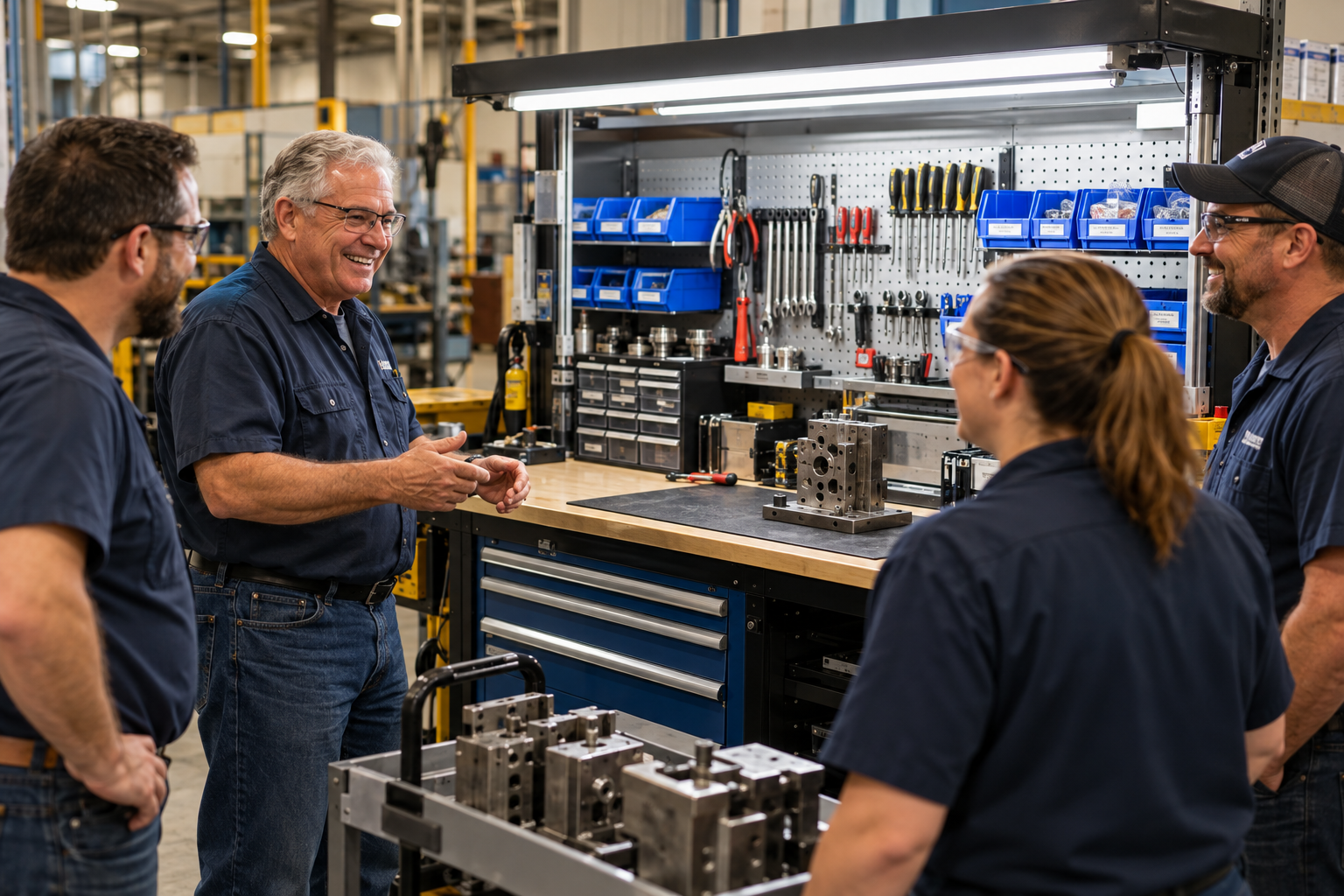
It had integrated lighting, storage, and places for small bins of parts needed to complete repairs.
The team then developed additional bulk storage behind the station and created a special cart for transporting fixtures to and from the repair area.
Suddenly, they had a much more complete solution. And the reaction from Jeff's coworkers was wonderful.
They were thrilled by what he'd done. They were proud of him, and they even made a few humorous signs to celebrate his contribution.
The atmosphere had changed. What began as an effort to organize a tool room had become something much more personal.
What Changed
Throughout the week, we invited plant leadership to visit the work areas and see the improvements taking shape.
Those visits mattered. The team could see that leadership was interested in their ideas and excited about their progress.
By Friday, the transformation was remarkable.
Parts and supplies were organized. Critical inventory needs were visible. Preventive maintenance scheduling had been introduced. And the new workstation provided a dedicated, ergonomic location for repairing and maintaining fixtures.
But the most memorable moment came during the final report-out.
The room was packed. Plant leaders, tool room employees, and coworkers from other areas gathered to hear what the team had accomplished.
When Jeff stood up to present his portion, he delivered a message that I won't forget.
"This is the way we need to work from now on. We're never going back. Don't let us go back to the old ways. This is too important."
Think about that. At the beginning of the week, we had a team that was somewhat skeptical about what could be accomplished.
By Friday, one of its most experienced members was publicly challenging his coworkers to sustain the improvements.
He wasn't saying it because I asked him to. He was saying it because he believed it. And the story didn't end on Friday.
The Improvements Continued
Two weeks after the Kaizen, I received photographs from the project's sponsor.
The team had already developed 3D-printed components to improve the storage of critical fixtures.
A few weeks later, more photographs arrived. This time, the team had created a visual management area showing the progress of repairs and work in process.
They were continuing to improve the system without waiting for another Kaizen event.
The team also reported that it believed repairs and preventive maintenance could now be completed in less than one day. Several jobs had already been completed within that timeframe, although more operating experience would be needed to confirm sustained performance against the original goal.
And perhaps my favorite development? People were beginning to ask:
"When are we going to improve the rest of the tool room?"
That's when you know something important has happened.
The Takeaway
I've facilitated more than 400 Kaizen events, and I've seen some remarkable technical improvements.
But the moments I remember most often involve people.
Jeff didn't contribute his workstation because someone told him to. He contributed it because he had become personally invested in making the new process successful.
He saw something better. He helped create it. And then he challenged everyone around him to protect it.
That's the difference between compliance and ownership.
Compliance means following the new process because someone expects you to. Ownership means protecting the new process because you believe in it.
And when employees begin asking when they can improve other areas, continuous improvement is no longer something being pushed by leadership.
It's something people are beginning to pull for themselves.
Why This Matters
Manufacturers often invest significant effort in improving processes, equipment, and workplace organization.
But technical improvements alone don't guarantee lasting results.
Sustainability depends on creating the conditions where employees understand the need for change, participate in developing solutions, and take responsibility for maintaining them.
That's why employee engagement is so important to my approach to Kaizen. The goal isn't simply to make a process better by Friday.
It's to help the people who own that process become determined to keep it better long after Friday.
Sometimes that commitment shows up in a performance metric. Sometimes it shows up in a photograph of another improvement made weeks later.
And sometimes it shows up when a 47-year veteran quietly disconnects his own workstation because he wants his coworkers to have something better.
That's a moment I'll remember for a long time.
Ready to Create Improvements Your Team Will Protect?
A successful Kaizen should deliver measurable business results while developing the engagement, ownership, and commitment needed to sustain them.
At Process Improvement Partners, we help manufacturing teams solve critical operational problems while building the capability to continue improving.
If you're ready to explore what a focused Kaizen could accomplish in your organization, let's start a conversation.