
Kaizen Success Stories
Real Manufacturing Results. One Kaizen at a Time
Explore real-world Kaizen success stories showing how manufacturing teams solved critical problems, improved performance, and created sustainable results.
From 46 Minutes to 15: A Huddle Transformation
How a team redesigned its weekly construction huddle in a single day and discovered a better way to manage its work.
Kaizen Snapshot
Setting: A growing organization managing multiple construction projects across several locations.
Challenge: Improve a weekly construction huddle that lacked consistent focus, clear priorities, and accountability for follow-up actions.
Stakes: Valuable time was being consumed without consistently identifying critical work, resolving problems, or establishing ownership of actions.
Approach: Help the team understand the purpose of effective huddles, observe its existing meeting, identify improvements, and immediately test a redesigned approach.
Outcome: The team reduced its weekly huddle from 46 minutes to approximately 15 minutes, a 67% reduction, while improving focus, visibility, and accountability. The team agreed to adopt the new approach immediately.
Key Lesson: The purpose of a huddle isn't to hold a meeting. It's to help people run the business.
The Situation
We've all been there. You're sitting in a meeting that wanders from one topic to another. People provide updates, discussions go off on tangents, and before you know it, most of an hour has passed.
But when the meeting ends, you're not entirely sure what was accomplished. What were the most important priorities? Who agreed to do what? And when will those actions be completed?
I recently had an opportunity to help a construction management team improve its weekly huddle.
The organization was managing multiple construction projects, and its local team met weekly to review progress and discuss issues. They already had a huddle process, but leadership recognized that it could be more effective. The question wasn't simply whether they could make the meeting shorter.
Could they make the huddle more valuable to the people who attended it?
We decided to find out.
What Was Getting in the Way
The team included the local general manager, employees responsible for coordinating construction activities, and administrative support.
Several people from other locations participated as observers, hoping to bring what they learned back to their teams.
The general manager led the weekly huddle, which included a whiteboard for tracking information. There was already some structure and visual management in place. But was the huddle helping them manage their work as effectively as it could?
Before making changes, I shared a simple framework built around four questions:
See: What's happening right now?
Align: What matters most?
Act: Who needs to do what?
Learn: What can we improve?
We also discussed three types of huddles.
A daily huddle focuses on running today's work, typically taking 10–15 minutes.
A weekly huddle focuses on performance trends, priorities, actions, and improvements, generally taking 30–60 minutes.
And a leadership huddle focuses on removing barriers the team cannot resolve on its own.
Each serves a different purpose, but all share one important objective: Reduce the risk of problems going unaddressed.
I also emphasized something fundamental to effective daily management.
People should attend huddles because the huddles actually help them.
Not because someone requires their attendance, but because participating makes their jobs easier.
With that understanding, we were ready to observe the existing process.
The Decision
I asked the general manager to conduct the weekly huddle exactly as he normally would.
No changes. No special preparation. And no attempt to make the meeting better because I was observing. I wanted to see the process as it actually operated.
So the team conducted its regular huddle while I listened and timed it.
The discussion moved from one topic to another. There were updates, questions, and conversations that wandered beyond the most important issues.
The whiteboard was being used, but the meeting lacked a consistent structure for identifying priorities, assigning actions, and establishing accountability.
When the huddle ended, 46 minutes had passed.
And I wasn't entirely clear who was responsible for what. I don't share that as criticism of the general manager or his team. They were doing what they had always done.
Like many organizations, they had established a meeting process without necessarily stepping back to ask whether it was accomplishing its intended purpose. That's what we were about to change.
What We Did
After observing the original huddle, I asked the team a simple question.
"What do you actually want this huddle to accomplish?"
They wanted to understand the most important work requiring attention, align around priorities, and establish clear responsibility for completing actions.
Next, I asked everyone to identify what needed to change. Using Post-it notes, team members shared their ideas.
They wanted a clearer agenda, better focus, visible priorities, documented actions, and accountability. They also wanted to avoid spending time discussing topics that didn't require everyone's attention.
These weren't my recommendations. They were the team's own observations about what would make its huddle more effective.
Together, we began designing a new approach.
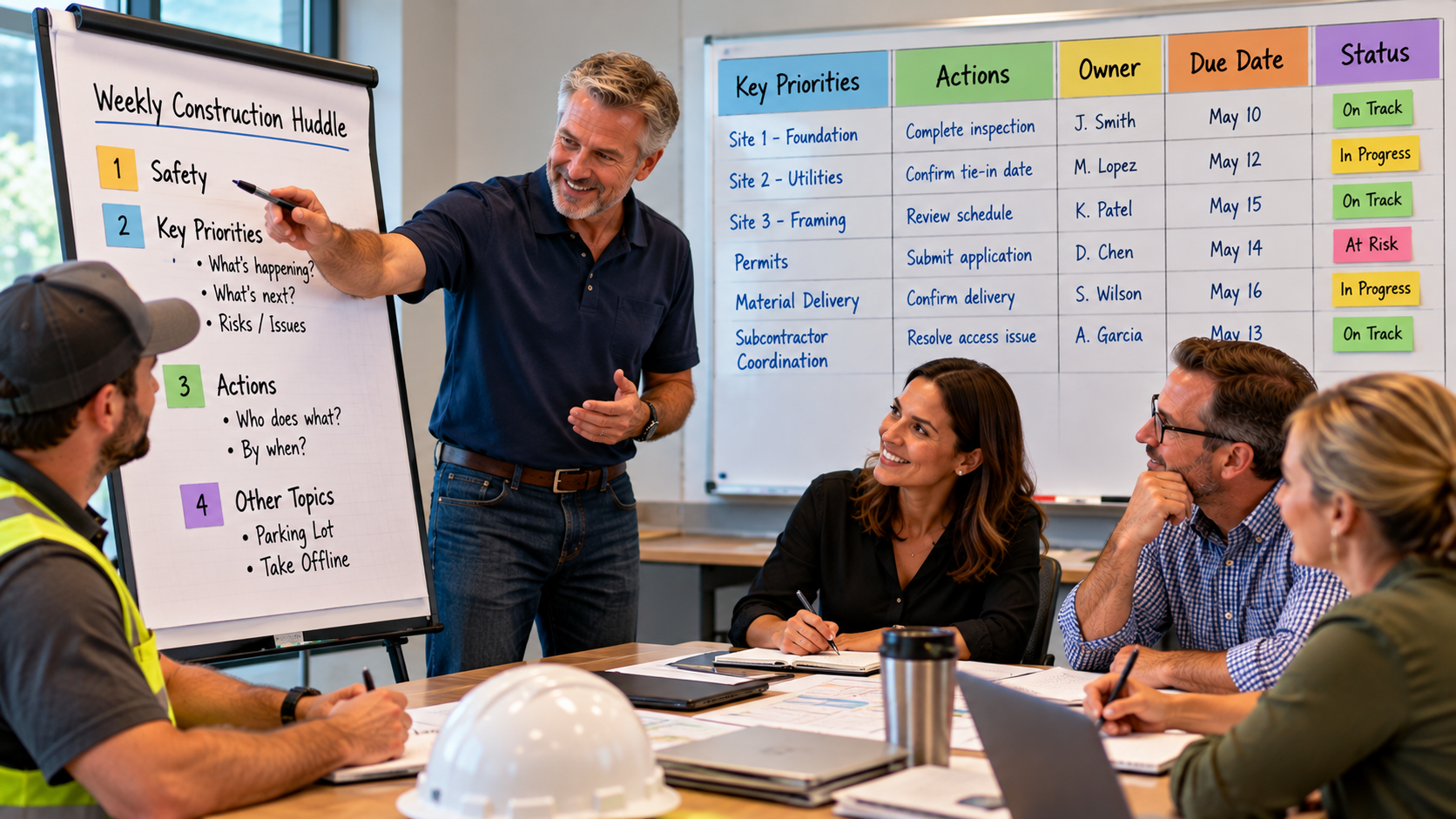
Safety would come first. Then the team would review critical priorities and issues requiring attention. Actions would have clear owners and completion dates. And discussions that didn't require the entire group would be handled separately.
The objective was straightforward.
Focus on what matters, make decisions, assign actions, and move on.
Once the team had developed its new approach, I suggested we test it immediately.
The Breakthrough
The general manager led the redesigned huddle. Same team. Same work.
But this time, they followed the agenda they had just created.
They began with safety, reviewed critical priorities, identified issues requiring attention, and established clear action ownership.
When discussions started moving beyond the huddle's purpose, they kept them focused. The whiteboard helped everyone see what mattered and what needed to happen next. And then something remarkable happened.
15 minutes later, the huddle was finished.
The original meeting had taken 46 minutes. The redesigned huddle accomplished its purpose in 15 minutes.
That's a 67% reduction in meeting time.
But here's what made the result especially meaningful. Nobody felt rushed. The team hadn't simply eliminated discussion to meet an arbitrary time limit. They had focused on the information, decisions, and actions that mattered most. And their reaction was wonderful.
Team members shared that the new approach made sense. They felt they were focusing on the right things. At least one participant commented that the redesigned huddle was much more effective. They were pleased with how quickly they had completed the meeting without sacrificing its value.
That's when I knew we had accomplished something important.
We hadn't just made the meeting shorter. We'd made it better.
What Changed
By the end of our session, the team had developed and tested a new approach to its weekly construction huddle.
The improvements were straightforward. The huddle now had a clear purpose and agenda. Safety and critical priorities received appropriate attention. Actions were visible, with assigned owners and completion dates. Discussions that didn't require the entire team could be handled separately. And everyone understood what needed to happen next.
Perhaps most importantly, the team had designed the process itself. They had observed their own huddle, identified what wasn't working, and developed a better approach.
The team agreed to begin using the redesigned huddle immediately.
Several participants from other locations also recognized opportunities to apply the same approach to their own daily and weekly huddles.
What started as an effort to improve one meeting now had the potential to influence management practices across the organization.
The Improvements Continue
One of the things I found most encouraging was that the team didn't simply learn how to conduct a better huddle. They experienced a practical method for improving any recurring management activity.
Understand what the activity should accomplish. Observe how it actually works. Identify what's getting in the way. Develop a better approach. And test it.
The organization is now preparing to apply a similar method to improving its Gemba walks.
Participants will learn the principles of effective Gemba walks, evaluate their current practices, test improvements, and refine their approach. The process will be supported virtually, allowing teams at different locations to apply what they learn in their own workplaces. I find that particularly exciting.
The organization isn't simply adopting a better huddle format. It's beginning to develop a repeatable approach to improving how its leaders manage and support their teams.
The Takeaway
I've participated in and facilitated countless huddles throughout my career.
Some have been incredibly effective. Others have been little more than status meetings where people report information and move on.
The difference isn't necessarily the length of the meeting or the sophistication of the visual management system.
It's whether the huddle actually helps people do their jobs.
A good huddle makes priorities clear, helps people identify problems, creates opportunities for team members to support one another, and establishes accountability.
But there's another lesson from this experience.
You don't always need a major improvement project to achieve meaningful results.
Sometimes all it takes is helping people understand the purpose of an activity, observe what they're doing, and challenge whether there's a better way.
In this case, a small team redesigned a meeting that had become part of its normal routine. They didn't need new technology, additional employees, or an expensive management system.
They needed a clear purpose, a better process, and the willingness to try something different. And in a single session, they demonstrated that they could accomplish more in less time.
Why This Matters
Organizations invest considerable effort in developing strategies, setting objectives, and identifying improvement opportunities. But achieving those objectives depends on what happens every day.
Are priorities clear?
Do employees know what matters most?
Are problems identified and addressed quickly?
Does everyone understand who is responsible for taking action?
Effective huddles help answer those questions. They create regular opportunities for teams to align their efforts, solve problems, and reinforce accountability.
That's why I consider effective daily management practices so important to sustaining improvements.
A successful Kaizen event might transform a process in a week. But the routines leaders and employees follow afterward help determine whether those improvements last.
The best huddles aren't meetings people are required to attend. They're meetings people want to attend because they help them succeed.
For this construction team, the transformation began with a simple experiment. Forty-six minutes became fifteen. But the most important result wasn't the time saved.
It was a team discovering a better way to work together.
Ready to Make Your Daily Management More Effective?
Effective huddles, visual management, and clear accountability help teams stay focused, solve problems, and sustain improvements.
At Process Improvement Partners, we help organizations strengthen their leadership routines and develop practical management systems that deliver lasting results.
If your team is spending too much time in meetings without getting the results you need, let's explore how a better approach could help.