
Kaizen Success Stories
Real Manufacturing Results. One Kaizen at a Time
Explore real-world Kaizen success stories showing how manufacturing teams solved critical problems, improved performance, and created sustainable results.

Attention to Detail
In 2007, I moved my family across country to take a new role as Production Manager for a ceiling tile plant in Oregon. The plant had a strong team-based culture. People genuinely wanted to help each other work in as safe and productive manner as possible. It wasn’t unusual to see the Plant Manager on the factory floor, assisting the technicians with their work or helping them stay safe.
In 2007, I moved my family across country to take a new role as Production Manager for a ceiling tile plant in Oregon. The plant had a strong team-based culture. People genuinely wanted to help each other work in as safe and productive manner as possible. It wasn’t unusual to see the Plant Manager on the factory floor, assisting the technicians with their work or helping them stay safe.
Plant performance had deteriorated over the years and we were operating at less than budgeted levels. I was determined to identify the reasons and work with the technicians to turn things around.
The first two months of my time at the plant, I spent more time on the factory floor than in meetings or in my office. I came into the plant at any hour of the day or night, trying to assess and understand the reasons for the lowered performance. People had the right attitude. They wanted to win. What was holding them back?
The Team Managers had strong relationships with their people. The equipment was in generally good condition and there was an established preventive maintenance program. Something was missing and I had to find out what it was.
One morning, while taking a walk around the plant, I noticed papers on clipboards at each operating station on the line. They were titled “While Running Tasks.” Taking a closer look, I saw operations checks to be completed and signed off by the technicians on shift. There were many blank spaces on the papers, meaning that checks weren’t completed during the week.
I reviewed these papers and found that less than half of the checks had been completed and signed off. The Team Managers told me the checks were defined as critical to the performance and safety of the line. Teams of technicians had identified and agreed to the tasks. They met every three months to review and update the “While Running Tasks” as new issues arose.
I reviewed the forms to see if there was any correlation between tasks not completed and downtime or scrap events. In a two-month sample, more than one-third of the downtime and scrap events could have been prevented if the checks were completed properly and on time. I now knew what had to be done.
Working with my three Team Managers, we came up with a plan to rapidly improve performance. We would rededicate ourselves to the “While Running Tasks.” Nothing less than a 100% completion rate was acceptable. Technicians would be accountable to complete and sign off on all tasks during their shift. Team Managers would audit the tasks on every shift, and I’d audit randomly every day and do a complete audit at the end of every week.
My Team Managers wanted to conduct crew meetings and share the new requirements with their crews. I told them I wanted to be a part of every meeting, sharing my logic and belief in our new requirement. They agreed and we planned crew meetings for the next day at 6:30 am, 3:30 pm, and 10:30 pm.
I kicked off each meeting. I told the crews how impressed I was by the teamwork I had observed. I also talked about the honesty of people working there. No one ever signed off on anything unless they had actually completed a task. Now, it was time to use our teamwork and honesty to improve performance at the plant.
I reviewed my findings about the “While Running Tasks.” I shared examples of line failures and scrap events directly impacted by the incompletion of the critical work they had identified and agreed to. We owed it to each other to perform the work we agreed to. Next, I laid out the principles and expectations moving forward:
1. Attention to detail will improve performance and keep everyone safe.
2. While Running Tasks are the first line of defense to prevent problems and reduce safety risk.
3. We must achieve 100% compliance to While Running Tasks – anything less increases risk for downtime and injuries.
4. Completing While Running Tasks is a condition of employment.
I then handed the meeting to the Team Manager, who described how he would work with his crew to attain 100% compliance. He described how he would hold himself and each crew member accountable to their “While Running Tasks.” Crews were also encouraged to review their “While Running Tasks” and verify they were practical and designed to prevent problems.
We received many questions. It was easy to answer any concerns. We truly believed this approach was going to keep everyone safer and more productive. People were worried they were going to be fired if they forgot a task once in a while. We understood and put in levels of discipline. We didn’t want to fire anyone. We did believe that 100% compliance was the best strategy to improve performance at the plant. We couldn’t compromise our beliefs.
During the first two weeks, there were a few “forgotten” tasks. There was some discipline recorded. No one was fired. The first month, compliance reached 90%. Plant performance was noticeably improved. The second month, compliance was 98%. The third month, we achieved 100% compliance. Everyone could tell the difference. The plant was running significantly better. For the next year and a half, compliance stayed at 100%. During that time, the plant attained company records for performance. Attention to detail cost us nothing; except time, focus, and commitment.

Let’s See How Things Go
During my tenure as Production Manager at a ceiling tile plant in Oregon, I implemented strict rules around changeovers: No one is allowed in the breakroom during a changeover without Team Manager approval; Everyone is available to help during the changeover; Everyone is at their stations when the line is ready to start up; One Best Way changeover procedures are followed to the letter. No deviations. The procedures were developed by the technicians. There was no reason not to follow them.
During my tenure as Production Manager at a ceiling tile plant in Oregon, I implemented strict rules around changeovers:
· No one is allowed in the breakroom during a changeover without Team Manager approval.
· Everyone is available to help during the changeover.
· Everyone is at their stations when the line is ready to start up.
· One Best Way changeover procedures are followed to the letter. No deviations. The procedures were developed by the technicians. There was no reason not to follow them.
These rules came from my observations the first two months after I arrived at the plant. Those not directly involved in the changeover used that time to go to the break room. We lost vital minutes waiting for technicians to return from break when a changeover was completed. Sometimes help was needed to verify changeover settings prior to starting the line back up. If resources weren’t available, things took longer. Technicians were frustrated when they had to wait for help.
Technicians didn’t like the “no break during changeover” rule. I explained changeovers were the most critical activity during the production run and everyone should be helping to execute the safest, most accurate changeover possible. It couldn’t be done from the breakroom.
Some argued they wouldn’t be able to get their breaks under these new rules. I felt they’d have more flexibility around their breaks once changeover performance improved.
Immediately after the new rules were implemented, employees came to my office to express their displeasure. After listening to their arguments, I explained why I felt the rules were necessary. The plant had a culture of teamwork and help. There was no way to help teammates from the breakroom. Then, I told them, “let’s give it a chance and see how things go.” They didn’t like my answer. I was firm in my convictions and sent them on their way.
At the beginning of every changeover, I took a walk to the break room to ensure people were following the changeover rules. I didn’t want to put all of the burden on my Team Managers. I held myself accountable for rule enforcement. From time to time, I found people in the break room during a changeover. I always asked if their Team Manager had approved the break. Most of the time, they got up and went back to the line, indicating they hadn’t.
After four weeks, changeover time was reduced by 33%. Not only was the time reduced, it was more predictable. Just by having everyone available to help with the changeover and in place when the line was ready to start up. My team noticed the results. Visits to my office by “dissatisfied customers” came down significantly.
Team Managers felt more comfortable enforcing the changeover rules. They knew I had their back and they were seeing results. They were able to explain the rules and the reasons for them. It was no longer “Adam’s rules for changeovers”.
Two weeks later, a technician came to my office. He said, “Adam, I know you’re just going to tell me ‘let’s give it a chance and see how things go.’ I just wanted to tell you how I feel about the changeover rule anyway.” I thanked him for the feedback. He knew what I was going to say. There was no point repeating it.
Changeovers became a source of pride across all of the crews. Teamwork strengthened and performance continued to improve. What was once difficult and frustrating was now safe, simple, and predictable.
Owning Their Solution in the Weld Shop
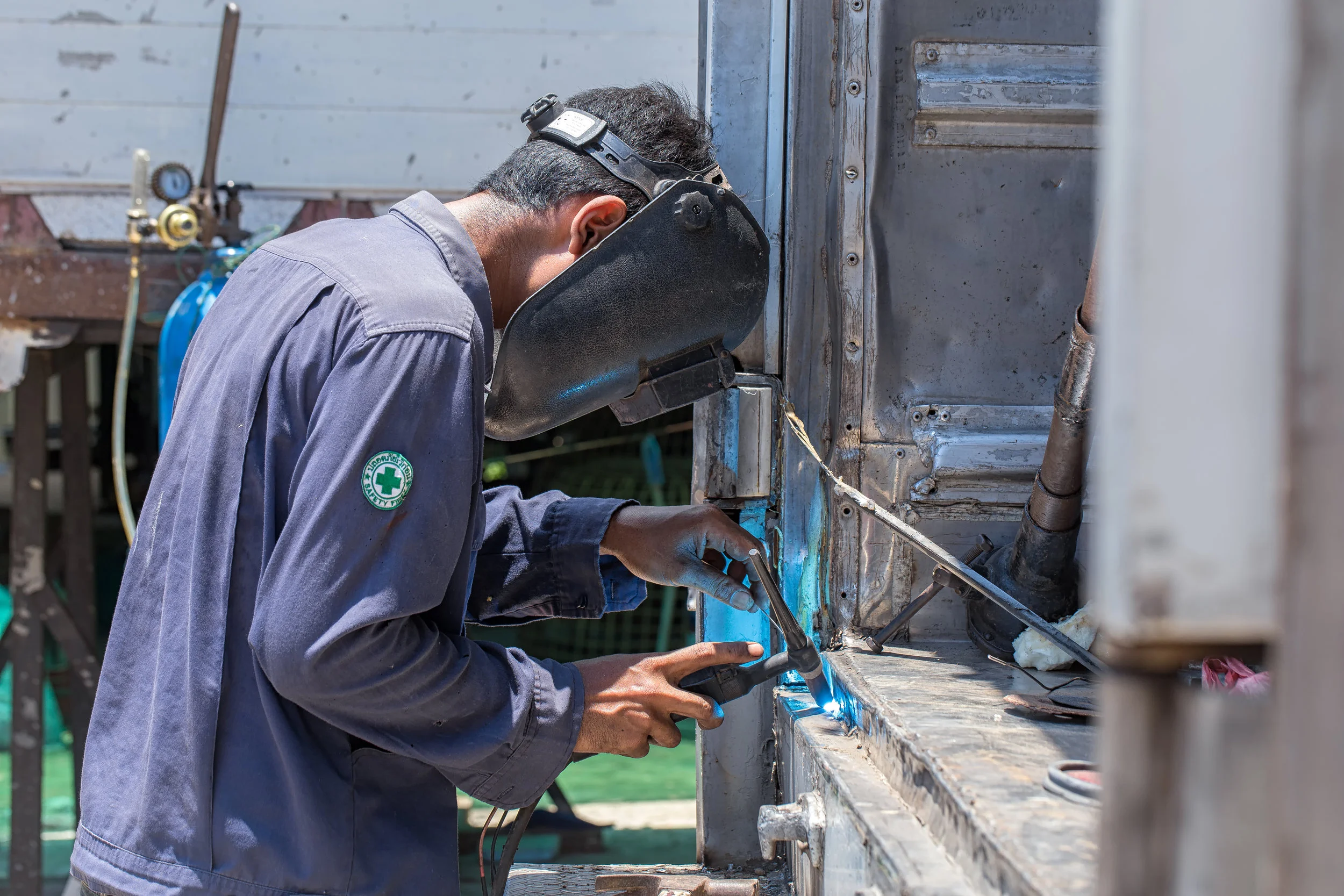
I have conducted many workplace organization Kaizens (5S) over the years. The results have always been dramatic. All of the teams were made up of production operators or office workers, with some mechanics assisting the team. The production operators or office workers owned the areas needing organization and the mechanics were able to do some of the more complex tasks needed during the Kaizen. All of the teams, that is, until I met my Weld Shop team. Five mechanics and an engineer, who underestimated what we could accomplish.
I have conducted many workplace organization Kaizens (5S) over the years. The results have always been dramatic. All of the teams were made up of production operators or office workers, with some mechanics assisting the team. The production operators or office workers owned the areas needing organization and the mechanics were able to do some of the more complex tasks needed during the Kaizen. All of the teams, that is, until I met my Weld Shop team. Five mechanics and an engineer, who underestimated what we could accomplish.
Let me tell you about a typical mechanic on a Kaizen team. He or she is there to support the team, but not usually vested in the improvement process. Most of the time, they participate in the Kaizen and do great work, but sometimes they aren’t interested in being there, and would rather be doing their “normal” job. Facilitating a Kaizen with a team where some of the members were this way was not new for me, but having the entire team this way was. The good news was the area we were going to be working on would directly impact their safety and productivity. The better news was they had a supervisor, acting as the team leader, who was extremely excited about the possibility of improving the weld shop. And the best news was I could leverage their pride and competitive nature to turn their existing Weld Shop into a show place for all the world to see. Only if I could get them to own the improvements, of course.
When I run a 5S Kaizen, I do it step by step. On the first day of the Kaizen, after training the team in all of the S’s, we took a walk in the space we were going to organize. I asked the team to identify things we could remove first – the clutter. This is the first S. I asked many questions and they identified the items to be removed while I took photos. Then, after removing all of the clutter, we decided on the best locations for anything remaining in the space. We did this in an organized fashion and I had team members demonstrate how each new location would be safer and more productive than the old location. This is the second S – Set in Order. Following this, we made sure that everything left in the shop was in the best possible shape. We did this by cleaning and inspecting all tools, equipment, materials, and storage spaces. If we found something in disrepair, we either fixed it or replaced it. We relied on everything in the area to work, so we took great care. This is the third S – Shine.
The first three S’s, Sort, Set in Order, and Shine, are the most physical, dramatic, and fun parts of the Kaizen. By the time we got to the fourth and fifth S, the team was extremely energized and the area looked dramatically different from where we started. Here’s an example: Before we started the Kaizen, you had to enter the Weld Shop and walk about 30 feet to turn on the lights. To get to the light switch, you had to navigate in the dark through all of the clutter in the hopes of finding the switch without running into something. In some of the initial “before” photos, you couldn’t tell there was a light switch on the wall at all. During the evening of the second day of the Kaizen, we relocated the light switch to the entrance of the Weld Shop, on an outside wall. Lights could now be turned on before entering the shop, eliminating the safety risk of navigating in the dark to the switch.
The fourth S is Standardize. For this step, the team was tasked to create a managing system to ensure the improvements they made would continue to live on, be supported and requirements followed by everyone using Weld Shop in the future. This was not a physical exercise. It was a mental and paper exercise. Teams typically create checklists, sign-off sheets, signs, and audits that must be followed by anyone using the area. To mechanics, this is “paperwork”, and although it has more than four letters, it might as well be a four-letter word. This is the last thing they wanted to work on, and I knew that. I also knew that this was the most important step, as their improvements would deteriorate back to the “before” condition if not done properly and completely. The real trick would be for the team to own their solution and not just go through the motions. I had a plan, but it was risky. I needed to facilitate an emotional event, so the team would create and own their managing system.
On the morning of the third day of the Kaizen, after congratulating the team on the improvements of the first two days, I explained this would be “Standardize and Sustain Day”. They looked at me with grumpy faces as I showed them examples of checklists and audits other teams had developed. They were not impressed, to say the least. In fact, they didn’t believe simple pieces of paper would keep people from messing up all of their good work. I showed them examples of how teams made these documents visible and established responsibility all the way up to plant leadership. They were still not buying it. I needed to push them further.
I showed a slide of a checklist, going line by line over each requirement. I could see the discomfort and frustration in their faces. I was on line eight of the checklist when one of the mechanics, whose face was beet red said, “Adam, we’ve had enough of your paperwork. We’re going to the smoke shack. You can’t come with us. We’ll figure it out and then we’ll tell you what we’re going to do.” All of the team members stormed off and left me in the meeting room by myself. I had facilitated the significant emotional event. I didn’t really know if they would ever come back, and if they did, what would they come back with?
It felt like two hours, but it was only twenty minutes when all of the team members returned to the meeting room. They looked pretty proud of themselves as one of them declared, “Adam, we’re going to tell you what we’re going to do. We’ll talk and you type.” They listed eleven things they wanted on “their” checklist. They were similar to what I had presented, but it was in their words and it was their ideas, and that’s all that mattered. I thanked them for coming up with such a well-thought out checklist and then challenged them to develop the system to ensure everyone would use it properly and not “pencil-whip” it. This is the fifth S, Sustain. Enthusiastic and full of pride, the team developed a visual Area Owner board, with all of the required documents easy to find and to use. Then they set up daily and weekly requirements for the area users, the Area Owner, and members of the plant leadership team.
On the final day of the Kaizen, the team shared their results with the plant leadership team and some executives visiting from their corporate office. It’s not unusual for mechanics to shy away from presenting in front of an audience. In this case, all team members spoke from their hearts and explained how important it would be to support and sustain all of their good work, which was improving safety and productivity for them and the rest of the plant. They even asked the executives to hold the team and plant leadership accountable to keep this good thing going and spread this effort to other areas of the plant.
After the presentation was over, I spent a few minutes with the team, getting their final thoughts about the Kaizen. Happy with the results and most aspects of the Kaizen, they told me they wished I had been more assertive with them during the week. We laughed as I told them I wasn’t sure they were coming back to the meeting room after storming out on Standardize and Sustain Day. They told me it was just the motivation they needed to get to their solution.