
Hidden Capacity Was Sitting Above Their Heads
Kaizen Snapshot
Setting: Maintenance shop at a large power generation manufacturer
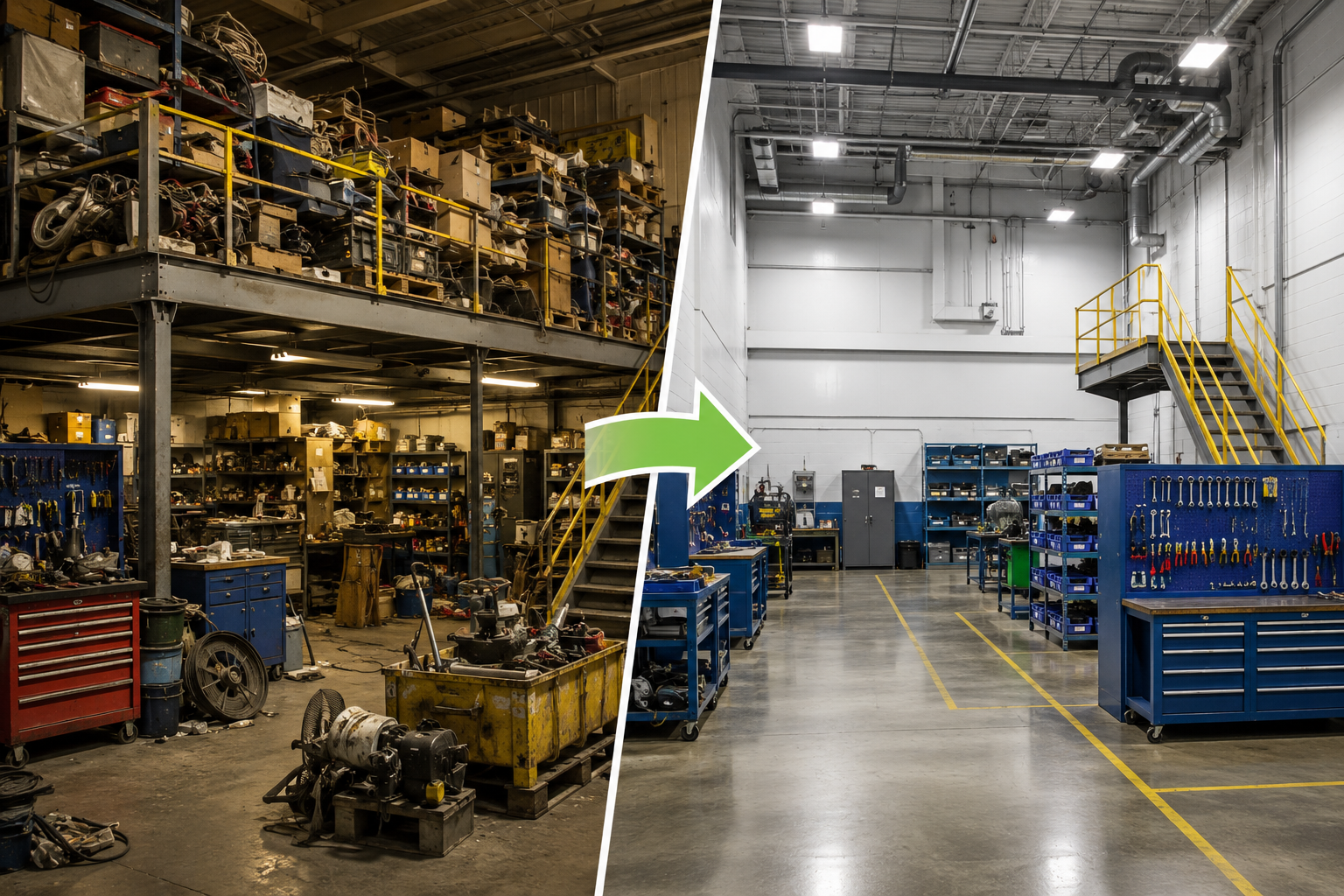
Challenge: A maintenance shop buried under years of clutter, making work slower, less safe, and consuming valuable production space.
Stakes: Lost productivity, longer search times, reduced safety, and a mezzanine blocking future manufacturing capacity.
Approach: 5S Kaizen, hands-on team engagement, visual management, and assigning area ownership.
Outcome: Search time reduced from 22 minutes to 2.3 minutes (90%), the mezzanine was completely cleared, and the newly available space was later converted into additional production capacity.
Key Lesson: The greatest result wasn’t organizing tools—it was creating ownership.
The Situation
After two successful 5S Kaizen events at another facility, I was invited to facilitate a maintenance shop transformation at a different manufacturing plant.
Before the event even began, the sponsor and team leader shared a hidden objective. Above the maintenance shop sat a large mezzanine packed with years of accumulated material. If the team could completely empty that space, leadership could eventually remove the mezzanine and reclaim valuable production space.
Rather than keeping that goal a secret, we made it the team’s challenge from Day One.
What Was Getting in the Way
Walking the Gemba made the problem obvious. Four different maintenance areas were overflowing with obsolete equipment, excess inventory, forgotten parts, and items nobody could confidently identify.
The clutter affected everything:
Mechanics spent unnecessary time searching for tools and parts.
Valuable floor space disappeared.
Hidden hazards went unnoticed.
Even the maintenance leader admitted he struggled to throw things away.
To establish a baseline, we asked experienced maintenance technicians to locate six randomly selected items throughout the shop before the event began. Even the people who worked there every day needed an average of 22 minutes to find them. Most of the team doubted that one week of 5S could make much difference.
What We Did
The week began with Lean and 5S training before heading to the Gemba. To reinforce credibility, one of the maintenance technicians from the previous successful 5S event joined our team to share firsthand experience.
As the team sorted through years of accumulated material, something interesting happened. People began realizing just how much unnecessary clutter had quietly become “normal.” Instead of asking, “Should we throw this away?” the conversations became, “Why have we been keeping this?” Once they understood that anything truly needed could be replaced if necessary, hesitation disappeared. Momentum accelerated.
By the third day, the entire mezzanine had been emptied. With the clutter gone, maintenance issues that had been hidden for years suddenly became visible—including wiring, lighting, ductwork, and other infrastructure that could finally be repaired. Even employees who weren’t part of the Kaizen volunteered to help.
The Breakthrough
One maintenance technician had been the biggest skeptic on Day One. He had spent the most years in the department and wasn’t convinced 5S would change anything. By midweek, he had completely changed. He wasn’t simply participating anymore. He was protecting the new workplace.
When I introduced the concept of an Area Owner on Day Three, it became immediately obvious who should take the role. Another teammate even volunteered to cover the responsibilities during his upcoming vacation so the improvements wouldn’t slip backward.
By Friday, the former skeptic proudly announced, “Take my picture.” He wanted everyone to know he would be responsible for keeping the area that way. That may have been the most important improvement of the week.
What Changed
At the end of the Kaizen, we wanted to know whether the improvement was real, not just familiar to the team that had spent the week organizing the space. So instead of asking the maintenance technicians to repeat the exercise, we handed slips of paper listing six randomly selected items to people who were not familiar with the maintenance shop. We also intentionally avoided choosing easy items.
Even with those tougher conditions, the average search time dropped from: 22 minutes → 2.3 minutes. A reduction of nearly 90%.
The improvement wasn’t just measurable. It was obvious. The maintenance shop looked completely different. Anyone could walk in, immediately identify what belonged there, and quickly locate what they needed.
Leadership toured the area during the report-out and described the transformation as night and day. A month or two later, the final piece of the story unfolded. The empty mezzanine was removed. The plant gained valuable production space to support future growth.
The Takeaway
5S isn’t about cleaning. It’s about removing everything that prevents people from doing great work. When employees help build the system themselves, they don’t just maintain it, they own it.
Why This Matters
Many organizations think of 5S as housekeeping. The best 5S events do far more:
They improve safety.
They eliminate wasted motion.
They reduce frustration.
They create pride.
And sometimes they even create entirely new manufacturing capacity that was hidden in plain sight.
Ready to Unlock Hidden Capacity?
If your maintenance shop, warehouse, or production area has become harder to navigate, less safe, or filled with years of accumulated clutter, a focused 5S Kaizen can deliver results far beyond better organization. Sometimes the biggest capacity gains aren’t found in new equipment. They’re already sitting inside the space you have today.
Schedule a Breakthrough Assessment to uncover the opportunities hiding in plain sight.