
Kaizen Success Stories
Real Manufacturing Results. One Kaizen at a Time
Explore real-world Kaizen success stories showing how manufacturing teams solved critical problems, improved performance, and created sustainable results.
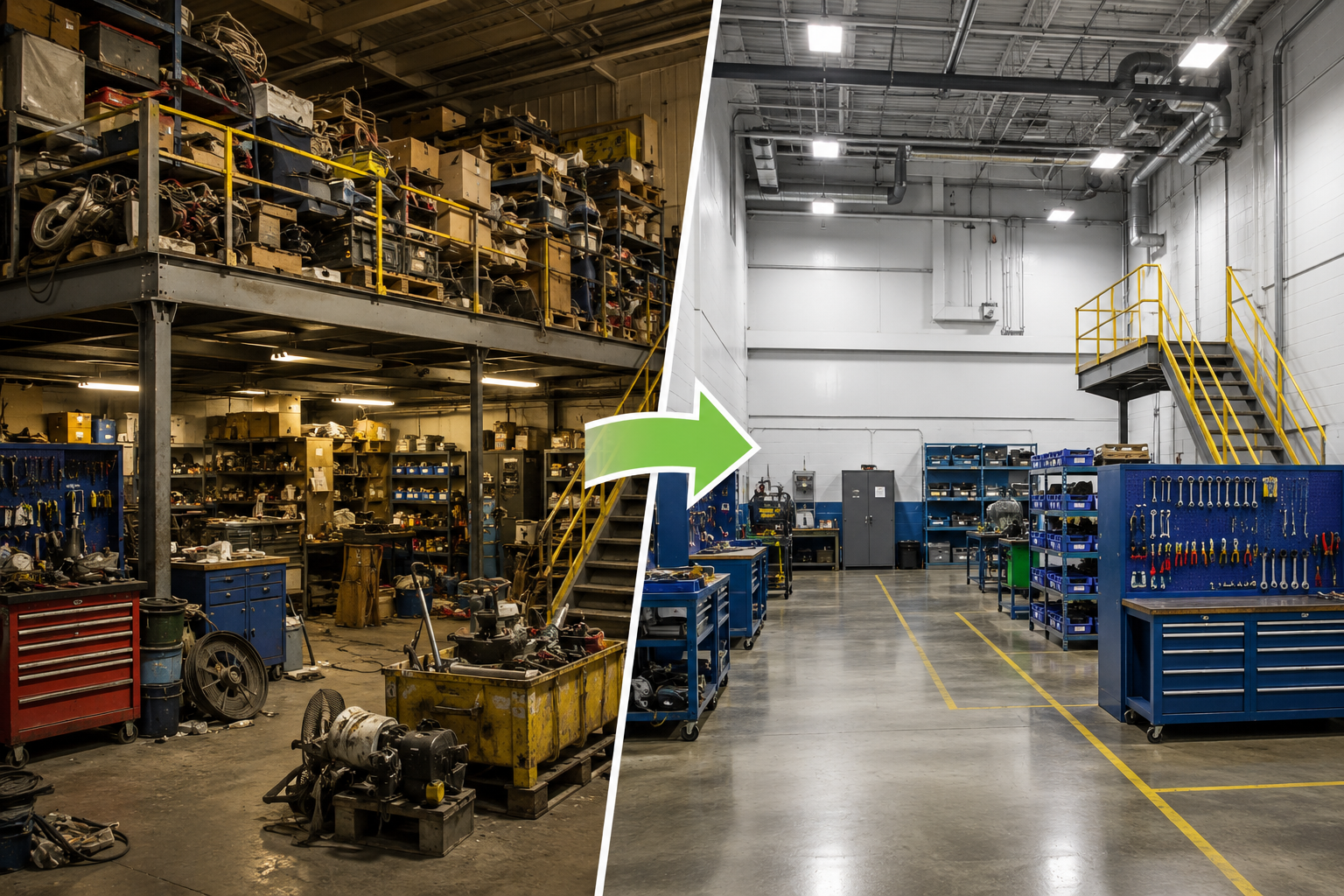
Hidden Capacity Was Sitting Above Their Heads
Sometimes your biggest capacity expansion isn't a new building—it's hiding inside the one you already have. Discover how a 5S Kaizen transformed a cluttered maintenance shop into an organized workplace while creating new manufacturing capacity and inspiring employees to take ownership of the improvements.
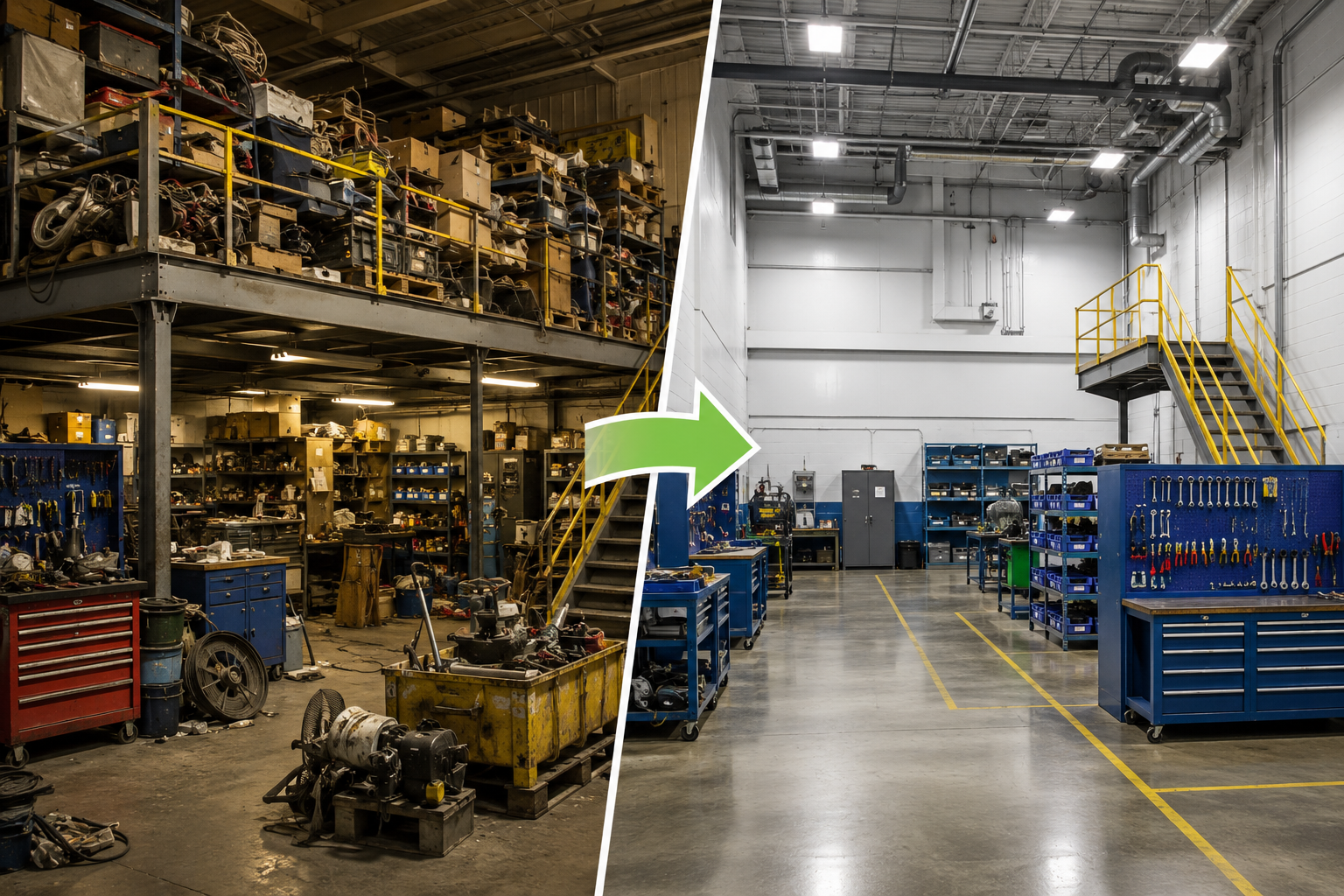
Kaizen Snapshot
Setting: Maintenance shop at a large power generation manufacturer
Challenge: A maintenance shop buried under years of clutter, making work slower, less safe, and consuming valuable production space.
Stakes: Lost productivity, longer search times, reduced safety, and a mezzanine blocking future manufacturing capacity.
Approach: 5S Kaizen, hands-on team engagement, visual management, and assigning area ownership.
Outcome: Search time reduced from 22 minutes to 2.3 minutes (90%), the mezzanine was completely cleared, and the newly available space was later converted into additional production capacity.
Key Lesson: The greatest result wasn’t organizing tools—it was creating ownership.
The Situation
After two successful 5S Kaizen events at another facility, I was invited to facilitate a maintenance shop transformation at a different manufacturing plant.
Before the event even began, the sponsor and team leader shared a hidden objective. Above the maintenance shop sat a large mezzanine packed with years of accumulated material. If the team could completely empty that space, leadership could eventually remove the mezzanine and reclaim valuable production space.
Rather than keeping that goal a secret, we made it the team’s challenge from Day One.
What Was Getting in the Way
Walking the Gemba made the problem obvious. Four different maintenance areas were overflowing with obsolete equipment, excess inventory, forgotten parts, and items nobody could confidently identify.
The clutter affected everything:
Mechanics spent unnecessary time searching for tools and parts.
Valuable floor space disappeared.
Hidden hazards went unnoticed.
Even the maintenance leader admitted he struggled to throw things away.
To establish a baseline, we asked experienced maintenance technicians to locate six randomly selected items throughout the shop before the event began. Even the people who worked there every day needed an average of 22 minutes to find them. Most of the team doubted that one week of 5S could make much difference.
What We Did
The week began with Lean and 5S training before heading to the Gemba. To reinforce credibility, one of the maintenance technicians from the previous successful 5S event joined our team to share firsthand experience.
As the team sorted through years of accumulated material, something interesting happened. People began realizing just how much unnecessary clutter had quietly become “normal.” Instead of asking, “Should we throw this away?” the conversations became, “Why have we been keeping this?” Once they understood that anything truly needed could be replaced if necessary, hesitation disappeared. Momentum accelerated.
By the third day, the entire mezzanine had been emptied. With the clutter gone, maintenance issues that had been hidden for years suddenly became visible—including wiring, lighting, ductwork, and other infrastructure that could finally be repaired. Even employees who weren’t part of the Kaizen volunteered to help.
The Breakthrough
One maintenance technician had been the biggest skeptic on Day One. He had spent the most years in the department and wasn’t convinced 5S would change anything. By midweek, he had completely changed. He wasn’t simply participating anymore. He was protecting the new workplace.
When I introduced the concept of an Area Owner on Day Three, it became immediately obvious who should take the role. Another teammate even volunteered to cover the responsibilities during his upcoming vacation so the improvements wouldn’t slip backward.
By Friday, the former skeptic proudly announced, “Take my picture.” He wanted everyone to know he would be responsible for keeping the area that way. That may have been the most important improvement of the week.
What Changed
At the end of the Kaizen, we wanted to know whether the improvement was real, not just familiar to the team that had spent the week organizing the space. So instead of asking the maintenance technicians to repeat the exercise, we handed slips of paper listing six randomly selected items to people who were not familiar with the maintenance shop. We also intentionally avoided choosing easy items.
Even with those tougher conditions, the average search time dropped from: 22 minutes → 2.3 minutes. A reduction of nearly 90%.
The improvement wasn’t just measurable. It was obvious. The maintenance shop looked completely different. Anyone could walk in, immediately identify what belonged there, and quickly locate what they needed.
Leadership toured the area during the report-out and described the transformation as night and day. A month or two later, the final piece of the story unfolded. The empty mezzanine was removed. The plant gained valuable production space to support future growth.
The Takeaway
5S isn’t about cleaning. It’s about removing everything that prevents people from doing great work. When employees help build the system themselves, they don’t just maintain it, they own it.
Why This Matters
Many organizations think of 5S as housekeeping. The best 5S events do far more:
They improve safety.
They eliminate wasted motion.
They reduce frustration.
They create pride.
And sometimes they even create entirely new manufacturing capacity that was hidden in plain sight.
Ready to Unlock Hidden Capacity?
If your maintenance shop, warehouse, or production area has become harder to navigate, less safe, or filled with years of accumulated clutter, a focused 5S Kaizen can deliver results far beyond better organization. Sometimes the biggest capacity gains aren’t found in new equipment. They’re already sitting inside the space you have today.
Schedule a Breakthrough Assessment to uncover the opportunities hiding in plain sight.

This Stuff Works
At a gummy vitamin manufacturer in Pennsylvania, I was asked to facilitate a team of mechanics responsible for supporting and maintaining the manufacturing operation. They had difficulty keeping their maintenance area compliant with strict food production regulations. Our goal was to develop a system to guarantee compliance, while improving their ability to service their customers.
At a gummy vitamin manufacturer in Pennsylvania, I was asked to facilitate a team of mechanics responsible for supporting and maintaining the manufacturing operation. They had difficulty keeping their maintenance area compliant with strict food production regulations. Our goal was to develop a system to guarantee compliance, while improving their ability to service their customers.
On the morning of the first day of the Kaizen event, I taught Lean principles and how 5S is used to optimize safety and productivity in a space. It all sounds good in a classroom. The team wondered how it applied to their situation. After training, we took a Gemba walk through their workspace. They thought they were in pretty good shape. The space was cluttered and lacked any hint of organization. They had nothing to compare to and hadn’t been exposed to other examples of 5S in the facility. After generating ideas in their work area, I took them to two locations in the plant that had used 5S: a production line and the Weld shop.
Our first stop was the production line. I asked one of the technicians operating the line to give the team a tour and point out what they had done and the benefits he had seen. He obliged and described 5S and its benefits as best he could. Team members were paying attention to what he was saying, but asked few questions and wrote fewer notes. I thanked the technician and took the team to the Weld shop.
On our way to the Weld shop, I asked team members what they thought of the production line. Feedback fell into two categories:
1. It looks pretty good.
2. I can’t see how it applies to our area.
I knew the next tour stop would be more inspiring. I was intimately familiar with what was done in the area. I could provide a more compelling review for the team.
When we got to the Weld shop, I noticed Jimmy working on a project. He was the team leader when we applied 5S to the Weld shop.
Jimmy: “What are you doing here?”
Me: “This is the Kaizen team from the gummy vitamin maintenance area. I’m giving them a tour of the Weld shop and showing them what your team accomplished.”
Jimmy: “Okay, just don’t get in the way. I’ve got lots of work to do.”
Me: “Thanks Jimmy. If you want to give the tour or share your thoughts, please do.”
Jimmy: “That’s fine. You can give the tour.”
Jimmy is not someone who likes to speak in front of groups or work with teams. Jimmy is also one of those folks who isn’t a fan of management or consultants. But, if he believes in something, it’s useful and helpful to him and others. He doesn’t give out compliments often (ever?) and doesn’t fall in line and do whatever he’s told.
I started the tour pointing out various ideas and improvements the Weld shop Kaizen team made six months earlier. Jimmy was paying attention to what we were doing, but didn’t say a word. I think he was interested to see how I’d describe the work of the Weld shop team. I did my best to represent their efforts and as I did, you could see the pride grow in Jimmy’s face.
My next stop on the tour was at the tool board created by the team during the Kaizen event. As I started describing and demonstrating the use of the tool board to the team, Jimmy got more and more interested. My new team was asking many questions and taking notes on my responses and their observations.
Rob (team leader): “This looks good and all. Does it really stay this way?”
Me: “I don’t think they cleaned up for us.”
Ben (team member): “Does this really work?”
Jimmy: “Look, this may sound silly and it may sound stupid. This $#*% works!”
This was the moment of clarity and credibility for the team. If Jimmy thought so, it must be so. I stopped the tour. The team had seen everything they needed.
I thanked Jimmy and took the team back to the meeting room to review their observations and ideas. On the way back, I challenged them to beat the results of the production line and the Weld shop. They told me they were up for the challenge.
The rest of the week, the team did amazing work, identifying the critical tools needed (All Tools Available), giving them the most visible and logical homes (Visible Evidence) and even telling the leadership team what they needed them to do to sustain the efforts from now on (Layered Audits and Accountability). I am not sure their area was any nicer or better thought out than the Weld shop or the production line, but they thought so, and that’s all that matters.

Let It Go
In 2010, Armstrong World Industries emerged from bankruptcy. A minority stake of the company was bought by a private equity firm. This firm knew there were many improvement opportunities and brought in consultants to help create a culture of continuous improvement across the global organization. Their approach was to hold many Kaizen events on a weekly basis, exposing as many people to the principles of Lean as quickly as possible.
In 2010, Armstrong World Industries emerged from bankruptcy. A minority stake of the company was bought by a private equity firm. This firm knew there were many improvement opportunities and brought in consultants to help create a culture of continuous improvement across the global organization. Their approach was to hold many Kaizen events on a weekly basis, exposing as many people to the principles of Lean as quickly as possible.
Having recently completed my assignment as the St. Helens Oregon Operations Manager, I was asked to provide support to the consultants. Sometimes I co-facilitated Kaizen events with the consultants. Other times, I was asked to facilitate Kaizen events independently of the consultants. This story is about one of the first Kaizen events held at the Marietta, Pennsylvania ceiling tile plant.
Paired with a consultant, I co-facilitated a team using 5S to improve the safety and productivity of their packaging area. 5S stands for: Sort, Set in Order, Shine, Standardize, and Sustain. Using this methodology, teams take a step by step approach as they make quick and meaningful changes to a target area. Lean was new at the plant, so we provided extensive Lean training to the team. The team was comprised of line operators, mechanics, a supervisor from the area, and a few staff members.
After the training, we took the team out to Gemba (the place where the work is done) to assess the materials that were no longer needed in the area. This is the first S, Sort. During Sort, the team is to decide what is absolutely necessary and what is clutter. The clutter is then disposed of or removed from the area. Once done, the team then moves on to Set in Order. The packaging area was built twelve years earlier and it was apparent most things in the area were from the first days of production.
A Case of Clutter
Many of the team members were having a difficult time finding things to dispose of. When something was found that didn’t look current or relevant, people would say things like, “We may need it in the future.” Or, “If we fixed it, we could use it.” After a few hours in the area, it didn’t look the team was willing to take a leap of faith and remove much of the unused and unusable equipment and materials.
The consultant and I stepped away from the team to discuss a strategy. “Adam,” he said, “we need to demonstrate it’s alright to remove and dispose of the clutter. Let’s pick a few things to remove, do it ourselves, and see if we can get others to join in.” I agreed, knowing we had to demonstrate it was okay to do something drastic to get breakthrough results. We took a walk around the area and found a few items that looked like they didn’t belong and then happened upon something that definitely needed to go.
Underneath a platform was an old rolling toolbox, covered in dust. Except it was unable to roll. One of the wheels was missing. When we looked through the drawers, all we saw were various nuts and bolts covered with years of grease and grime. The toolbox hadn’t been used in years and it looked to be an ideal candidate for the dumpster. It was pretty heavy, so we asked one of the team members to assist us as we pulled it out from under the platform. After getting it out, we placed it on a skid, ready to be taken away by a forklift.
A Toolbox Road Block
Except we couldn’t. Just as soon as we had called for the forklift, the supervisor on our team came at us with an angry look in his eyes. “What do you think you’re doing?” We explained what and why we were doing what we were doing. His face turned red. “I bought that toolbox for $300 and it’s served us well. I can’t believe you would just throw it out. We could fix it and use it.” When we pointed out the three new, clean rolling toolboxes in use in the packaging area, he stormed off.
We decided to talk with the rest of the team members. They told us no one had used the toolbox in years, the other toolboxes were sufficient, and the materials inside the old toolbox were of no use to them. They agreed to dispose of it and started to find other things in a similar condition to be removed as well.
The supervisor didn’t return that day. At the end of the day, the consultant and I were called to the Plant Manager’s office to talk about what had happened. The supervisor had stopped by the office earlier. After describing what we had done and the reaction of the supervisor and the team, we were told to tone down our approach. Lean was new to the plant and the people working there, and not everyone was on board. The supervisor was very proud of his accomplishments, helped design the packaging area, and took ownership for everything in the area, even the broken-down toolbox.
The Plant Manager told us it was more important to get the whole team engaged, rather than take extreme measures to prove a point. We agreed, and after leaving what felt like the principal’s office, we developed our strategy to reengage the team and improve relations the next day.
Taking a New Approach
The next morning, with the full team in a meeting room, we apologized for taking such drastic actions. We promised to get full team approval before making any more changes. When the team went back to the packaging area, they were energized. The consultant and I were able to step back and let the team make all of the organizational decisions in the packaging area. By the end of the week, the team removed more than 80% of the supplies, tools, equipment, and materials in the area. What remained was logically organized, in pristine condition and very visual. It was easy to see the condition of the area and if anything was out of place.
After a tour of the area, plant leadership remarked how much better everything looked and felt. Team members talked about the impact of the work and how it would benefit them in their normal jobs. This was the first of hundreds of Kaizen events at the Marietta ceiling plant over the next decade. Everyone learned valuable lessons. But I may have learned the most valuable lesson of all – pay strict attention to the team and understand what engages and motivates them. Even small changes are important; you don’t have to shoot for the moon every time. As long as the team owns the change, it will be sustained.
Ownership at the Right Level
I was Lean Champion for the global technology team at Armstrong World Industries for many years. During that time, I supported teams of technicians, scientists, engineers, project managers, and the leadership team across four different departments. I had the good fortune to assist teams in their efforts to develop and launch new products, deploy capital equipment, and build factories all over the world. All departments had access to the Pilot Plant to support their efforts when necessary.
I was Lean Champion for the global technology team at Armstrong World Industries for many years. During that time, I supported teams of technicians, scientists, engineers, project managers, and the leadership team across four different departments. I had the good fortune to assist teams in their efforts to develop and launch new products, deploy capital equipment, and build factories all over the world. All departments had access to the Pilot Plant to support their efforts when necessary.
The Pilot Plant was a series of disconnected processes which had the resources and capabilities to test new materials, products, processes, and other ideas in a controlled way. Information gleaned from tests and trials was utilized in the effective delivery of projects and other development efforts. Each of the processes in the Pilot Plant had an owner, who was responsible for the care and safety of the process. The owner would also try to schedule the process to allow it to be utilized effectively and to keep wait times to a minimum. All process owners were the technicians who were most familiar with the operation of their process. Although they were at the lowest level of the group, they were very proud of their equipment and took ownership to keep things safe for their customers.
As Lean Champion, I spent many hours in the Pilot Plant, learning about its capabilities and trying to understand how I might be able to help the technicians in their efforts to support the rest of the organization. It was during my early days in the Pilot Plant that I met a gentleman, we’ll call him Roy, who was lead technician. He had just taken on the leadership role for the Pilot Plant, responsible for the overall effectiveness and operations. Having worked in one of Armstrong’s factories prior to his arrival at the corporate center, he had vast equipment knowledge and some leadership experience.
A Source of Frustration
Before taking over as lead technician, Roy worked in the Pilot Plant as a process owner and participated in the annual Pilot Plant clean-up. This was a multi-day effort by all technicians at the end of the year. They would go through all of the materials, supplies, and equipment throughout the plant and clean out the clutter and reorganize things in as safe and productive manner as possible. All development and testing in the Pilot Plant would be delayed during this time, as all technicians were busy cleaning things up and trying to make sense of what they had.
None of the technicians liked the annual clean-up process because they knew it wouldn’t take long for things to go back to the way they were prior to the clean-up. Roy expressed his frustration to me more than a few times. Once he became lead technician, he was even more frustrated and wanted to do something about it. My first suggestion to Roy was that he should discuss his frustration with his manager and gauge his support for Roy’s efforts. Roy did this, but seemed just as frustrated. Upon further discussion with Roy, I found out his manager was supportive of his efforts, but didn’t offer solutions Roy thought he could implement without direct assistance from his manager. He really wanted his manager to tell everyone to clean up after themselves.
Over the next few months, I facilitated 5S (Sort, Set in Order, Shine, Standardize, Sustain) events in the Pilot Plant to support Roy’s efforts to make areas safer and more productive for everyone. The few area owners who had completed 5S events had a strong managing system to keep their areas in top shape. The other 30 or so areas did not, so clutter and disorganization was prevalent everywhere else in the Pilot Plant. Roy was getting more and more frustrated.
Turning the Corner
One Monday morning, following the weekly technician meeting in the Pilot Plant, Roy stopped me on my way back to my office. “Adam, I’m really frustrated,” he said. “My manager won’t hold everyone accountable to keep the Pilot Plant organized and safe. He tells them it’s their responsibility, but doesn’t do anything about it when they’re not compliant. What can I do?” “Roy,” I said, “Who’s the leader of the Pilot Plant?” “I am,” he said. “Well, as leader, you have every right to set expectations and hold accountability. You are the operations manager; your boss is the plant manager. The plant manager needs you to get your operations in order. Let me help you do that.”
Over the next few weeks we built our strategy for putting the Pilot Plant in order. Our strategy included: setting clear expectations for all areas of the Pilot Plant, redefining responsibilities for all area owners (not just the areas that had been 5S’d), developing a weekly leadership walk (Gemba walk), and creating visual management to hold all area owners accountable. We mounted a large white board in the main meeting room and put lines and names on it, ready to explain it to the technicians at the next technician meeting.
The next Monday morning, we introduced the new strategy for making the Pilot Plant the safest, most productive place possible. The technicians listened with keen interest and asked many questions as Roy described the changes. They were skeptical that there would be any change in behavior of the scientists, engineers, or managers when they used the spaces in the Pilot Plant. Then Roy explained the white board, which he called the “Area Owner” board. On it were over 30 Pilot Plant locations with the corresponding name of the area owner and a space for a date to be written. At the first of every month, a red magnet would be placed for each location, signaling the owner hadn’t yet met certain monthly requirements. Once those requirements were met, the Area owner would replace the red magnet with a green magnet. The Area Owner would write in the date the requirements were met. At the beginning of the next month, all magnets were set back to red.
The technicians were furious. They thought those red magnets made them look like they weren’t doing a good job and didn’t want any part of the new system. I jumped in and explained it was a very visual and urgent way to show what areas weren’t yet compliant and who might need help. The system wasn’t a reflection of the specific area owner, unless he or she hadn’t made the effort to meet the requirements or ask for help. We felt if we could get all areas to green every month, we wouldn’t need the annual cleanup, which everyone hated.
A Delicious Incentive
At this point, the technicians started to buy-in and support the idea, but they were still skeptical that some of the area owners would be motivated to get to green every month. I knew I needed to provide incentive. I said, “The first month we get all areas to 100%, I’ll buy every area owner lunch and we’ll celebrate!” That got their attention. I then described the design of the management walk: We would take a selection of managers of the scientists and others who used the Pilot Plant and tour all areas, looking for areas where we could reinforce the need for compliance to the requirements. We would do this every week and sign off to show we had and we were just as accountable as the technicians.
For the next few months, I attended every Monday morning technician huddle, and reinforced the new systems and encouraged the area owners to get their areas to green before the end of the month. One Monday, late in the third month of the “Area Owner Challenge”, there was only one technician whose area was still red. Almost to a person, the technicians pressured him to get his requirements done and make sure Adam would buy them lunch! They did it in a fun way, but I knew they were serious. I knew our system was working at last.
Over the next months, the technicians hit 100% compliance almost every month, and by the end of the year there was no need for the annual cleanup. Pride in the Pilot Plant grew. In the following years, the Pilot Plant was bench-marked many times. Not because of the technology, but because of the strong ownership and pride and systems that allowed new products and projects to be delivered in the safest and most productive way possible.

Shine a Light on the Problem
The Corporate Quality Manager of a suspended ceiling manufacturer had a problem. When he wanted to check for defects on ceiling tiles, he had them shipped from the manufacturing plant and installed in ceiling grid in the corporate testing facility. This 12’ x 24’ ceiling grid configuration was adjacent to a large bank of windows. He then waited for the weather to cooperate. You see, he wanted the proper angle of sunlight to shine across the face of the tiles, and depending on the time of year and weather conditions, he might have to wait weeks to assess the quality of the tiles. The windows were often obstructed with testing materials, which made access and viewing even more difficult.
The Corporate Quality Manager of a suspended ceiling manufacturer had a problem. When he wanted to check for defects on ceiling tiles, he had them shipped from the manufacturing plant and installed in ceiling grid in the corporate testing facility. This 12’ x 24’ ceiling grid configuration was adjacent to a large bank of windows. He then waited for the weather to cooperate. You see, he wanted the proper angle of sunlight to shine across the face of the tiles, and depending on the time of year and weather conditions, he might have to wait weeks to assess the quality of the tiles. The windows were often obstructed with testing materials, which made access and viewing even more difficult.
The ceiling manufacturer was about to introduce a large quantity of new products and the installation setup would not be sufficient to check all the new products’ quality prior to product launch. A change had to be made. As Lean Champion for the company, my help was enlisted to solve the problem. After some initial discussions and a tour of the area, the Quality Manager and I agreed we needed to think differently about the setup and process of quality testing. We decided to use a Kaizen event to optimize the design of the required testing space.
We assembled a team of testing technicians, quality technicians, scientists, and marketing representatives to think through the testing requirements and systems to install. We also identified a space to use for the new quality testing area. After a few weeks of touring various buildings and negotiating for space, we chose two adjoining 20’ x 50’ spaces on the ground floor of the testing facility. These spaces were filled with equipment and materials from many years of testing and development. We were sure we would be able to remove most of it and re-purpose the space for the benefit of the company. Although these spaces were large, they had no windows to the outside, so we would have to figure out another way to provide proper lighting to the face of the ceiling tiles.
On the first day of the Kaizen, we reviewed Lean principles and spent extra time on 5S. Next, we took the team on a walk of the current testing area and then to the identified spaces. Their first reaction was surprise and disappointment. They thought we should use the existing space by the outside window and reorganize materials and tools.
Our goal was to be able to assess tiles for quality at any time, regardless of the weather. This goal forced us to rule out the current location for testing. In the new space, the clutter got in the way of the team’s vision of what was possible. So, we did the first S, “Sort”. During Sort, the team removed 90 percent of what was in the space. Some equipment, which had been purchased to provide critical data in years past, was no longer useful, and was removed. The team contacted as many of the equipment owners as possible, to ensure we wouldn’t throw out anything critical. Everything would be removed from the space, no matter what.
Once we cleared out the space, we developed our concept for testing. The idea was to create a number of testing spaces, or pods, in which to install and check various types of ceiling tiles. These tiles needed to be at least seven feet off of the floor, so that they could be observed from below as well as from the side, using some form of raking light. The light had to go across the painted face of the tile, so defects and inconsistencies would be readily apparent. The team agreed the size of each pod should be 12’ x 12’. This allowed us to create three pods in each 20’ x 50’ space, for a total of six. We now had three times the capacity of the existing testing space. But, how were we going to create the necessary lighting?
The first thing we had to do was to identify the intensity and angle of light we needed. Fortunately, we were able to do so on the second day of the Kaizen, as the sun came out and provided the necessary lighting required in the existing testing space. Using light meters and the experience of the team, we identified the proper number of lumens (intensity) and optimal angle for the light in the pods.
The next step was to build the ceiling grid configurations in the pods. We put together three installations of ceiling grid in one of the two rooms. Each was squared up and then ceiling tiles were installed. We made sure we had enough space on all sides of the installations, so we could view the tiles from any angle, without obstruction.
Now it was time to go shopping. We purchased enough lights for one of the pods, before committing to all six. We bought a number of different fluorescent lighting configurations (and kept the receipts) to allow us to test and identify the optimal configuration.
On the morning of the third day, we performed our first lighting tests in one of the pods. A technician climbed a scaffold and held one of the lights up to the ceiling tile installation. The team wasn’t pleased. They asked him to move the light a little further away and a little higher. Things started to look better. Then, after a slight adjustment in location and height, they felt they were getting the type of lighting required. Using light meters, they verified a consistent result compared with the natural light measured on day two. The team collected several measurements and developed plans to assemble permanent lighting fixtures for all pods.
Later in the day, the first lighting fixture was installed and the team verified their results. Everything was as expected. Then the team realized an opportunity to provide the same lighting at a 90-degree angle to the original light fixture. They would just need to install an additional fixture and connect it at right angles to the original fixture. This gave them additional inspection capability they never had before.
On the fourth day, the first pod was complete and plans were made to install the same lighting in the other five pods and to hard-wire everything to make it as safe and efficient as possible. Now the team had a new problem. With the extreme increase in productivity and complete elimination of wait time to test, everyone would want to use the pods at the same time.
The solution was to designate an owner for the area and a system to ensure the area was well-managed and organized. To reserve the use of a testing pod, a white board was installed to make reservations visible, by pod. If someone used a pod longer than the requested time, the area owner would follow-up and hold them accountable to honor their commitments.
At the report out, the team proudly reported on their results. They were able to take a process that used to take weeks and reduced it down to minutes. They also increased the capacity of the area by a factor of three. Anyone could now use the pods safely and productively and testing would no longer slow down any new product development or testing project. In the next six weeks, all lights and wiring were installed, and the space has been in continuous use for years.
The team learned how to shine a light on the problem and solve it creatively.

The Little Team That Could and Did
Process Improvement Partners (PIP) recently conducted a free site assessment for a small electronic targeting systems company in Glen Rock, PA.
Process Improvement Partners (PIP) conducted a site assessment for a small electronic targeting systems company in Glen Rock, PA.
The day started with introductions, with each employee sharing their experiences with continuous improvement and their expectations for the day. Some were excited about the process while others weren’t sure what to expect.
Following introductions, PIP demonstrated various continuous improvement tools and techniques. One technique, 5S, got the attention of the Office Manager. She said she thought everyone could use 5S in their personal workspaces and the various production and testing areas around the facility. After about an hour and a half of discussion in the meeting room, it was time to find out if she was right.
We took a walk of the facility and offices. We could easily see from the start, there were many opportunities to improve safety and productivity. Whenever we walked into a space or an office, there was no indication of the health or status of the area. Most areas were cluttered and disorganized. Using the theme, “How do you know …” we discussed our ability to understand what was happening in each space. The only person who knew what was going on at the time was the person who was using the area or office. In some of the offices, even the person using it wasn’t so sure everything was as it should be. It wasn’t easy to see if anyone needed help to get their work done, so they usually had to fend for themselves.
After the walk, the team brainstormed many ideas they thought would improve their productivity and safety. Sorting through more than 60 ideas, a theme emerged – use 5S to improve safety and productivity in all areas of the facility. But, where should they start? Did they need outside help to use these new tools?
It turns out they didn’t. The next week, they jumped right in and began their continuous improvement journey. With the Office Manager as the leader, they picked the first area to work on, the main production area.
Using what they learned about 5S, they brought order to the area and made it a better place to work for everyone. They were proud of what they had accomplished and knew that this was only the beginning of their efforts. Using available time during the following weeks, they began to spread the use of 5S all over the facility.
They now know what they want to do and how to do it. It turns out you don’t need a bunch of trained facilitators and continuous improvement personnel to make positive change. You just need the willingness to learn and apply some simple tools and techniques to improve your situation. And, if something doesn’t work exactly as planned, learn from it and try again.
Process Improvement Partners is in business to help organizations and people help themselves. Sometimes, all they need is a little support, a little nudge, and a few simple tools to get started.
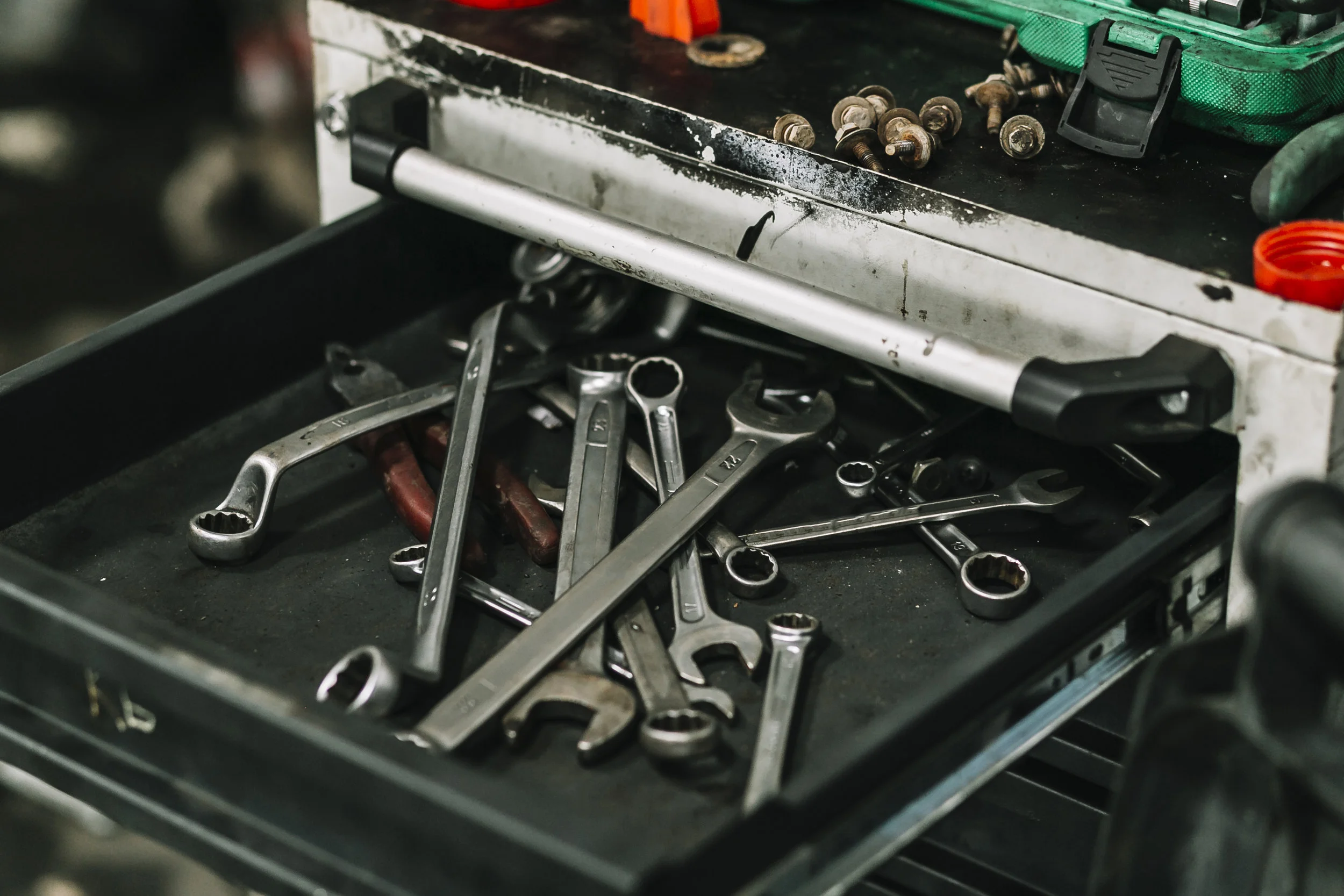
Lead from the Front – The Story of the Pink Tools
A large, multi-national company started their Lean journey in 2010. The company brought in consultants, who facilitated and guided Kaizen events and coached leaders at every manufacturing site around the world. One of their plants, in central Ohio, had a strong culture of employee engagement and was expected to lead the other plants in positive outcomes resulting from the Kaizen events. Early on, they weren’t able to identify an internal leader of their continuous improvement journey, so I was asked to act as the interim “Lean Champion” for the plant.
A large, multi-national company started their Lean journey in 2010. The company brought in consultants, who facilitated and guided Kaizen events and coached leaders at every manufacturing site around the world. One of their plants, in central Ohio, had a strong culture of employee engagement and was expected to lead the other plants in positive outcomes resulting from the Kaizen events. Early on, they weren’t able to identify an internal leader of their continuous improvement journey, so I was asked to act as the interim “Lean Champion” for the plant.
The plant manager, let’s call him Steve, and I had worked together in other roles years before. At one time, I was a direct report of his in the corporate office, so we knew each other very well. Soft spoken and strongly principled, he had the proper mindset to lead a Lean transformation.
Following their initial Value Stream Mapping event, which set the overall Lean strategy for the plant, we agreed the first Kaizen would be a 5S event on their most critical production line. We picked the strongest, most engaged team we could to ensure our first Kaizen would be wildly successful. Top line operators, mechanics, and support staff dedicated five days in order to drive breakthrough safety and productivity of the line.
In the early days of the Lean journey, we were all required to provide a full day of training to the team. Most of the team members weren’t familiar with Lean and the terms used with Lean, so the idea was to make them comfortable by providing extensive training. Most line operators and mechanics don’t have much tolerance for sitting in a classroom all day, so I knew my approach had to be as engaging as possible. Luckily for me, most of the team members had a willingness to learn and a good sense of humor. I infused the training with as much humor as possible, and did my best to entertain them through the long day of training. They hung in there, and when training was complete, we went to the line to see what important improvements we could make.
We walked the line and made many observations. I couldn’t help but notice the extremely dirty condition of the equipment, the floor around it, and the lack of any obvious tools to help the operators and mechanics do their jobs. I asked them what they did when the line went down for repair. The team members took me to their personal toolboxes, which were in various stages of disarray, and explained that if they didn’t have what they needed, they would have to find proper tools elsewhere. They would often lose minutes, if not hours, in search for what they needed. It became apparent having the proper tools was a huge improvement opportunity.
After the tour was over, the team shared their ideas to improve the situation at the line. Many of the ideas had a common theme: having the proper tools where needed, when needed, would greatly improve the safety and productivity of the line. This meant tools would have to be taken out of tool boxes and placed visibly on a board, where anyone could get to them at any time. When the team went to prioritize the ideas to work on, tools availability and visibility became a low priority. I knew there was something they weren’t telling me. Upon further investigation, I discovered trust was the reason tools weren’t picked as a top priority. The team felt their coworkers and contractors working in the plant couldn’t be trusted to return tools when they were finished using them. Even worse, they thought contractors would take tools out of the plant with them intentionally. I knew I had to do something extreme to overcome these trust issues.
“Paint them pink,” I told the team. They looked at me as if I can just come from Mars. “Let me explain,” I said. “If you were to paint all of the tools on the tool board pink, no one would ever wonder where they came from, lose them, or take them out of the plant. Who wants a pink wrench?” Now there was laughter. I wasn’t entirely serious, but I wanted to show them there was an answer and nothing should stand in the way of doing the right thing. Then, I excused myself for a few minutes and let the team mull over my suggestion.
I walked to the plant manager’s office and asked him if he had a few minutes for me. I explained what was going on in the Kaizen event and the mistrust issues the team had. He was aware of tools leaving the plant and wanted to know what he could do to help. This is exactly what is needed from leadership and this was my opportunity to coach Steve. “Steve, we are going to do our best to develop the best system to assure tools never leave the factory and are always available to those who need them. But, we’re new at this, and just like anything else, rules will be broken, so we will need your help. At the report out, we are going to propose this rule: tools are either in use or on the tool board, and no where else ever. We will need you to reinforce this immediately at the end of the report out. Then, the first time someone breaks this rule, you must pound your fist and stomp your feet and make such a fuss that everyone will remember it.” Steve looked at me in a knowing way, but seemed to want a bit more explanation. “How often have you pounded your fist and stomped your feet in front of your employees, Steve? Never! So, do it once and you’ll never have to do it again.” He told me he would consider it. I knew he would do the right thing.
The team sent me to the store to get red paint (not pink) and built a tool board filled with red tools. The rest of the line was cleaner and more organized than it had ever been. During the report out, the team pleaded for everyone to help them maintain the conditions of the line and keep the tools on the new tool board. Steve chimed in to reinforce the importance of this new rule: either in use or on the board, but nothing in between, ever. After much congratulating, the team disbanded, their job well done.
About 2 months later, I was facilitating another Kaizen team in the same plant, when during a process walk, I was called over by an operator, let’s call him Bob, who had been on the original 5S team. Bob showed me the tool board with all the tools in their proper place. I asked him if anyone tried to break the rule. He said it only happened once, and when Steve heard about it, he raised such a fuss it shocked everyone and it never happened again.
Even the Most Organized Person Can Improve
A global ceilings manufacturer wanted to improve the safety and productivity of its testing facility. Over the years, many capabilities had been added to the facility without regard to the needs of the technicians who worked there. Because of this and the lack of a managing system to ensure the organization and productivity of the facility, the technicians took it upon themselves to hold an annual “cleanup week” at the end of the year. All technicians would stop their project work and devote their time to go through equipment, materials, and spaces and clean out any clutter they felt they could get rid of.
A global ceilings manufacturer wanted to improve the safety and productivity of its testing facility. Over the years, many capabilities had been added to the facility without regard to the needs of the technicians who worked there. Because of this and the lack of a managing system to ensure the organization and productivity of the facility, the technicians took it upon themselves to hold an annual “cleanup week” at the end of the year. All technicians would stop their project work and devote their time to go through equipment, materials, and spaces and clean out any clutter they felt they could get rid of.
Three weeks after “cleanup week,” conditions had reverted back and it didn’t look as if any effort had been exerted. This happened annually, and the technicians were extremely frustrated. The lead technician of the testing facility wanted to do something different and sought me out for advice. After walking through the facility with him and listening to his concerns, I suggested we meet with his manager, who was responsible for the testing facility. We took a walk together and discussed the problems created by the clutter and lack of organization in the facility. After about an hour of discussion, we agreed we should use an improvement approach called 5S (Sort, Set in Order, Shine, Standardize, and Sustain) in a targeted area to see if we could make sustainable improvements that could be replicated in other areas of the facility. But, where should we start?
We decided to pick an area known for its organization and strong ownership. We also wanted to pick an area small enough to do proper 5S on in a week or less. We had just the area – the manual paint spraying area. This area was used by many of the scientists, technicians, and project team members. It had a very strong area owner, let’s call her Regina. Regina was known for her tenacity and ability to hold people accountable to follow her rules for the area. This was the area owner we needed. The area was fairly well organized and small enough to demonstrate the value of 5S in a week or less.
We approached Regina and asked her if she would be willing to lead the first 5S team in the testing facility. She agreed, but wasn’t sure what improvements we could make. She was proud of what she had been able to accomplish and had every right to be. She didn’t realize what was possible with 5S and proper sustaining systems. I gave her a quick overview of what I thought might be possible and advised her to pick the team she wanted to help her do the best job possible. Over the next few weeks, she visited with team members to encourage them to participate and share a vision of what was going to happen. She even convinced the manager of the testing facility to participate. He showed his leadership commitment to the effort and raised quite a few eyebrows in his peer group.
The first day of the Kaizen was “Sort” Day. On this day, the team goes through all of the materials, parts, and equipment and makes tough decisions about what to keep and what to remove or throw away. They removed at least 50% of what was in the area. This was shocking to Regina, as she thought he had been diligent to keep unused things out of the area. What she didn’t realize was she was being conservative in her decision making and those using the materials knew some of them would never be used again. We removed so much clutter and materials, the team was able to remove the top shelves in the area, allowing everyone to reach any materials without getting on a step stool or even reaching over their heads. We then added signage to show everyone it was unacceptable to store anything above their heads.
The second day of the Kaizen was “Set in order” Day. On this day, the team took all remaining materials, parts, and equipment and identified the best locations to place them in. After doing so, they labeled the locations, painted outlines, and generally made it impossible to put things in the wrong location. During this effort, I noticed a few of the technicians talking about repair parts for paint guns. Apparently, each one had his or her own repair parts, because they didn’t trust they would be able to find them when they were needed. I asked this question, “If we always knew where the repair parts were and they were immediately available, would you need to squirrel away repair parts?” They all agreed they wouldn’t, but didn’t trust 5S would keep parts from being lost, stolen, or just walking away. I asked them to trust me and with their help, we designed the most visible system possible for the repair parts. I agreed to let them keep their own stash of parts for a few months as a backup plan, but asked them to try the new system first and hold others accountable to do so as well. They grudgingly agreed and were extremely skeptical. Understandable, but I told them we were going to create the new system and rules for it and they could be the ones to help make it work and also enforce them, with the help and support of the leadership team. We would have to teach the leadership team the proper way to support the new system, and we would use our report out to start the process. I would also work separately to coach and teach the leadership team how they should behave.
After “Sort” and “Set in order” days, we worked on Shine, which means to clean and inspect and assure every piece of equipment, tool, and material is in the best condition possible. All of the team enjoyed the day, as they were able to repair and replace things that had been working at less than optimal levels for many years. All repairs and replacements were done on the spot and at very little cost to the company. It helped the team realize they would be empowered to keep things in top operating condition at all times.
On the last days of the Kaizen, we worked on the sustaining systems to ensure all of the team’s efforts would live on. This included responsibilities for those using the area, those maintaining the area, audits of the area, and visits to the area by leadership.
On the final day of the Kaizen, the team presented their results to a packed meeting room. There was a lot of excitement, but nothing like what happened when they gave a tour of the “new” area. People were amazed at what the team had accomplished and the quality of the sustaining systems they had built. They were even more amazed when Regina talked about the difference of having the repair parts out in the open and not squirreled away by each technician. She related a story of how she had lost over 2 hours looking for a specific repair part a technician had locked in his desk. Because she didn’t have the part in her stash, she had to track the technician down, wait for a meeting he was attending to end, and then get the key for the locked desk drawer. This was a typical story, not an exception. Now, because of the team’s efforts, she could get to any repair part in less than 10 seconds. This was an immediate improvement to safety and productivity.
When the tour was over, there was much clapping and recognition for the team. Many in the audience stayed to talk to team members about their perspective on what had happened. They relayed the same thought they had before the Kaizen, “Regina’s area is so organized. What improvement can we make?” Now they knew. In the following months and years, more the two dozen other areas in the testing facility used 5S and installed the same sustaining systems.
These simple tools helped the facility reduce their customer response time by more than 50%, doubled productivity, and greatly reduced safety risks throughout the facility. It also opened their eyes to the idea that no matter how good you think you are, you can always get better.
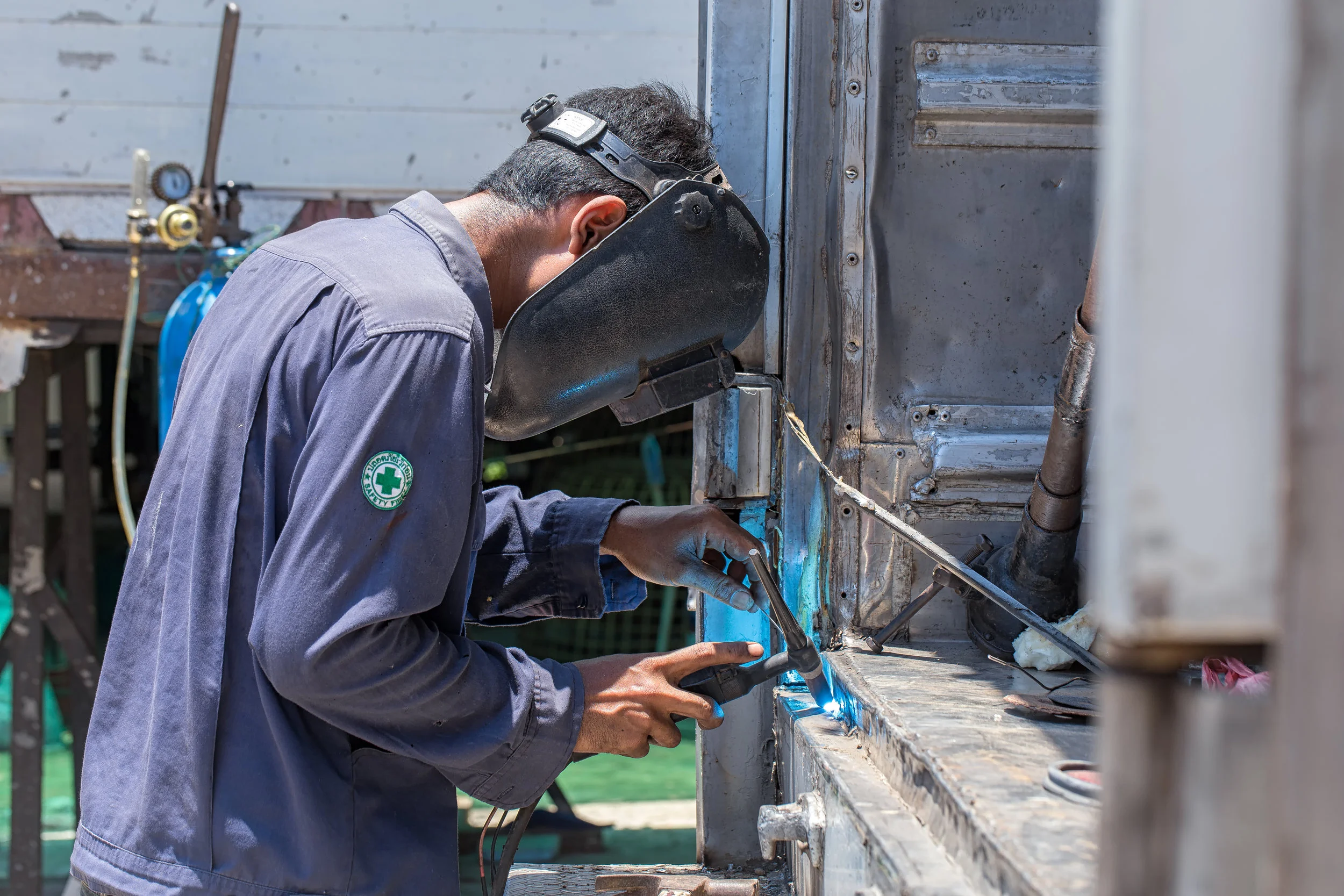
Owning Their Solution in the Weld Shop
I have conducted many workplace organization Kaizens (5S) over the years. The results have always been dramatic. All of the teams were made up of production operators or office workers, with some mechanics assisting the team. The production operators or office workers owned the areas needing organization and the mechanics were able to do some of the more complex tasks needed during the Kaizen. All of the teams, that is, until I met my Weld Shop team. Five mechanics and an engineer, who underestimated what we could accomplish.
I have conducted many workplace organization Kaizens (5S) over the years. The results have always been dramatic. All of the teams were made up of production operators or office workers, with some mechanics assisting the team. The production operators or office workers owned the areas needing organization and the mechanics were able to do some of the more complex tasks needed during the Kaizen. All of the teams, that is, until I met my Weld Shop team. Five mechanics and an engineer, who underestimated what we could accomplish.
Let me tell you about a typical mechanic on a Kaizen team. He or she is there to support the team, but not usually vested in the improvement process. Most of the time, they participate in the Kaizen and do great work, but sometimes they aren’t interested in being there, and would rather be doing their “normal” job. Facilitating a Kaizen with a team where some of the members were this way was not new for me, but having the entire team this way was. The good news was the area we were going to be working on would directly impact their safety and productivity. The better news was they had a supervisor, acting as the team leader, who was extremely excited about the possibility of improving the weld shop. And the best news was I could leverage their pride and competitive nature to turn their existing Weld Shop into a show place for all the world to see. Only if I could get them to own the improvements, of course.
When I run a 5S Kaizen, I do it step by step. On the first day of the Kaizen, after training the team in all of the S’s, we took a walk in the space we were going to organize. I asked the team to identify things we could remove first – the clutter. This is the first S. I asked many questions and they identified the items to be removed while I took photos. Then, after removing all of the clutter, we decided on the best locations for anything remaining in the space. We did this in an organized fashion and I had team members demonstrate how each new location would be safer and more productive than the old location. This is the second S – Set in Order. Following this, we made sure that everything left in the shop was in the best possible shape. We did this by cleaning and inspecting all tools, equipment, materials, and storage spaces. If we found something in disrepair, we either fixed it or replaced it. We relied on everything in the area to work, so we took great care. This is the third S – Shine.
The first three S’s, Sort, Set in Order, and Shine, are the most physical, dramatic, and fun parts of the Kaizen. By the time we got to the fourth and fifth S, the team was extremely energized and the area looked dramatically different from where we started. Here’s an example: Before we started the Kaizen, you had to enter the Weld Shop and walk about 30 feet to turn on the lights. To get to the light switch, you had to navigate in the dark through all of the clutter in the hopes of finding the switch without running into something. In some of the initial “before” photos, you couldn’t tell there was a light switch on the wall at all. During the evening of the second day of the Kaizen, we relocated the light switch to the entrance of the Weld Shop, on an outside wall. Lights could now be turned on before entering the shop, eliminating the safety risk of navigating in the dark to the switch.
The fourth S is Standardize. For this step, the team was tasked to create a managing system to ensure the improvements they made would continue to live on, be supported and requirements followed by everyone using Weld Shop in the future. This was not a physical exercise. It was a mental and paper exercise. Teams typically create checklists, sign-off sheets, signs, and audits that must be followed by anyone using the area. To mechanics, this is “paperwork”, and although it has more than four letters, it might as well be a four-letter word. This is the last thing they wanted to work on, and I knew that. I also knew that this was the most important step, as their improvements would deteriorate back to the “before” condition if not done properly and completely. The real trick would be for the team to own their solution and not just go through the motions. I had a plan, but it was risky. I needed to facilitate an emotional event, so the team would create and own their managing system.
On the morning of the third day of the Kaizen, after congratulating the team on the improvements of the first two days, I explained this would be “Standardize and Sustain Day”. They looked at me with grumpy faces as I showed them examples of checklists and audits other teams had developed. They were not impressed, to say the least. In fact, they didn’t believe simple pieces of paper would keep people from messing up all of their good work. I showed them examples of how teams made these documents visible and established responsibility all the way up to plant leadership. They were still not buying it. I needed to push them further.
I showed a slide of a checklist, going line by line over each requirement. I could see the discomfort and frustration in their faces. I was on line eight of the checklist when one of the mechanics, whose face was beet red said, “Adam, we’ve had enough of your paperwork. We’re going to the smoke shack. You can’t come with us. We’ll figure it out and then we’ll tell you what we’re going to do.” All of the team members stormed off and left me in the meeting room by myself. I had facilitated the significant emotional event. I didn’t really know if they would ever come back, and if they did, what would they come back with?
It felt like two hours, but it was only twenty minutes when all of the team members returned to the meeting room. They looked pretty proud of themselves as one of them declared, “Adam, we’re going to tell you what we’re going to do. We’ll talk and you type.” They listed eleven things they wanted on “their” checklist. They were similar to what I had presented, but it was in their words and it was their ideas, and that’s all that mattered. I thanked them for coming up with such a well-thought out checklist and then challenged them to develop the system to ensure everyone would use it properly and not “pencil-whip” it. This is the fifth S, Sustain. Enthusiastic and full of pride, the team developed a visual Area Owner board, with all of the required documents easy to find and to use. Then they set up daily and weekly requirements for the area users, the Area Owner, and members of the plant leadership team.
On the final day of the Kaizen, the team shared their results with the plant leadership team and some executives visiting from their corporate office. It’s not unusual for mechanics to shy away from presenting in front of an audience. In this case, all team members spoke from their hearts and explained how important it would be to support and sustain all of their good work, which was improving safety and productivity for them and the rest of the plant. They even asked the executives to hold the team and plant leadership accountable to keep this good thing going and spread this effort to other areas of the plant.
After the presentation was over, I spent a few minutes with the team, getting their final thoughts about the Kaizen. Happy with the results and most aspects of the Kaizen, they told me they wished I had been more assertive with them during the week. We laughed as I told them I wasn’t sure they were coming back to the meeting room after storming out on Standardize and Sustain Day. They told me it was just the motivation they needed to get to their solution.

How to Organize Your Work Space With 5S
In the world of Lean Manufacturing, 5S is used to organize workplaces to make them safer and more productive. Although many great manufacturing organizations and others have been credited with inventing or popularizing 5S, I’m pretty sure my mom invented it.
In the world of Lean Manufacturing, 5S is used to organize workplaces to make them safer and more productive. Although many great manufacturing organizations and others have been credited with inventing or popularizing 5S, I’m pretty sure my mom invented it.
When I was young, I wasn’t very organized. My mother told me, “pick up your clothes,” “put your toys away,” “make your bed,” and most importantly, “there’s a place for everything and everything in its place.” Not only did she tell me to do these things, she showed me how to do them, nagged me about them, and checked my work quite often. I couldn’t get away with anything!
Although I really didn’t heed my mother’s advice as a child, as I grew older, I came to realize how powerful these statements were. When I entered the working world, I started applying 5S to many different situations and was amazed at the immediate positive impact that I was able to make. I also saw how deeply it moved those that were able to participate in 5S efforts. They became disciples of the effort and wouldn’t allow others to erode any of the benefits of the change.
As simple and powerful as 5S is, there are many who don’t understand what it is and how it should work and use it to just “clean things up.” I would like to share my understanding and approach to 5S and try to clear up some of the confusion.
The first thing to understand is the purpose of using 5S. I believe 5S should be used to improve the safety and productivity of an area or work space. Once agreement and alignment around this purpose has been established, the team will make choices that will benefit the users of the area.
The first S, Sort, tells us to remove anything that is not immediately needed or useful in the area. Duplication, clutter, and non-working things are to be removed, discarded, donated, or sold. Three hammers turn into one, broken things are repaired or replaced. Things that were saved, “just in case,” are no longer allowed in the area. It’s not unusual to take away more than 70% of the tools, materials, documents, and other things that were just getting in the way. Productivity is improved by reducing the time and effort required to find what’s needed. Safety is improved, as you no longer have to move clutter out of the way to get to what is needed.
Set in Order, the second S, says to create visible, easy to find locations for all remaining materials, tools, and equipment in the area. Define proper inventory levels, place things within reach, make it impossible to lose anything or put it away improperly. As Mom said, “A place for everything and everything in its place.” Trip and bump hazards are eliminated in this step, greatly improving safety. Productivity continues to improve as it becomes difficult for anyone to be non-compliant to the system requirements.
The next S, Shine, tells us to clean and inspect everything that remains in the area, to ensure that it is in optimal condition. We are trying to prevent problems before they happen by identifying any issues, cracks, leaks, or poor performance that may occur with our tools, equipment, documents, and other things that help us do our work. Some think that Shine means “clean things up.” I believe Shine is much more powerful than that, as this effort can reduce risk of failure, greatly improving productivity. Safety is enhanced because we can rely on everything to work properly when called upon, creating no surprises.
The fourth S, Standardize, tells us to create expectations and audits to involve everyone in keeping things as they should be. No longer is it the responsibility of just one person, but the greater community. When I work in an area, I may not realize that things are shifting to their prior condition, things are starting to return to the area that were previously removed, or people aren’t putting things away properly. With a series of audits and auditors, there is a better chance to catch issues quickly and hold each other accountable to follow the rules of the area. In context of my childhood, I thought my room was OK every day, but Mom didn’t always see it that way, and often pointed out the error of my thinking. The safety and productivity gains are maintained through the commitment of the community and its auditors.
The fifth and final S, Sustain, challenges us to continually improve the performance of the area. By scoring the performance of the area and tracking it for everyone to see, we can identify further improvements that would enhance the safety and productivity of the area. Once an area has seen the benefit of implementing 5S, it is not unusual for people to see other things in the area that could become part of the overall 5S system.
I think we can all agree that being organized is beneficial. I think we also can agree that we should listen to our mothers more often. Because I don’t like my vegetables, I can’t guarantee that I will do everything that mom tells me, but I will definitely do my best to listen more.