
Kaizen Success Stories
Real Manufacturing Results. One Kaizen at a Time
Explore real-world Kaizen success stories showing how manufacturing teams solved critical problems, improved performance, and created sustainable results.
Hidden Capacity Was Sitting Above Their Heads
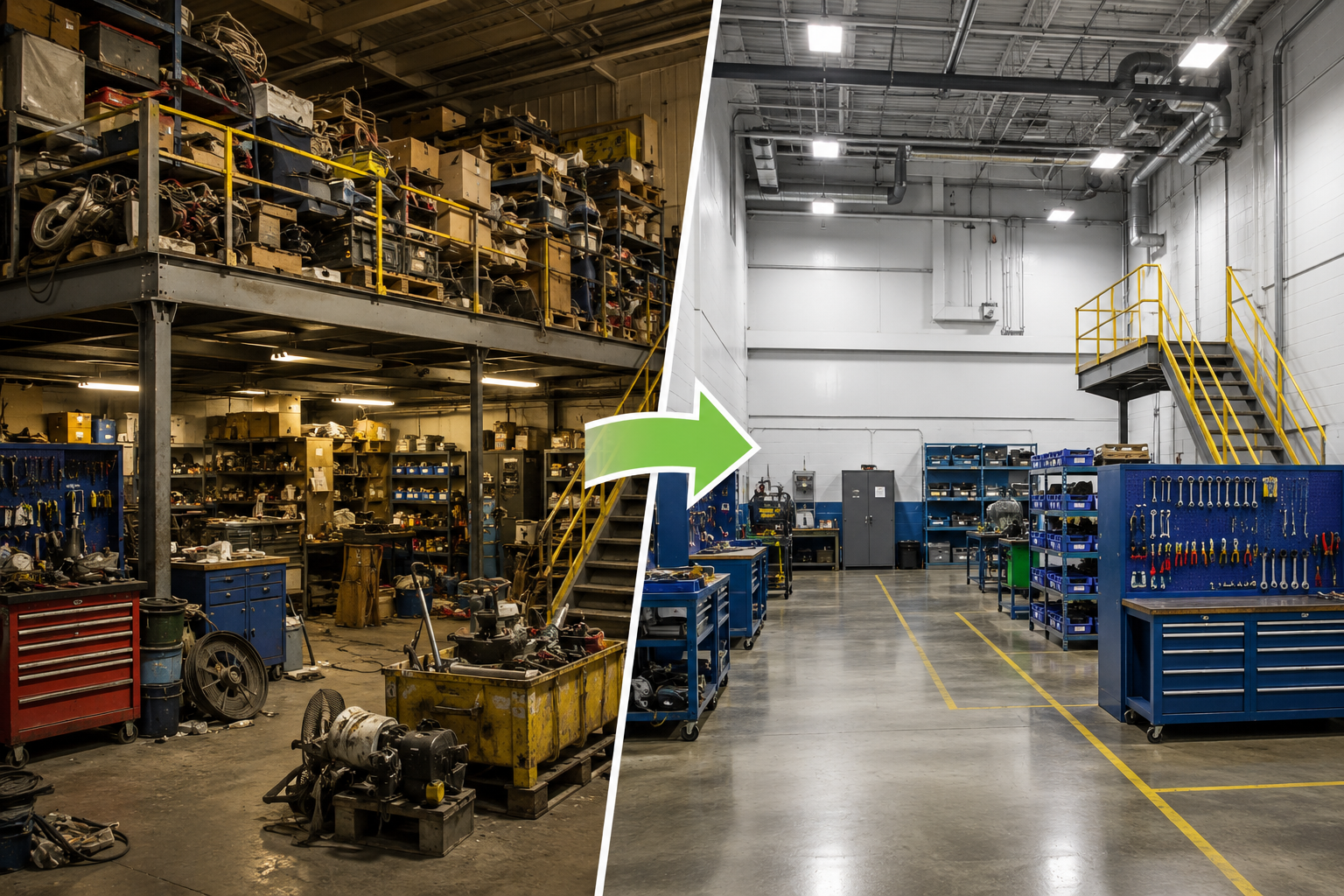
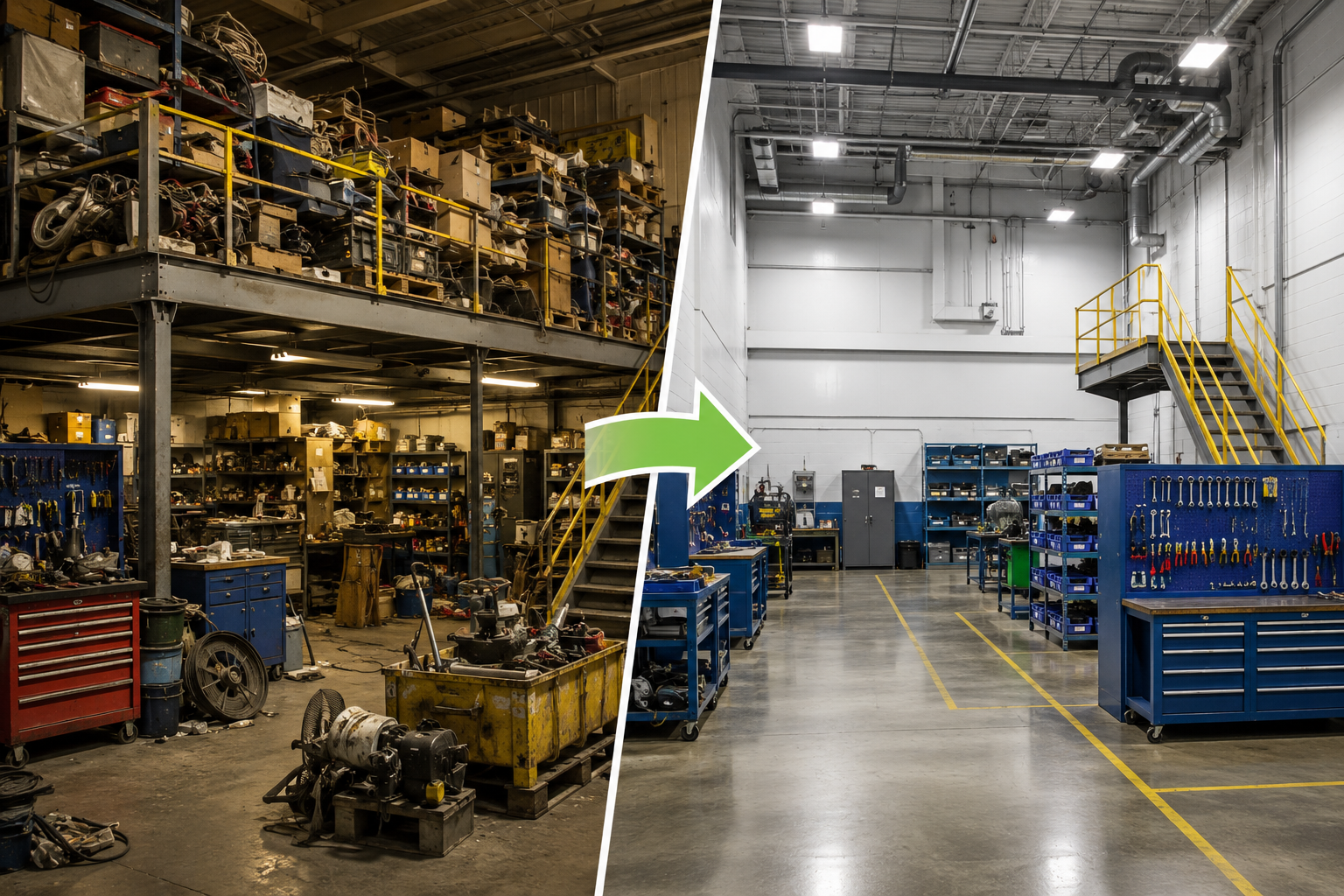
Sometimes your biggest capacity expansion isn't a new building—it's hiding inside the one you already have. Discover how a 5S Kaizen transformed a cluttered maintenance shop into an organized workplace while creating new manufacturing capacity and inspiring employees to take ownership of the improvements.
Kaizen Snapshot
Setting: Maintenance shop at a large power generation manufacturer
Challenge: A maintenance shop buried under years of clutter, making work slower, less safe, and consuming valuable production space.
Stakes: Lost productivity, longer search times, reduced safety, and a mezzanine blocking future manufacturing capacity.
Approach: 5S Kaizen, hands-on team engagement, visual management, and assigning area ownership.
Outcome: Search time reduced from 22 minutes to 2.3 minutes (90%), the mezzanine was completely cleared, and the newly available space was later converted into additional production capacity.
Key Lesson: The greatest result wasn’t organizing tools—it was creating ownership.
The Situation
After two successful 5S Kaizen events at another facility, I was invited to facilitate a maintenance shop transformation at a different manufacturing plant.
Before the event even began, the sponsor and team leader shared a hidden objective. Above the maintenance shop sat a large mezzanine packed with years of accumulated material. If the team could completely empty that space, leadership could eventually remove the mezzanine and reclaim valuable production space.
Rather than keeping that goal a secret, we made it the team’s challenge from Day One.
What Was Getting in the Way
Walking the Gemba made the problem obvious. Four different maintenance areas were overflowing with obsolete equipment, excess inventory, forgotten parts, and items nobody could confidently identify.
The clutter affected everything:
Mechanics spent unnecessary time searching for tools and parts.
Valuable floor space disappeared.
Hidden hazards went unnoticed.
Even the maintenance leader admitted he struggled to throw things away.
To establish a baseline, we asked experienced maintenance technicians to locate six randomly selected items throughout the shop before the event began. Even the people who worked there every day needed an average of 22 minutes to find them. Most of the team doubted that one week of 5S could make much difference.
What We Did
The week began with Lean and 5S training before heading to the Gemba. To reinforce credibility, one of the maintenance technicians from the previous successful 5S event joined our team to share firsthand experience.
As the team sorted through years of accumulated material, something interesting happened. People began realizing just how much unnecessary clutter had quietly become “normal.” Instead of asking, “Should we throw this away?” the conversations became, “Why have we been keeping this?” Once they understood that anything truly needed could be replaced if necessary, hesitation disappeared. Momentum accelerated.
By the third day, the entire mezzanine had been emptied. With the clutter gone, maintenance issues that had been hidden for years suddenly became visible—including wiring, lighting, ductwork, and other infrastructure that could finally be repaired. Even employees who weren’t part of the Kaizen volunteered to help.
The Breakthrough
One maintenance technician had been the biggest skeptic on Day One. He had spent the most years in the department and wasn’t convinced 5S would change anything. By midweek, he had completely changed. He wasn’t simply participating anymore. He was protecting the new workplace.
When I introduced the concept of an Area Owner on Day Three, it became immediately obvious who should take the role. Another teammate even volunteered to cover the responsibilities during his upcoming vacation so the improvements wouldn’t slip backward.
By Friday, the former skeptic proudly announced, “Take my picture.” He wanted everyone to know he would be responsible for keeping the area that way. That may have been the most important improvement of the week.
What Changed
At the end of the Kaizen, we wanted to know whether the improvement was real, not just familiar to the team that had spent the week organizing the space. So instead of asking the maintenance technicians to repeat the exercise, we handed slips of paper listing six randomly selected items to people who were not familiar with the maintenance shop. We also intentionally avoided choosing easy items.
Even with those tougher conditions, the average search time dropped from: 22 minutes → 2.3 minutes. A reduction of nearly 90%.
The improvement wasn’t just measurable. It was obvious. The maintenance shop looked completely different. Anyone could walk in, immediately identify what belonged there, and quickly locate what they needed.
Leadership toured the area during the report-out and described the transformation as night and day. A month or two later, the final piece of the story unfolded. The empty mezzanine was removed. The plant gained valuable production space to support future growth.
The Takeaway
5S isn’t about cleaning. It’s about removing everything that prevents people from doing great work. When employees help build the system themselves, they don’t just maintain it, they own it.
Why This Matters
Many organizations think of 5S as housekeeping. The best 5S events do far more:
They improve safety.
They eliminate wasted motion.
They reduce frustration.
They create pride.
And sometimes they even create entirely new manufacturing capacity that was hidden in plain sight.
Ready to Unlock Hidden Capacity?
If your maintenance shop, warehouse, or production area has become harder to navigate, less safe, or filled with years of accumulated clutter, a focused 5S Kaizen can deliver results far beyond better organization. Sometimes the biggest capacity gains aren’t found in new equipment. They’re already sitting inside the space you have today.
Schedule a Breakthrough Assessment to uncover the opportunities hiding in plain sight.

Working Like a Business Owner
During our benchmarking tour of our European plants, we met hourly operators who were so engaged in their work that they had process understanding that rivaled one of our highest level scientists. And, they wanted to know more!
During my career at Armstrong World Industries, I had the opportunity to travel across the U.S. and to many places around the world. I met impressive people everywhere, but the team I met in Team Valley, UK still stands out as some of the most invested employees I’ve ever encountered.
I was part of a four-person team visiting several of our European manufacturing plants to benchmark best practices and bring ideas back to our local manufacturing plants. The group included the industrial engineering manager, the capital engineering manager, a project engineer, and me.
As we visited plants across Germany and the Netherlands, we saw great examples of things we could adopt back home. We had some fun adventures, met interesting people, and saw some incredible sights.
Our final stop was the ceiling tile plant in Team Valley UK, which had a reputation for best-in-class performance, strong leadership, and a highly engaged workforce.
As we walked the plant floor in the morning, it was immediately obvious why the plant ran so well. Everyone was actively working to keep things running smoothly, following standard work, and using simple, effective tools to maintain operations. Operators and mechanics weren’t just doing their jobs—they were fully involved in improving them.
In the afternoon, we sat in on a technical review by the company’s leading dryer scientist. The room was full, and the discussion dove deep into the science of curing ceiling tiles. I was completely lost in the technical details—and I would’ve dozed if not for the energy in the room.
What kept it alive was the engagement. The most insightful, animated questions were coming from hourly operators. They weren’t there just to listen—they were trying to understand every detail so they could run their lines better. At one point, the scientist even told them, “You all understand this better than I do.” I don’t know if it was true, but it sure felt like it.
It was clear the leadership had built a culture where people truly cared. Not just about doing their jobs, but about understanding why things worked the way they did. Everyone from hourly operators to engineers was fully invested in the success of the plant.
That experience solidified something for me: the way we lead directly shapes the culture and performance of an organization. It’s not a new concept, but seeing it in action left a lasting impression. It still influences how I approach leadership and team engagement today.

Aligned Area Owners are the glue that holds things together – Part 2
I took a site visit to a new client that runs a paper mill in Oklahoma. After a solid day of meeting the leadership team and touring the site, we agreed on a series of Kaizen events, starting with two 5S events, one on the paper mill side of the plant, and the other one on the converting side. Talk about night and day! In Part I, we saw what happens when the area owner wasn’t aligned. This story is about an aligned area owner.
I took a site visit to a new client that runs a paper mill in Oklahoma. After a solid day of meeting the leadership team and touring the site, we agreed on a series of Kaizen events, starting with two 5S events, one on the paper mill side of the plant, and the other one on the converting side. Talk about night and day! In Part I, we saw what happens when the area owner wasn’t aligned. This story is about an aligned area owner.
After the first Kaizen event, I made sure Mike, my team leader, and Steve, our sponsor, were aligned about the approach and how we would need a strong Area Owner. They assured me it wouldn’t be a problem, as two of the participants from the first Kaizen were from their area and they were excited about what happened and what would be possible for their team.
From the moment we kicked off on Monday morning, the atmosphere was positive. Our two team members from the first Kaizen event had shared their stories of success with the new team members. Although there was skepticism, everyone seemed willing to help and try anything. The spaces were huge and the clutter seemed overwhelming. Our challenge was to reduce find and retrieval time by 75% or more. This might be a stretch to achieve.
The team immediately got to work and gave their all. By the middle of the second day, there was a remarkable change in the spaces. You could actually see the floor. Major safety issues had been eliminated and the clutter wasn’t overwhelming anymore. We could see a path to the finish and were inspired to beat the results of the first team.
During the week, we had many challenges, including finding and removing a kitty “graveyard” behind one of the storage racks (it was pretty disgusting), and going beyond our scope to rearrange some personal toolboxes in the area (I typically try to stay away from telling people how to arrange their personal stuff). The team pressed on, with an amazing breakthrough in their sights.
By the end of the fourth day, the transformation was stunning. Now, it was time to test “find and retrieval time,” We took six random items and assigned them to team members to find. The goal was to get below 2 minutes (from our baseline average of 8+ minutes). Each team member found their item and returned it to us in less than a minute. But, just to show we weren’t stacking the deck in our favor, we found two “volunteers.” Our first test subject was Steve, our sponsor. He found his item in less time than the team member who had been assigned the item in the first trial. Good thing he had a sense of humor about it!
Next, we assigned someone who had never been in the area to find a part. He took the information and walked into the wrong room. Team members wanted to help him. I told them to be patient and see how things played out. Our test subject entered the correct room after about 30 seconds of searching and went to the correct cabinet and returned the item to us in just over a minute. The team was ecstatic – they had won!
Afterwards, we went back to the meeting room and two team members volunteered to be the Area Owners, one for each room. They happily built their boards, created their audits, and took pride of ownership. What a difference from the first Kaizen event.
The vibe at the report-out was bursting with energy and excitement. All who attended were astonished at the transformation of the space and the full engagement and ownership of all of our team members. They all understood what we had done would positively benefit all of the maintenance employees, their managers, and the plant customers they served. The area owners were going to see to it things stayed that way.

Aligned Area Owners are the glue that holds things together – Part 1
I took a site visit to a new client that runs a paper mill in Oklahoma. After a full day of meeting the leadership team and touring the factory, we agreed to a series of Kaizen events, starting with two 5S events, one in the paper mill building, and the other one in the converting building. Talk about night and day! Here’s the first story about what happens when the area owner wasn’t aligned. (And to learn about the experience when the area owner is aligned, be sure to read Part II.)
I took a site visit to a new client that runs a paper mill in Oklahoma. After a full day of meeting the leadership team and touring the factory, we agreed to a series of Kaizen events, starting with two 5S events, one in the paper mill building, and the other one in the converting building. Talk about night and day! Here’s the first story about what happens when the area owner wasn’t aligned. (And to learn about the experience when the area owner is aligned, be sure to read Part II.)
I should have seen the warning signs. In the weeks leading up to the first Kaizen event, Joe, my team leader, and Frank, my sponsor, spoke about how they originally wanted Julie, responsible for the area, to be team leader. She wasn’t on board with the idea of leading the event, or even working to improve the productivity and safety of her storage and supply areas. She was going to be on the team, but it didn’t sound like something she wanted to do. I advised Joe to try to bring her on board willingly, as this event would directly impact the work she did in a positive way. We had two team members from the other side of the plant who would be involved in the following month’s Kaizen event.
On the first day, it was immediately apparent Julie didn’t want to be there. She was the resource the maintenance technicians relied on to acquire supplies for their work orders. Julie was very guarded when she spoke and said little, unless called on directly (which happened a few times). When we took our Gemba walk, every space looked like a tornado hit, including Julie’s office. Our measure for success was equipment find and retrieval time. Our goal was to cut it by 75% or more. I knew it should be an easy win. Except for Julie’s continued negative comments and lack of enthusiasm for the work. Her toxic attitude was impacting other team members. I spoke with Joe at an early break, just to stay aligned. Julie worked for him, so he was aware of her general attitude at work.
Once we started sorting through tons of equipment and supplies, the team became engaged and was having fun. We removed more than 50% of large and small items throughout three critical spaces. Now it became easy to organize things in a way that made finding items quick and safe. We were able to take everything off of the floor, so access to shelves didn’t require the movement of items out of the way to get to what was needed.
At the afternoon break on the first day, Julie made a negative comment about the work we were doing. I talked with Joe and asked him to speak with her to understand what was behind her comment. He rolled his eyes, but agreed to talk with her. When he returned from the conversation, he tried to shake off her comment as if she was concerned our efforts wouldn’t be sustained.
As the week progressed, Julie’s negative comments were more frequent, and other team members were affected by her negative vibe. On the evening of the second day, I spoke with our overall sponsor, the plant manager, to make him aware and also to understand what could be going on with Julie. After all, the space now looked fantastic and the rest of the team was excited about the changes they made. He said he’d keep an eye on things and speak with her directly, if needed. He even spent a few hours helping the team out cleaning up the areas. This was true leadership commitment.
On the third day, something set Julie off, and she stormed out of the meeting room. She felt the need to speak with the plant manager. He reminded her of how critical it was for her to participate and support the work of the team. It was directly beneficial for her job and the jobs of those she supported. She came back to the team in a slightly better frame of mind.
The rest of the week went well, but things went sideways when it came time to put the Area Owner board together. Julie didn’t want to be the official owner, but we didn’t let that stop us. Joe knew it had to be her, in order for our work to be sustained. So, we mounted the board, daily audit, weekly audit and tracking, and Julie’s photo and contact details on the board and did an initial assessment of the space. We also timed six random individuals to find and retrieve materials and supplies in the space. We easily beat our Kaizen objectives and the team was excited. Everyone, that is, except Julie.
At the report out, it wasn’t surprising that Julie didn’t participate by presenting part of the team’s story. She sat in the audience quietly and didn’t even make eye contact with any of the presenters, who were telling a very positive, winning story.
At the wrap up with Joe and Frank, we reviewed the great efforts and results by the team, in spite of Julie’s toxic behavior. We were hopeful she’dcome around, once she realized this effort was directly going to help her daily work. But we also knew there would be extra effort to support this first 5S space and keep things moving forward.
I left the plant feeling conflicted. On one hand, we had a strong win and team members were inspired to take this work forward to other locations. On the other hand, we had an owner who didn’t demonstrate the leadership behavior required.
I believe Julie felt exposed. In the past, she was the “go-to” person for any needs from the maintenance organization. Now, they would be more self-sufficient and not need her as much. Continuing to act and feel the way she did and does (2 months later), the system won’t be sustained without intervention or the introduction of a new Area Owner.

Peggy’s Toolbox
I’m always organizing things around the house. One winter, I cut the shapes of my tools into foam and lined the drawers of my tool box. It looked so nice, I showed it to my family so they could admire it too. They humored me, but didn’t seem very impressed.
On a trip to Costco, I bought a labeler. It seemed like something that might come in handy for one of my home organization projects. Peggy, my wife, asked me what I needed with one. I wasn’t sure, but it was inexpensive. What was the harm in having one?
I’m always organizing things around the house. One winter, I cut the shapes of my tools into foam and lined the drawers of my tool box. It looked so nice, I showed it to my family so they could admire it too. They humored me, but didn’t seem very impressed.
On a trip to Costco, I bought a labeler. It seemed like something that might come in handy for one of my home organization projects. Peggy, my wife, asked me what I needed with one. I wasn’t sure, but it was inexpensive. What was the harm in having one?
Eventually, I went through the tubs stored in our basement and consolidated and disposed of things. From time to time, I got Peggy’s permission to donate or throw things away. After each tub was completed, I put a label on it to identify contents and the date it was reviewed. That way, I wouldn’t feel the need to do it again for a few years. I showed off my work. Once again, I was met with a less than excited reaction.
I took some grief for being so organized, but Peggy and I laughed about it often. She was also quietly organizing the kitchen. We’d go to a store and come back with plastic containers of various sizes.
One morning, while taking out my breakfast cereal, I noticed labels on the plastic containers in the pantry. All of a sudden, the labeler had purpose. The idea of organizing and making things visible, was beneficial to Peggy. More than that, she was committed to the idea.
I help out in the kitchen after dinner. Peggy washes the dishes and I dry and put them away. I always forget which Pyrex goes where and must be reminded often. One day, I asked why the Pyrex goes where it does and wouldn’t it be better to store it differently? I was met with this explanation:
“Don’t mess with my toolbox and I won’t mess with yours.”
From then on, I haven’t questioned Peggy’s system. I get well fed and meals always come out on time, regardless of the number of ingredients or side dishes. I don’t question the need for another container, pot, pan, or utensil. I reap the rewards.
Peggy’s fully committed to her system. She sees the value of organization and ensures everyone knows and follows the standard. And as a family, we receive Clear Benefits through the use of her toolbox!

If Everyone’s Responsible, Nobody’s Responsible
I visited a consumer goods factory in Pennsylvania. They were profitable, but concerned their ability to service customer orders was deteriorating. I met with plant leadership and took a Gemba walk through the distribution center.
I visited a consumer goods factory in Pennsylvania. They were profitable, but concerned their ability to service customer orders was deteriorating. I met with plant leadership and took a Gemba walk through the distribution center.
They were proud of their efforts to apply 5S. I asked Angela, the Distribution Center Manager, how they used 5S to help them service their customers. She was unsure of my question, so I posed it in a different way:
Me: “What benefits do you get by using 5S?”
Angela: “It’s cleaner in the distribution center than before we used 5S.”
Me: “It does look clean. Well done. How does that help you?”
Angela: “We don’t spend time cleaning up behind each other.”
Me: “How do you ensure it stays clean?”
Angela: “I remind our employees to use 5S and clean up after themselves daily. Sometimes they need additional reminding.”
Me: “Can you show me an example?”
We walked to a tool board. There were spaces for seven different tools. The shape of each was painted on the board. It was apparent where things were to be placed, except all tools weren’t on the board. Only two of the seven were present.
Me: “Where are the other five tools?”
Angela: “I’m not sure. People are probably using them right now.”
Me: “Can we take a look or is there someone we can ask to find out?”
Angela: “We should be able to ask anyone here. Everyone’s responsible for keeping the tool boards filled.”
Me: “I’d like to find out how that’s working.”
We found a distribution center employee and asked him if he knew where the missing tools were. He wasn’t sure. We walked to four other tool boards. Freshly painted, all were missing tools. Without an owner for the boards, there was no Accountability to keep them filled and ready for use. This led to less than effective cleaning.
During the rest of our Gemba walk, we found many more examples of how the lack of Accountability kept performance at low levels. When everyone’s responsible, nobody’s responsible. Once we identified systemic lack of Accountability as the underlying cause of low customer service levels, Angela and I chartered a Kaizen event to resolve the situation.
Color Coded Badges
The Pilot Plant at Armstrong World Industries, a global ceiling tile manufacturer, has tons of operating equipment designed to allow technicians, engineers, and scientists to try out their ideas and experiment in their efforts to create new processes and products. One of the areas in the Pilot Plant that gets the most use is the wood shop. Containing over 50 separate pieces of equipment, much of it requiring skills to operate it safely.
The Pilot Plant at Armstrong World Industries, a global ceiling tile manufacturer, has tons of operating equipment designed to allow technicians, engineers, and scientists to try out their ideas and experiment in their efforts to create new processes and products. One of the areas in the Pilot Plant that gets the most use is the wood shop. Containing over 50 separate pieces of equipment, much of it requiring skills to operate it safely.
Each area in the Pilot Plant has an owner, and the wood shop is no exception. Troy is his name (made up to protect the guilty), and he manages a tight ship. As much of the equipment in the wood shop had cutting and grinding capabilities, there was a need to train people to use the equipment safely and properly. Troy takes his responsibilities very seriously and has trained all of the people who wanted to use the equipment himself, on an annual basis. If someone wanted to use the equipment but wasn’t trained or qualified, Troy wouldn’t let them. That is, if he was aware of it.
It turns out that some of the employees used the equipment without training or qualification from Troy, when he wasn’t there. Word got back to Troy and he was not happy about it. This was his area and he was responsible for it. He knew he needed to do something to keep people safe and doing the right thing, but his earlier efforts confronting those who were breaking the rules didn’t get the desired results. He even spoke with the managers of those who were breaking the rules and that didn’t work either. More and more frustrated, he looked like he was about to blow a gasket one day and I decided to see if how I could help.
Shifting Responsibility
When we first started discussing the problem, Troy told me people should respect the rules and equipment and act responsibly. If they weren’t willing to follow the rules and keep themselves safe, “we should fire the lot of them.” Knowing that terminating employees isn’t the ideal solution, I wondered if he was willing to try a different approach. As I had worked with Troy for many years and we got along pretty well, he humored me and listened to what I had to say.
I acknowledged the problem and how critical it was for people to do the right thing. I also acknowledged Troy’s tremendous energy and effort that he had put into the training and expectations in the wood shop. He had trained more than fifty employees annually and kept careful records. He did the follow-up and communication and tracked compliance. Quite a task, as it was in addition to his normal duties in the Pilot Plant. I asked Troy if he thought there was a way to make it easier to enforce compliance that wouldn’t be totally reliant on him. If I saw Joe using a band saw, I had no way of knowing whether Joe had been trained and qualified to use the band saw. I could ask Joe, but that wasn’t an efficient way to create accountability.
Troy looked at me kind of funny. I get that look often. I could tell he was processing my question. Then I pointed out the area in his wood shop where everyone can assess compliance, the tool board. Anyone could tell whether all the right tools were on the board and when they were missing. It was easy to step in and hold people accountable to do the right thing. The visual nature of the board made it easy for anyone to help. Now the light bulb went on for Troy. I was ready to help some more, but I could see that he wanted to figure things out for himself.
Earn Your Badge
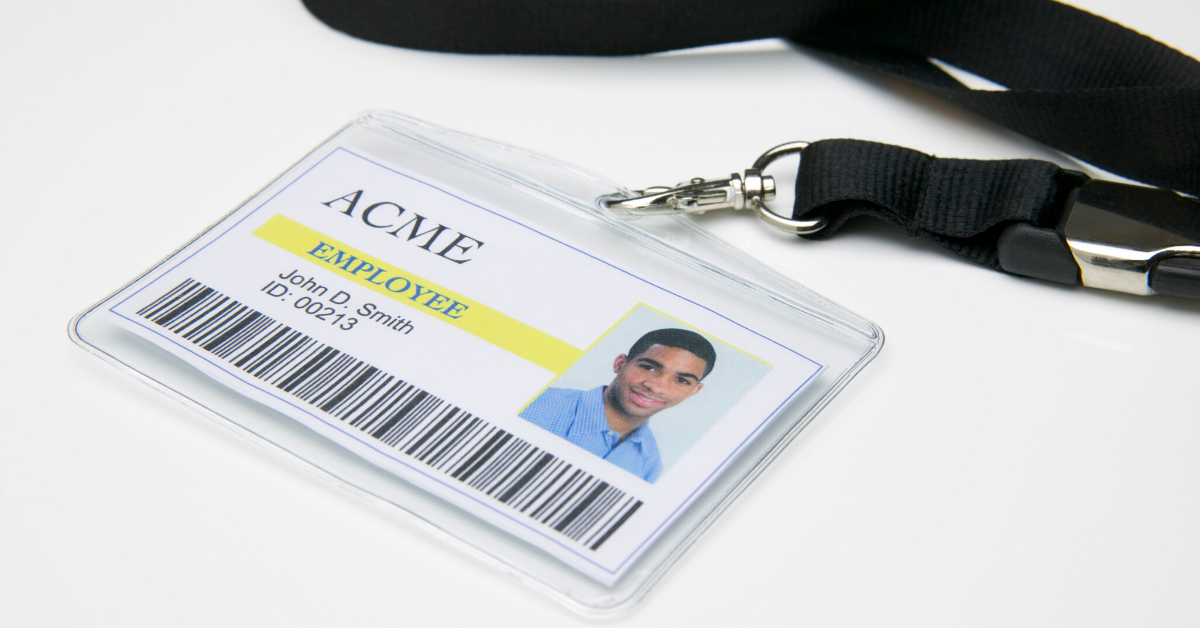
Three weeks later, Troy was ready to share his solution for training and accountability in the wood shop. He created a badge system with three colors, red, blue, and yellow. Yellow was the lowest safety risk level, blue was next, and red was the top safety risk level. He identified the safety risk of each of the over 50 pieces of equipment used in the wood shop, assigned them a risk color, and attached the appropriate badge to each piece of equipment. Next, he communicated the new badging system to the organization. Finally, he would personally assign a badge to each person based on their training and Troy’s qualification rules. Only Troy could issue the badge and only someone wearing a badge was authorized to use the equipment with the corresponding risk level as the badge being worn. If you wanted a higher-level badge, you had to be personally trained and qualified by Troy. Nobody got a colored badge unless Troy authorized it.
The rest of the organization was now able to assess compliance within seconds and help Troy keep everyone safe and doing the right thing. Troy put in all of the preparation and effort. But the rest of the organization could help him maintain compliance. It didn’t take long before we stopped hearing stories of people trying to go around the system. And for good reason, our leaders were holding themselves accountable to help Troy keep the area safe and compliant. The rest of the organization saw how important it was and stayed compliant. It stayed that way through my last days at Armstrong. If I know the organization and Troy, it still is that way to this day.

Little Things Mean A Lot – Revisited
A global consumer goods manufacturer was experiencing high levels of downtime, jams, and long changeovers on a critical production line. They invited Process Improvement Partners to their plant to observe and discuss the problem and identify opportunities for improvement. After reviewing performance, we took a walk to the line. The line was running, and after a description of line components, it became apparent there were quick opportunities to improve performance of the line.
A global consumer goods manufacturer was experiencing high levels of downtime, jams, and long changeovers on a critical production line. They invited Process Improvement Partners to their plant to observe and discuss the problem and identify opportunities for improvement. After reviewing performance, we took a walk to the line. The line was running, and after a description of line components, it became apparent there were quick opportunities to improve performance of the line. The techniques we would use were quite basic: leveling, squaring, aligning, and centering of products with the process. It seemed so simple, and the customers were skeptical. We suggested a five-day Kaizen to improve line reliability, scheduled for January 2019.
Leading up to the Kaizen event, we had many discussions with line operators, mechanics, and engineers, and we made several confirming observations on the line. During a discussion with the Plant Manager, it became apparent he didn’t buy-in to the approach. He had used a process called “Center Lining” before, and had mixed results. In addition, it took weeks to accomplish. We assured him centering of the process would be completed on the first day of the Kaizen and then we would optimize all parts of the process around the center in the following days. He was still skeptical, but heard enough and saw our confidence, and gave final approval for the Kaizen to proceed.
Taking a Different Approach
In most Kaizen events, we provide a structured approach to the team charged with solving a problem. We very rarely dictate specific actions to the team. In this case, the entire first day was controlled and team members were asked to follow very specific instructions before implementing their ideas.
After receiving training on the approach, the team walked to the production line. We reviewed safety requirements, shut down the line, and locked it out. The next step was to identify the center of the critical packaging process. This was the part of the line where everything comes together – the product and the package. We told the team everything leading up to the packaging process should be located and optimized to the center of the process. They didn’t think it would be very important, but were willing to learn and find the center of the line.
We located the center of the line at the midpoint of the conveyor frame on the out-feed side of the equipment and wrapped a string around that point. Then, stretching the string through the equipment, we found the center of the conveyors leading up to the equipment. A trained eye can keep the center precise within 1/32”, so we found what we believed to be center along approximately 100 feet of equipment and conveyor and pulled the string taut. Then, we marked the equipment and conveyor every 4 feet along its length to identify center for the process. Once complete, we noticed all product was coming into the equipment off center. The packaging was tracking off-center as well. That was the first time the skeptical team members saw something they weren’t expecting.
Taking Things to the Next Level
Our next step was to check the levelness of all of the conveyors leading up to and through the equipment. Ideally, all conveyors should be no more than 1/32” out of level at every transition (one section of conveyor to the next section) and side to side. Using a torpedo level and some shims, the team documented levelness of every section of conveyor.
In the middle of the leveling effort, I realized the team needed a longer level than was available in the various toolboxes around the line. Having done some work in the weld shop in the same factory, I knew there was a six-foot level that would be helpful in our efforts. I walked to the weld shop and asked the area owner if I could borrow the level. He reminded me of the rules of the tools in the weld shop – “Tools should either be on the board or in use. So, don’t forget to return the level as soon as you’re finished with it!” I reassured him that I was well aware of the rule (I had helped the team develop it, after all). So, sufficiently held accountable, I took the level with me.
Now, you need to know that the level had a label on it that read, “Weld Shop 6 Foot Level.” There was no way to not know where it came from and where it was supposed to go. Using the level, I was able to help the team identify and locate proper location and levelness of the conveyers.
Rule of the Tools
Every so often, I had to put down the level, and I made sure I placed it carefully on a table. Sam, an operator on the line we were working on reminded me that I was responsible to return the level as soon as we were done with it. Then, Ray, a supervisor on another line who happened to be walking by made sure to tell me the same rule. Then the HR manager told me. And finally, the plant manager, who was over at the line checking out our work, felt that he needed to remind me to return the level to the weld shop. Whether or not they were doing this to mess with me, it didn’t matter. What did matter was that the story of the weld shop and the rules of the tools had made it all the way through the plant. Every time I was told the rules, the rules were reinforced. This was exactly what I hoped for.
Over the course of our work, the team found many of the conveyors were out of level by more than ¼” and some were out as much as ½”. The good news was this condition was easily corrected, and by the end of two hours, all conveyors were leveled throughout the process. The team was losing its skepticism as the products ran more consistently once we started the line back up. The first day ended with the team handing the line back over to the production organization. And, yes, I returned the level to the weld shop.
Ownership at the Right Level
I was Lean Champion for the global technology team at Armstrong World Industries for many years. During that time, I supported teams of technicians, scientists, engineers, project managers, and the leadership team across four different departments. I had the good fortune to assist teams in their efforts to develop and launch new products, deploy capital equipment, and build factories all over the world. All departments had access to the Pilot Plant to support their efforts when necessary.
I was Lean Champion for the global technology team at Armstrong World Industries for many years. During that time, I supported teams of technicians, scientists, engineers, project managers, and the leadership team across four different departments. I had the good fortune to assist teams in their efforts to develop and launch new products, deploy capital equipment, and build factories all over the world. All departments had access to the Pilot Plant to support their efforts when necessary.
The Pilot Plant was a series of disconnected processes which had the resources and capabilities to test new materials, products, processes, and other ideas in a controlled way. Information gleaned from tests and trials was utilized in the effective delivery of projects and other development efforts. Each of the processes in the Pilot Plant had an owner, who was responsible for the care and safety of the process. The owner would also try to schedule the process to allow it to be utilized effectively and to keep wait times to a minimum. All process owners were the technicians who were most familiar with the operation of their process. Although they were at the lowest level of the group, they were very proud of their equipment and took ownership to keep things safe for their customers.
As Lean Champion, I spent many hours in the Pilot Plant, learning about its capabilities and trying to understand how I might be able to help the technicians in their efforts to support the rest of the organization. It was during my early days in the Pilot Plant that I met a gentleman, we’ll call him Roy, who was lead technician. He had just taken on the leadership role for the Pilot Plant, responsible for the overall effectiveness and operations. Having worked in one of Armstrong’s factories prior to his arrival at the corporate center, he had vast equipment knowledge and some leadership experience.
A Source of Frustration
Before taking over as lead technician, Roy worked in the Pilot Plant as a process owner and participated in the annual Pilot Plant clean-up. This was a multi-day effort by all technicians at the end of the year. They would go through all of the materials, supplies, and equipment throughout the plant and clean out the clutter and reorganize things in as safe and productive manner as possible. All development and testing in the Pilot Plant would be delayed during this time, as all technicians were busy cleaning things up and trying to make sense of what they had.
None of the technicians liked the annual clean-up process because they knew it wouldn’t take long for things to go back to the way they were prior to the clean-up. Roy expressed his frustration to me more than a few times. Once he became lead technician, he was even more frustrated and wanted to do something about it. My first suggestion to Roy was that he should discuss his frustration with his manager and gauge his support for Roy’s efforts. Roy did this, but seemed just as frustrated. Upon further discussion with Roy, I found out his manager was supportive of his efforts, but didn’t offer solutions Roy thought he could implement without direct assistance from his manager. He really wanted his manager to tell everyone to clean up after themselves.
Over the next few months, I facilitated 5S (Sort, Set in Order, Shine, Standardize, Sustain) events in the Pilot Plant to support Roy’s efforts to make areas safer and more productive for everyone. The few area owners who had completed 5S events had a strong managing system to keep their areas in top shape. The other 30 or so areas did not, so clutter and disorganization was prevalent everywhere else in the Pilot Plant. Roy was getting more and more frustrated.
Turning the Corner
One Monday morning, following the weekly technician meeting in the Pilot Plant, Roy stopped me on my way back to my office. “Adam, I’m really frustrated,” he said. “My manager won’t hold everyone accountable to keep the Pilot Plant organized and safe. He tells them it’s their responsibility, but doesn’t do anything about it when they’re not compliant. What can I do?” “Roy,” I said, “Who’s the leader of the Pilot Plant?” “I am,” he said. “Well, as leader, you have every right to set expectations and hold accountability. You are the operations manager; your boss is the plant manager. The plant manager needs you to get your operations in order. Let me help you do that.”
Over the next few weeks we built our strategy for putting the Pilot Plant in order. Our strategy included: setting clear expectations for all areas of the Pilot Plant, redefining responsibilities for all area owners (not just the areas that had been 5S’d), developing a weekly leadership walk (Gemba walk), and creating visual management to hold all area owners accountable. We mounted a large white board in the main meeting room and put lines and names on it, ready to explain it to the technicians at the next technician meeting.
The next Monday morning, we introduced the new strategy for making the Pilot Plant the safest, most productive place possible. The technicians listened with keen interest and asked many questions as Roy described the changes. They were skeptical that there would be any change in behavior of the scientists, engineers, or managers when they used the spaces in the Pilot Plant. Then Roy explained the white board, which he called the “Area Owner” board. On it were over 30 Pilot Plant locations with the corresponding name of the area owner and a space for a date to be written. At the first of every month, a red magnet would be placed for each location, signaling the owner hadn’t yet met certain monthly requirements. Once those requirements were met, the Area owner would replace the red magnet with a green magnet. The Area Owner would write in the date the requirements were met. At the beginning of the next month, all magnets were set back to red.
The technicians were furious. They thought those red magnets made them look like they weren’t doing a good job and didn’t want any part of the new system. I jumped in and explained it was a very visual and urgent way to show what areas weren’t yet compliant and who might need help. The system wasn’t a reflection of the specific area owner, unless he or she hadn’t made the effort to meet the requirements or ask for help. We felt if we could get all areas to green every month, we wouldn’t need the annual cleanup, which everyone hated.
A Delicious Incentive
At this point, the technicians started to buy-in and support the idea, but they were still skeptical that some of the area owners would be motivated to get to green every month. I knew I needed to provide incentive. I said, “The first month we get all areas to 100%, I’ll buy every area owner lunch and we’ll celebrate!” That got their attention. I then described the design of the management walk: We would take a selection of managers of the scientists and others who used the Pilot Plant and tour all areas, looking for areas where we could reinforce the need for compliance to the requirements. We would do this every week and sign off to show we had and we were just as accountable as the technicians.
For the next few months, I attended every Monday morning technician huddle, and reinforced the new systems and encouraged the area owners to get their areas to green before the end of the month. One Monday, late in the third month of the “Area Owner Challenge”, there was only one technician whose area was still red. Almost to a person, the technicians pressured him to get his requirements done and make sure Adam would buy them lunch! They did it in a fun way, but I knew they were serious. I knew our system was working at last.
Over the next months, the technicians hit 100% compliance almost every month, and by the end of the year there was no need for the annual cleanup. Pride in the Pilot Plant grew. In the following years, the Pilot Plant was bench-marked many times. Not because of the technology, but because of the strong ownership and pride and systems that allowed new products and projects to be delivered in the safest and most productive way possible.
The Path to Consultancy
I worked more than 30 years for a multi-national company. During that time, I had the opportunity to help teams and solve problems all over the world, from the US to Europe to Asia. I worked in five distinct industries and had many roles, from engineering to operations to continuous improvement. I enjoyed most of what I did, but realized something was missing.
I worked more than 30 years for a multi-national company. During that time, I had the opportunity to help teams and solve problems all over the world, from the US to Europe to Asia. I worked in five distinct industries and had many roles, from engineering to operations to continuous improvement. I enjoyed most of what I did, but realized something was missing.
When you work for someone else, you meet their requirements and work on their assignments. You don’t always get the opportunity to pick your projects. Sometimes you have to work on things that have nothing to do with your chosen field or interests. But, that’s life in a big company.
I used to take time off and help friends identify and implement improvements in their own businesses. I would take a day, travel to their location, and walk through their process with them. We would spend time with the people, processes, and equipment, reviewing the issues and problems in their business. At the end of the day, I would help them lay out a plan to improve things, which they were able to use after my visit. I enjoyed doing this, and thought I could become a consultant after I retired from my primary career.
In April 2018, I was visiting a local company, and spent the day doing what I enjoyed, reviewing their processes, people, and issues. Following a wrap-up meeting, I told my contact I wanted honest feedback on my visit. I felt like I could use this feedback for the time in the future when I intended to consult. Maybe in about 3 to 5 years, I said. He said he would let me know what he heard and we left it at that.
One week later, I was downsized. While this was surprising to me, I didn’t feel bad about it, because I felt something better would come of it. I just had to figure out what that was. It didn’t take long, as I realized I had the opportunity to forge my own path as a consultant.
Downsizing with an upside
I placed a call to my friend from the week before and let him know I would now be available 3 – 5 years sooner than I expected to be. He seemed excited to hear that and said he would talk to his plant manager to see if he was interested in letting me help them execute the improvement plan we had developed together. The plant manager was willing to use my help. Now I had to figure out all of the details required to open and run a consulting business.
Luckily for me, and for many others, there are ample resources willing to help and support small business owners. Using those resources, a lot of networking, and tons of phone calls and meetings, I established my consultancy in May 2018. Once done, I was able to start working with my first client. We decided to run a Value Stream Mapping session to lay out a continuous improvement strategy for the plant in June. I had run many such sessions in my prior company. Now, I had to put one together with a group who had little to no experience with this approach. I knew I had to prepare them for what was going to happen and do everything possible to ensure they had a great experience and beat their expectations.
Success is in the details
I spent many days at the plant, preparing them and myself for the Value Stream Mapping event. Every detail was critical, from the layout of the meeting room to the activities each day and the food we would be feeding the attendees. The people at the plant were intrigued by how involved I was in even these details. I kept telling myself and them that it was all for ensuring a winning experience.
The first day of the event, we had over 50 people attend, and we broke them up into three working teams, with facilitators I had trained in advance. Throughout the week, each of these teams identified waste in their processes, ways to reduce the waste, and improvement efforts and projects to implement over the next few years. It was hard work, but the team members seemed to be having a good time and were energized by the opportunity to create their future. I was having a blast, realizing I was helping people do something they had never done before.
By the end of the week, all teams had strategic plans they were committed to implementing. Corporate leadership came to the plant for the report out and was extremely pleased with the results. After the event was over, I reviewed my approach with the leadership team to see what they thought. They were very happy and even suggested I could help them with a number of other improvement efforts over the coming months. This reaffirmed my belief that I had chosen the right path.
The reward for good work is more work
A few months later, I received a call from the corporate supply chain director for the same company. He told me I had been recommended to him by the plant manager and he wanted my help with another improvement project. I was elated and scheduled the work for August.
Since those early days, I have had the good fortune to acquire more improvement efforts for multiple locations of the same company and other companies as well. The more I do, the more I learn, and the more fun it has turned out to be. I have the opportunity to help people and do it in a way that is fun, engaging, and energizing. I am so glad I didn’t wait to get into consulting, even if I needed a nudge to start.
Line Up and Do the Right Thing
In 2011, I was asked to facilitate a Kaizen in Pensacola Florida. The problem to be solved was to improve material flow through the plant. Specifically, there were millions of square feet of goods in process, and items were getting lost, damaged, and generally causing confusion and chaos in the plant.
In 2011, I was asked to facilitate a Kaizen in Pensacola Florida. The problem to be solved was to improve material flow through the plant. Specifically, there were millions of square feet of goods in process, and items were getting lost, damaged, and generally causing confusion and chaos in the plant.
Building 37
After training the team in Lean concepts, we took a walk out into the process to see what was happening. These Gemba walks can be quite eye-opening, and in this case, it made the problem very real to all team members. There were literally hundreds of pallets of material all over the plant, with much of it stored in a building they called 37.
In Building 37, there was no rhyme or reason to the way materials were stored. These materials were stored for various processing lines, but there was no way to know what was being stored and where to find it. It was obvious something drastic had to be done.
The team developed a concept early in the week that made storage and retrieval of the materials more manageable and thought they could organize and store everything in one location, rather than all over the plant. They determined that they could use Building 37 for this purpose, but would need to make the building more visual and create some rules around storage of materials.
Creating Visual Organization
After many different layout suggestions, we came up with a scheme we thought would work. We decided we needed to move everything out of Building 37, in order to reorganize and line out the space in accordance with our new recommendations. We also realized that we would have to clean the floor and paint it to make it as visual as possible and easy for everyone to use and manage. Painting the concrete floor was something the team didn’t want to do. In the past, forklifts tore up the paint and the lines would be lost quickly. Instead, they did some research and found a company out of southern Georgia with a technology to stain concrete, rather than paint it. It seemed like this was a good option, so we placed a call with them to see if they could come and help us.
To our good fortune, they were willing to drop what they were doing and drive more than 4 hours to meet with us and do the work during the Kaizen week. We told them what we intended to do and the size of the building to be stained. They estimated 28 gallons of yellow concrete stain would do the trick.
All Hands on Deck
We spent many hours moving over 1100 pallets (2.3 million square feet) of ceiling tile out of Building 37 into the open air. We crossed our fingers that it wouldn’t rain overnight. After we moved all of the material out, we swept and scrubbed the floors. The whole team pitched in and we were almost finished before the concrete staining company showed up in the late afternoon. They helped us finish up and started going about their work.
Most of the team members had to leave by 6 pm that evening, so I volunteered to stay with the concrete staining company, who was busy doing their work. In the middle of it, they realized that 28 gallons of stain wouldn’t be enough. They placed a call and sent a runner down to the plant with more stain. The runner happened to be the wife of the owner, who had just put dinner on the table. She dropped what she was doing to help us.
Grievance to File
Around 7 pm, I was approached by a very tall and unhappy Pensacola employee, who happened to be in their workers’ union. He wanted to know what was going on. I explained that our Kaizen team was transforming Building 37 in a way that it would be safer and easier to find and retrieve materials for the production lines. He wasn’t happy with my answer. What he really wanted to know was why the union employees weren’t doing this work. I explained that our team decided concrete stain was the best way to line the floors, given the issues with forklift traffic, and since this technology and equipment wasn’t available in the plant, we had to utilize outside contractors. We wanted to keep this work in-house, but that option wasn’t available to us.
Again, he wasn’t happy with my answer, but really didn’t have a valid argument as to how the work could have been completed with existing Pensacola employees. So, he angrily stormed off, vowing to file a grievance. Around 10:30 pm, all the lines were stained into the floor, and the contractors were finished. I was happy to see them leave, as I needed my rest for the next day of the Kaizen.
Good Intentions, Great Results
We lucked out, there was no rain overnight, and we spent the morning putting everything back into Building 37, this time in a logical sequence and order for the materials to be easily found. The lines really helped, and to this day, the plant uses this system to keep materials organized for all of their production lines.
I never found out if the union employee filed a grievance, but even if he did, we had done the right thing for the plant with the best of intentions.

Where Is It?
In 2010, the company I used to work for decided to go Lean. They brought in consultants, who taught tools and techniques to employees all over the world. One tool I learned from them was 3P - Production Preparation Process. This technique maximizes creativity of a team by driving their thinking way beyond their comfort level.
In 2010, the company I used to work for decided to go Lean. They brought in consultants, who taught tools and techniques to employees all over the world. One tool I learned from them was 3P - Production Preparation Process. This technique maximizes creativity of a team by driving their thinking way beyond their comfort level.
Because I had extensive experience with Lean and had applied it for many years in my work, the consultants recognized my capability to facilitate and lead Kaizen events that were broad in scope and of high complexity. One consultant, who asked me to co-facilitate a 3P Kaizen, explained each step to me before and during the Kaizen. The team accomplished breakthrough results, but I didn’t fully understand how they got there. A few months later, I was asked to facilitate another 3P Kaizen, with a consultant as my co-facilitator. Once again, using the 11-step method of 3P, we were able to attain another breakthrough. Over the next two years, I used 3P a few more times and facilitated teams to breakthrough results. Something was bothering me, however. I still didn’t fully understand the meaning of the steps and why they were so powerful. I wanted to know more.
After some research, I discovered the inventor of the methodology was Chihiro Nakao, who ran a company called Shingijutsu. I also learned Shingijutsu was hosting a 3P seminar in 2013 and knew I had to go. Knowing it wouldn’t be an easy sell (costing over $6,000), I asked a higher-level manager to join me and convince our company there was immense value in attending. We were successful and made plans to attend the seminar in Muscatine, Iowa.
Shingijutsu’s World-wide 3P/Moonshine competition was a real-world problem-solving seminar hosted by Allsteel, a leading manufacturer of office furniture. Three teams of six were challenged to design, develop, and demonstrate a new chair and the process to produce it - all in one week. Each team had Allsteel members, as well as participants from outside companies. At the end of the week, our work would be judged by our “customers” and a winning chair design and manufacturing process would be selected. The prior year’s winning chair was being manufactured for the first time the week of the competition. This was going to be intense!
All of our movements before, during, and after each day’s efforts were controlled by Shingijutsu. We were picked up at the airport by them, taken to the hotel, met for breakfast, taken to the factory, and taken to dinner and back to the hotel at the end of each day. This kept us laser-focused and also provided the opportunity to get to know them during downtime each day.
On the morning of the first day of the competition, we were given an introduction to 3P and our mission for the week. We listened to expectations of the plant and our customers next. After that, we were split into three competing teams. Each team was assigned a Sensei to guide them through the process and a space to do their work. My team, made up of my co-worker, four workers from the plant, and me, was given a space above the factory floor, on a mezzanine. Our Sensei, Mike, was a retired Boeing employee, who had come out of retirement to join Shingijutsu at the behest of their founder, Sensei Nakao.
Mike quickly started the team on Steps 1 and 2 of the 11-step Nakao method, named after the inventor of 3P. In these steps, team members were challenged to understand the requirements of the customer at the deepest level. In my prior experience with 3P, I typically rushed through these steps, as they were difficult to explain to team members. Now, I realized these steps were foundational and there could be no shortcuts. The idea of 3P is to design the most waste-free product and process possible. If you don’t understand the essence of what the customer is asking for, you will design waste into the product and process. I was starting to understand – the struggle is important and teams should not be shortchanged of the experience. The day ended with my team finishing Step 2.
The next morning, we started on Steps 3 through 6. In these steps, we were challenged to think in new ways about how to solve the problem for the customer. Using nature as the model of efficiency, all of us had to come up with multiple ways nature does what we are being asked to do. Then, we were asked to sketch. This activates another part of the mind and brings out creativity. Next, we were asked to go even deeper into ways to solve the problem.
At this point, team members were engaged, enthusiastic, and excited. My team went to a meeting table to discuss how we would solve the problem. We got a bit loud and the discussion went back and forth. In less than 1 ½ minutes, Mike came over to our table and asked us what we were doing. We told him we were discussing the problem. He immediately stopped us and said to go out and find the solution, not discuss it at the table. I had never been shut down like that before, and I didn’t like it. I stood up and said, “We don’t even know what it is!” Mike said to go find it on Gemba (the real place, the place where the work is done). So, I did what any respectful student would do - I stormed off!
I went downstairs to the factory floor and started walking around the production lines. I was not happy. I didn’t know what I was looking for, but if that’s what Mike wanted, that’s what I was going to do. My mind was racing, I wasn’t focused, so I kept walking around without purpose. After about 20 minutes of walking aimlessly around the factory, I stopped at a production cell and decided to watch what they were doing. In three minutes, my mind started to relax and I was able to focus on what was going on. Ten minutes later, the activity in the work cell got me thinking about possible solutions to the problem we were trying to solve. Now I knew what Mike was trying to teach. The answer is not at a meeting table, it’s in Gemba. Open your mind and you will find the answer. Could it be that simple? The answer is yes!
I came back to the mezzanine, rejoined the other team members and was ready to solve the problem with them. My experience in Gemba reinforced how important it was to follow the 3P process fully, and not take shortcuts. The rest of the week took us through all 11 steps of the Nakao method and by the end of the week we had a new chair design and the manufacturing process to produce it at the required rate of customer demand.
Our team didn’t win the competition, but we all felt like winners. For me, it was mission accomplished. I learned 3P from the masters. I now had a better understanding of the meaning and purpose of all 11 steps. I also knew I shouldn’t shortcut any steps, they were all vital to the success of the process. But, most importantly, I learned the value of going to Gemba. All the answers are in Gemba. You just need to be willing to look for them.