
What Are You Going to Screw Up Today?
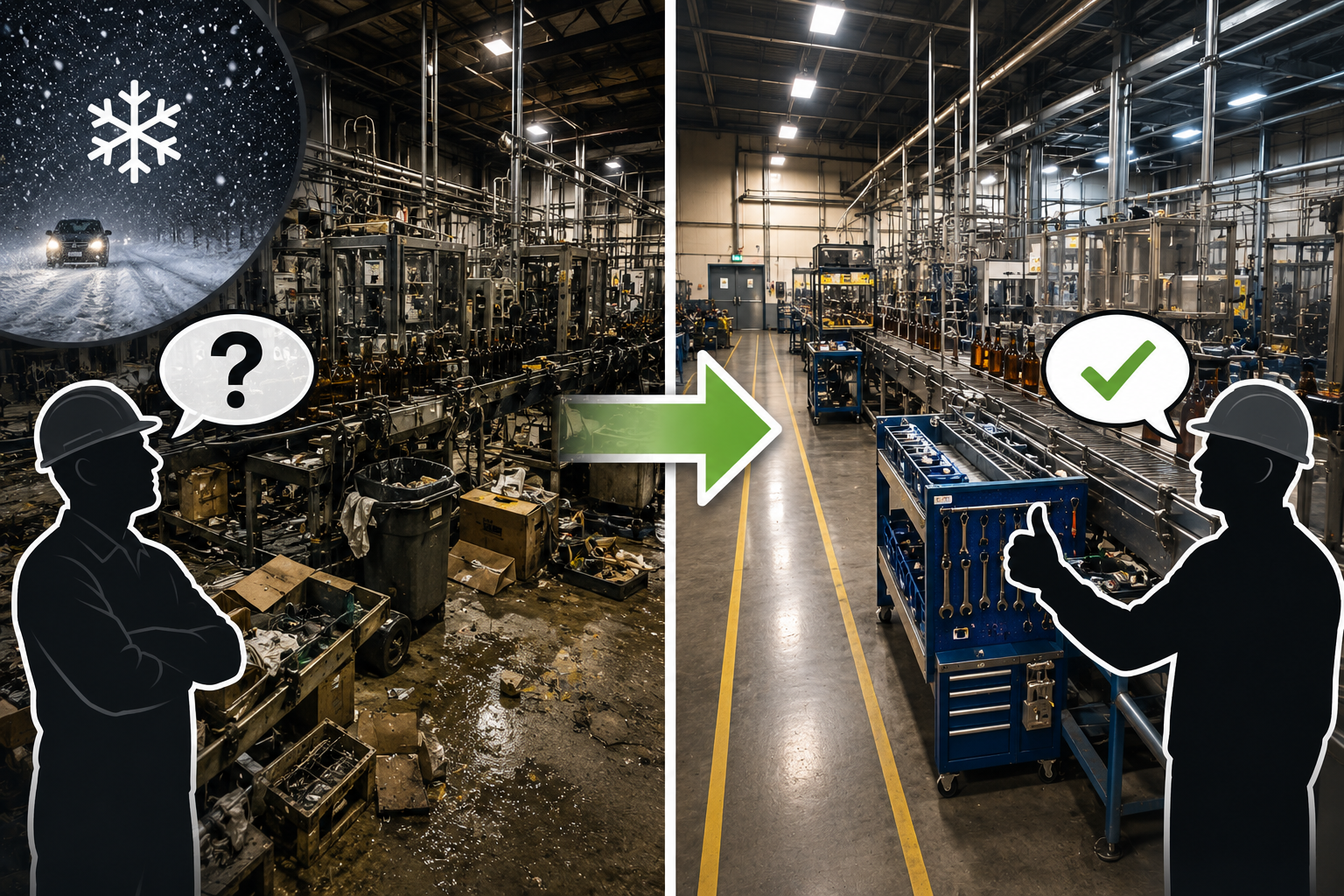
Kaizen Snapshot
Setting: Bottling line at a major beverage manufacturer
Challenge: Reduce lengthy changeovers despite losing nearly half the planned Kaizen to a historic winter storm.
Stakes: Limited time, missing team members, production pressure, and widespread skepticism about improvement efforts.
Approach: SMED training, operator-led process redesign, hands-on implementation, and coaching the production crew through the new process.
Outcome: Changeover time reduced by nearly 50%, operator travel reduced by an estimated 80–90%, and a skeptical employee became one of the strongest advocates for the improvement effort.
Key Lesson: You don't need perfect conditions to achieve breakthrough results.
What Are You Going to Screw Up Today?
The Situation
I was scheduled to facilitate a SMED (Single-Minute Exchange of Die) Kaizen to reduce changeover time on a bottling line at a major manufacturing facility. Like most changeover events, we had a carefully planned four-and-a-half-day schedule.
Then Mother Nature had other ideas. Weather forecasts predicted a major winter storm, so instead of flying in on Sunday as I normally would, I decided to leave a day early. That decision turned out to be the only reason I made it.
My connecting flight was canceled as snow began falling. After scrambling with the airline, I found a flight to Indianapolis, rented a car, and spent nearly three hours driving through a snowstorm to reach my hotel in Kentucky. When I arrived, the roads were covered with snow and ice. The town was nearly deserted. The plant had already shut down. At one point, we weren't even sure the Kaizen would happen.
What Was Getting in the Way
By Sunday, things had only gotten worse. The entire town was effectively closed. Restaurants were closed. The plant remained shut down. Employees couldn't leave their homes.
Our carefully planned schedule disappeared almost overnight. Eventually, leadership decided they would try to restart the facility late Monday afternoon, allowing us to begin the Kaizen on Tuesday if enough team members could safely make it to work.
Even then, several participants were still snowed in. We would have fewer people. Less time. And somehow, we still needed to deliver meaningful results.
What We Did
Tuesday morning finally arrived. The roads were passable. People slowly began making their way into the plant. Some looked genuinely happy just to have survived the drive. Instead of focusing on what we had lost, we focused on what we could still accomplish.
The team learned the principles of SMED before walking the Gemba to observe the current changeover. Operators mapped their movements using spaghetti diagrams. For many, it was the first time they had ever stepped back and looked at the entire process instead of just their own responsibilities. The waste quickly became obvious:
Long walks.
Poor organization.
Equipment that wasn't properly aligned.
No visual controls.
Little standard work.
The team generated improvement ideas and immediately began putting them into practice.
The Breakthrough
While we were observing the first changeover, a machine operator from the neighboring production line kept watching us. Finally, he walked over and asked, "What are you guys going to screw up today?"
Apparently, previous improvement efforts hadn't left him with much confidence. I smiled and replied, "Hopefully nothing. Our goal is simply to help this team make their work easier, safer, and better." He didn't look convinced. But our team was.
As they tested improvements during their own changeovers, something changed. Every success generated another idea. Every improvement inspired another. Despite losing nearly half the planned week, momentum kept building.
What Changed
By the final day, we made what many facilitators might consider a risky decision. Rather than spending the morning polishing our presentation, we invested those hours implementing a few final improvements. Then we handed the process back to the production crew.
Not to demonstrate it. Not to do it for them. To coach them through it. Each Kaizen team member partnered with a crew member, helping them follow the new process while explaining why each change had been made. The crew wasn't simply following instructions. They were learning the new standard from the people who had designed it. That investment paid off.
The production crew completed the changeover in just under half the original time. Spaghetti diagrams showed operator travel had been reduced by an estimated 80 to 90 percent. The line restarted smoothly. The crew looked confident. The improvements were no longer the Kaizen team's. They belonged to the operators.
The Moment That Said It All
Later that day, the same operator from the neighboring line walked over. This time he wasn't skeptical. He smiled and asked, "When can you help my line?"
That single question said more than any metric ever could. Trust had been earned.
The Report-Out
Despite the shortened week, the team delivered one of the most energetic report-outs I've ever witnessed. The excitement was genuine because every improvement had come from the people doing the work. The team leader later commented that in all his years participating in Lean projects and Kaizen events, he had never seen a team so engaged.
What began as a week threatened by weather had become one of the most successful changeover events they'd experienced. Even better, the improvements created a model that could now be replicated across the facility's other production lines.
The Takeaway
Kaizen isn't about having perfect conditions. It's about helping people solve real problems together. Snowstorms, compressed schedules, and missing team members. Those things make improvement harder. They don't make it impossible.
When people own both the problem and the solution, remarkable things can happen—even when the odds aren't in your favor.
Why This Matters
Many organizations delay improvement because they believe they need more time, more resources, or better circumstances. In reality, the greatest breakthroughs often happen when teams stop waiting for perfect conditions and begin improving with what they have.
The goal isn't perfection. The goal is progress. And when people experience that progress firsthand, skepticism turns into ownership—and ownership creates sustainable results.
Ready to Cut Your Changeovers in Half?
Long changeovers aren't usually caused by one big problem. They're the result of hundreds of small inefficiencies that have quietly become accepted over time.
A focused SMED Kaizen helps your team see those opportunities, eliminate unnecessary motion, create better standards, and dramatically reduce downtime—without sacrificing safety or quality.
Schedule a Breakthrough Assessment to discover how much hidden capacity is waiting inside your current changeover process.