
Kaizen Success Stories
Real Manufacturing Results. One Kaizen at a Time
Explore real-world Kaizen success stories showing how manufacturing teams solved critical problems, improved performance, and created sustainable results.
What Are You Going to Screw Up Today?
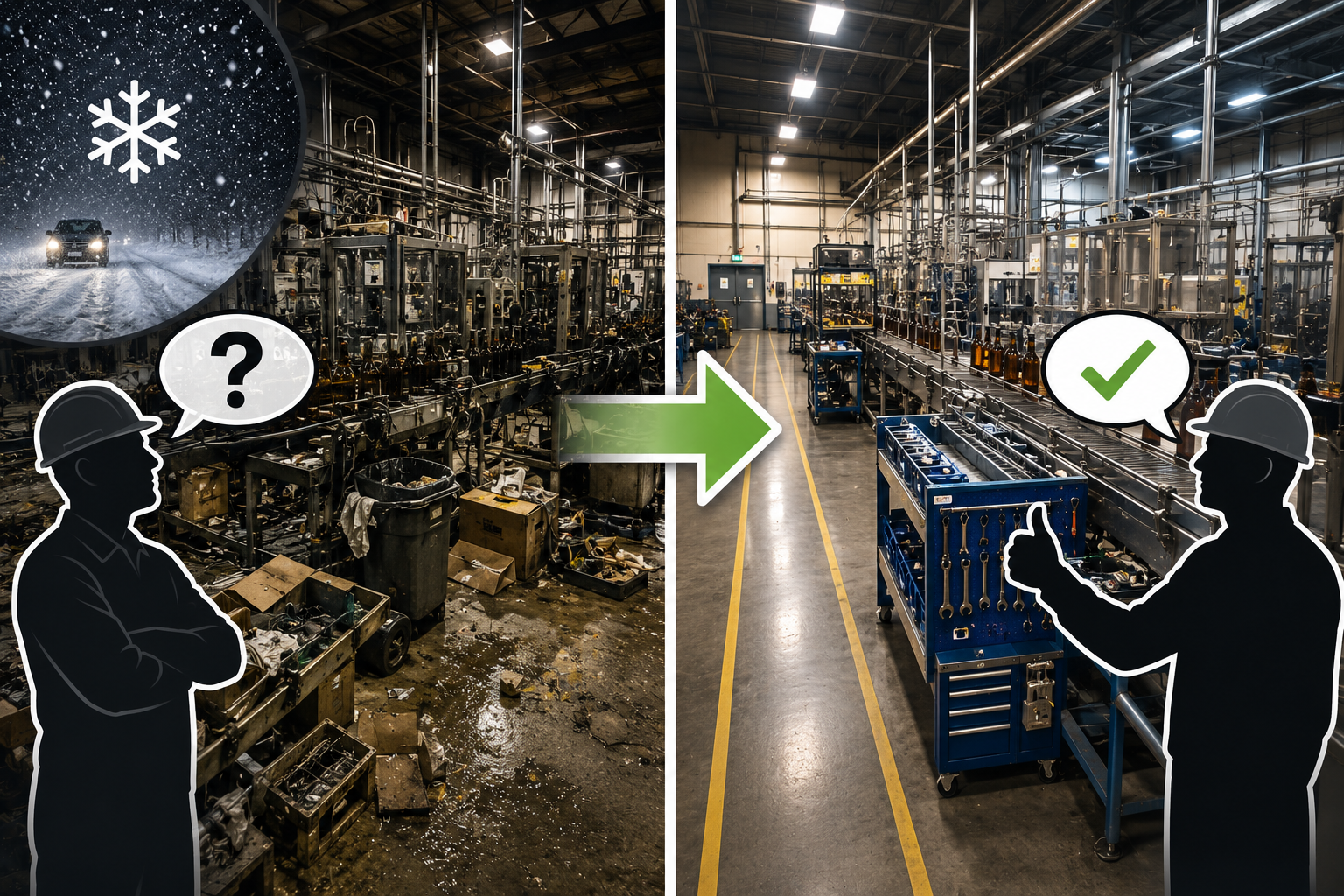
A historic winter storm shut down the plant, stranded team members, and cut a four-and-a-half-day Kaizen nearly in half. Most people would have postponed the event. Instead, the team cut changeover time by nearly 50% and turned one skeptic into one of its biggest supporters.
Kaizen Snapshot
Setting: Bottling line at a major beverage manufacturer
Challenge: Reduce lengthy changeovers despite losing nearly half the planned Kaizen to a historic winter storm.
Stakes: Limited time, missing team members, production pressure, and widespread skepticism about improvement efforts.
Approach: SMED training, operator-led process redesign, hands-on implementation, and coaching the production crew through the new process.
Outcome: Changeover time reduced by nearly 50%, operator travel reduced by an estimated 80–90%, and a skeptical employee became one of the strongest advocates for the improvement effort.
Key Lesson: You don't need perfect conditions to achieve breakthrough results.
What Are You Going to Screw Up Today?
The Situation
I was scheduled to facilitate a SMED (Single-Minute Exchange of Die) Kaizen to reduce changeover time on a bottling line at a major manufacturing facility. Like most changeover events, we had a carefully planned four-and-a-half-day schedule.
Then Mother Nature had other ideas. Weather forecasts predicted a major winter storm, so instead of flying in on Sunday as I normally would, I decided to leave a day early. That decision turned out to be the only reason I made it.
My connecting flight was canceled as snow began falling. After scrambling with the airline, I found a flight to Indianapolis, rented a car, and spent nearly three hours driving through a snowstorm to reach my hotel in Kentucky. When I arrived, the roads were covered with snow and ice. The town was nearly deserted. The plant had already shut down. At one point, we weren't even sure the Kaizen would happen.
What Was Getting in the Way
By Sunday, things had only gotten worse. The entire town was effectively closed. Restaurants were closed. The plant remained shut down. Employees couldn't leave their homes.
Our carefully planned schedule disappeared almost overnight. Eventually, leadership decided they would try to restart the facility late Monday afternoon, allowing us to begin the Kaizen on Tuesday if enough team members could safely make it to work.
Even then, several participants were still snowed in. We would have fewer people. Less time. And somehow, we still needed to deliver meaningful results.
What We Did
Tuesday morning finally arrived. The roads were passable. People slowly began making their way into the plant. Some looked genuinely happy just to have survived the drive. Instead of focusing on what we had lost, we focused on what we could still accomplish.
The team learned the principles of SMED before walking the Gemba to observe the current changeover. Operators mapped their movements using spaghetti diagrams. For many, it was the first time they had ever stepped back and looked at the entire process instead of just their own responsibilities. The waste quickly became obvious:
Long walks.
Poor organization.
Equipment that wasn't properly aligned.
No visual controls.
Little standard work.
The team generated improvement ideas and immediately began putting them into practice.
The Breakthrough
While we were observing the first changeover, a machine operator from the neighboring production line kept watching us. Finally, he walked over and asked, "What are you guys going to screw up today?"
Apparently, previous improvement efforts hadn't left him with much confidence. I smiled and replied, "Hopefully nothing. Our goal is simply to help this team make their work easier, safer, and better." He didn't look convinced. But our team was.
As they tested improvements during their own changeovers, something changed. Every success generated another idea. Every improvement inspired another. Despite losing nearly half the planned week, momentum kept building.
What Changed
By the final day, we made what many facilitators might consider a risky decision. Rather than spending the morning polishing our presentation, we invested those hours implementing a few final improvements. Then we handed the process back to the production crew.
Not to demonstrate it. Not to do it for them. To coach them through it. Each Kaizen team member partnered with a crew member, helping them follow the new process while explaining why each change had been made. The crew wasn't simply following instructions. They were learning the new standard from the people who had designed it. That investment paid off.
The production crew completed the changeover in just under half the original time. Spaghetti diagrams showed operator travel had been reduced by an estimated 80 to 90 percent. The line restarted smoothly. The crew looked confident. The improvements were no longer the Kaizen team's. They belonged to the operators.
The Moment That Said It All
Later that day, the same operator from the neighboring line walked over. This time he wasn't skeptical. He smiled and asked, "When can you help my line?"
That single question said more than any metric ever could. Trust had been earned.
The Report-Out
Despite the shortened week, the team delivered one of the most energetic report-outs I've ever witnessed. The excitement was genuine because every improvement had come from the people doing the work. The team leader later commented that in all his years participating in Lean projects and Kaizen events, he had never seen a team so engaged.
What began as a week threatened by weather had become one of the most successful changeover events they'd experienced. Even better, the improvements created a model that could now be replicated across the facility's other production lines.
The Takeaway
Kaizen isn't about having perfect conditions. It's about helping people solve real problems together. Snowstorms, compressed schedules, and missing team members. Those things make improvement harder. They don't make it impossible.
When people own both the problem and the solution, remarkable things can happen—even when the odds aren't in your favor.
Why This Matters
Many organizations delay improvement because they believe they need more time, more resources, or better circumstances. In reality, the greatest breakthroughs often happen when teams stop waiting for perfect conditions and begin improving with what they have.
The goal isn't perfection. The goal is progress. And when people experience that progress firsthand, skepticism turns into ownership—and ownership creates sustainable results.
Ready to Cut Your Changeovers in Half?
Long changeovers aren't usually caused by one big problem. They're the result of hundreds of small inefficiencies that have quietly become accepted over time.
A focused SMED Kaizen helps your team see those opportunities, eliminate unnecessary motion, create better standards, and dramatically reduce downtime—without sacrificing safety or quality.
Schedule a Breakthrough Assessment to discover how much hidden capacity is waiting inside your current changeover process.

Respect First - Running Kaizen Successfully in a Union Environment
How clarity, respect, and one simple agreement unlocked engagement and protected results.
Kaizen Snapshot
Setting: Unionized distillery in Kentucky
Challenge: Excessive changeover time between bottle sizes
Stakes: Many thousands of additional bottles per year
Approach: Gemba walk, union alignment, Kaizen Waiver
Outcome: Constraints removed, continuity protected, team fully engaged
Key Lesson: Respect builds alignment, even in complex environments
The Situation
I’ve been running Kaizen events for more than 30 years in all kinds of environments, union and non-union alike.
While the rules may differ, one thing never does:
people are people, and everyone deserves to be treated with respect.
During a recent site visit to a distillery in Kentucky, leadership shared their most pressing need: reduce changeover time when switching between bottle sizes.
If we could cut the time in half, the plant would unlock capacity for many thousands of additional bottles each year. The business case was obvious and worth pursuing.
What Was Getting in the Way
The plant was unionized, and two contract constraints surfaced immediately:
Division of labor: Production, maintenance, and management roles were clearly defined. In a Kaizen event, however, everyone needs to test ideas regardless of title.
Overtime by seniority: If overtime was required, a more senior employee could replace a team member mid-event, disrupting continuity and momentum.
I knew from experience that if we didn’t address these issues before the event, the team would be constrained and the results would suffer.
What We Did
In similar environments, I’ve used what I call a Kaizen Waiver, a temporary, transparent agreement that allows:
Any team member to do the work the team needs
Team continuity if overtime is required
My team leader hadn’t used this approach before, so I suggested we take a Gemba walk and meet directly with union leadership.
That’s when we met Sam, the union vice president.
“We’ve tried this before. What are you going to do that other consultants couldn’t?”
I didn’t deflect the question.
I told him exactly what I planned to do:
Listen to the team.
Prioritize improvements that would make the biggest impact on safety, quality, and effort.
Sam’s next concern was one I hear often:
“What happens when you’re gone?”
I explained that if we made the process safer, truly safer, no one would want to go back. And I would rely on both union leadership and plant leadership to hold people accountable to the new standard.
When Sam asked about the contract, I walked him through the Kaizen Waiver and why it was critical to the team’s success.
After thoughtful questions and discussion, he agreed to support the approach.
I asked if he wanted to be on the team. He declined, which was understandable. That would have put him in a difficult position with his membership. But his support was enough.
What Changed
With constraints removed up front, the team was able to:
Fully engage in testing and implementing improvements
Maintain continuity throughout the event
Focus on solving the real problem, not navigating rules
The Kaizen event itself was a success. But more importantly, it was done in a way that respected everyone involved.
The Takeaway
When you explain why you want to work differently, and you do it with respect, alignment is possible.
Union or non-union, Kaizen works best when trust comes first.
Why This Matters
Too many improvement efforts stall because leaders avoid hard conversations or try to work around constraints instead of addressing them directly.
Respect, clarity, and alignment remove friction — and create space for real results.
Ready to Apply This Approach?
If you’re navigating improvement in a complex environment and want results that stick:

A Little Dab Will Do Ya
In 1991, I was offered a line supervisor position at Armstrong’s ceiling grid factory in Franklin Park Illinois. I had been working as a staff Industrial Engineer at Thomasville Furniture in Thomasville North Carolina, so the position would be my first operations supervisory role.
In 1991, I was offered a line supervisor position at Armstrong’s ceiling grid factory in Franklin Park Illinois. I had been working as a staff Industrial Engineer at Thomasville Furniture in Thomasville North Carolina, so the position would be my first operations supervisory role.
I spent my first few months at the plant learning everything I could about the manufacture of ceiling grid and the approach I would take to supervising my small crew of factory workers. The only way I knew to learn was to spend as much time as possible on the factory floor, observing, asking questions, and trying to help where I could.
The factory had eleven separate operating lines and each of them made a variety of products. Each line consisted of an unwind station for coils of steel, roll-formers that bent the coil of steel into the shape of the ceiling grid, and a punch press which stamped out the holes and end details for each piece of grid. Finally, there was a packaging station that assisted the operators as they put the finished pieces in a box.
The lines operated fairly well, with limited downtime, until it was time to change over from one product type to the next. If the shape of the grid was changing, rolls on the roll-former would be switched out. If the size or shape of the product were changing, dies in the press would need to be moved or switched out. The process of changing over was long and drawn out and we never started right up after the changeover. I wanted to know more about this, but typically the highest skilled employees did the changeover and didn’t want to be bothered by my questions.
An Observation In Need of a Solution
After a few months of observing things, I decided that I needed to help somehow. I really wasn’t sure what I could do to help. I decided I would first try to better understand press die setup, as it looked more straight-forward than roll former setup. Spending many hours observing what was happening, I noticed that once the dies were placed in the proper location, they were then tightened using bolts. Then, a bar of grid would be stamped and checked for proper placement of holes, end details, and overall length. Tolerances were tight, so the dies would have to be placed accurately.
Every time this was done, the measurements required that the setup operator make adjustments to the location of the dies. I didn’t understand why this was. Why couldn’t he just find the optimal position, tighten the dies, and be ready to run on the first try? He told me that the dies always moved a bit when tightened and he had to tap them to their final position with a mallet. If things went well, he could do this on one additional attempt. If things went poorly, it could take many attempts which added up to many hours of downtime. I thought to myself, “There must be a way to get the dies set properly on the first try.” I didn’t know what to do. Luckily for me, I was about to take a trip that would change the way I thought about this problem.
I was asked to travel to the new headquarters of our joint venture with Worthington Steel in Malvern Pennsylvania. I like to read bit on airplanes so I looked at the bookshelf in the supervisor’s office and saw a book called, “A Revolution in Manufacturing: The SMED System,” written by Shigeo Shingo. I asked the other supervisor if he had read it and if I could borrow it. He told me that Armstrong bought the book for all of their manufacturing sites in the late 1980’s, but he had never read it. He told me I could take it and keep it if I wanted. So, I took this book with me on the airplane and started reading it.
New Way of Thinking Inspired by Socks
It was like a whole new world had opened up to me. Shigeo Shingo developed a changeover reduction process that is used by companies the world over and even is used during pit-stops at auto races. This was just what I needed. But, where to begin? A story in the book about golf told me what to try first. In the story, Mr. Shingo talks about playing golf and getting blisters on his feet at the end of the day. He loved golf, but didn’t love the blisters that came as a result and decided he must reason out how to eliminate them. He used his problem-solving skills and figured out that the blisters came from the rubbing of his socks on his feet when he was swinging the golf clubs. Why were the socks rubbing on his feet? Because there was less friction between the socks and his sweaty feet than there was between the socks and his shoes, which he had put on quite tightly. How would he resolve this? He figured out that by adding another pair of socks on his feet, he could keep the least friction between the two socks and therefore they would rub against each other, rather than rubbing on his feet. Problem solved; blisters eliminated!
So how does this apply to changeover reduction, you may ask? Now that he saw how reducing friction was beneficial, he decided to apply the same idea to press die setup. He also had a problem with dies moving once they were tightened down. He originally had a bolt and one washer that he used to tighten down dies on a smooth press surface. He noticed that the die would move on the smooth press surface when the bolt was tightened securely. Much like the socks, he decided to add an extra washer to the bolt and put a dab of oil between the two washers, guaranteeing that they would have the least friction of any component in the setup. He tried his idea out and it worked. And now, I had something I could try back at the plant when I returned.
Results Even Skeptics Could Not Ignore
When I got back to my plant, I was excited to share what I had learned with my setup operators. I explained what I had read and they were not impressed. “How do sweaty socks help improve changeover time?” they asked. I said I thought we should try an experiment to see if what I read really did work. One of the operators grudgingly agreed to give it a try. I wanted to make sure that we had real data for our experiment, so I asked him to set up a die in position as he normally would. In this case, we set up dial indicators on two corners of the die. They would be used to show us how much the die moved when tightened to the press. We zeroed out the dial indicators just before he made the final tightening of the bolts on the die. One corner mover .007” and the other moved 010”. That might not seem like a lot of movement, but it is more than we could tolerate and would require him to move the die with a mallet, just as he always had to do.
Now it was time to try the new way. We added a washer to each bolt on the die and put a dab of oil between the two washers on each bolt. We zeroed out the dial indicators just before making the final tightening of the bolts on each die. To our amazement, at the final tightening of each bolt, the washers moved, but the readouts on the dial indicators both read 0! There was no movement of the die. “Let me try that again,” he said, and he did. Once again, there was zero movement of the die. This was a breakthrough. Now the other setup operators wanted to try it for themselves. They couldn’t believe it as one by one each of them saw the dial indicators stay at zero, no matter how hard they tightened the bolts on the dies.
We immediately added washers and oil to the dies waiting to be used on the other lines. Then, we modified the other dies on the production lines after we took them out of the presses following production runs. From then on, every die that was set up in our presses maintained its location, saving valuable time, effort, and reducing frustration. I like to think that I would have figured this out on my own, but I realize that we all get set in our ways and sometimes need a story or two to change our thinking. I don’t play golf, but I now have much greater respect for the game and what can be learned from it.
Overcoming Resistance to Change
Process Improvement Partners was brought in to help a consumer goods manufacturer cut their changeover time (the time it takes to switch tooling and equipment over from one product to another) in half. By doing so, they would be able to reduce inventory and improve process performance.
Process Improvement Partners was brought in to help a consumer goods manufacturer cut their changeover time (the time it takes to switch tooling and equipment over from one product to another) in half. By doing so, they would be able to reduce inventory and improve process performance.
The company has five different shifts operating 24 hours a day, 7 days a week. Each crew believed it had the best approach to changeovers, but the results didn’t show it. There was major variation between and within shifts and none of the crews were able to start up their lines consistently and effectively coming out of a changeover.
The Path to Improvement
Process Improvement Partners recommended a 4 ½ day changeover reduction event, or SMED (Single Minute Exchange of Die) Kaizen, using representation from each of the crews. By doing this, we could identify best practices across all of the crews and teach changeover reduction techniques to be shared once the Kaizen was over. The leadership team agreed, and we began preparations for this critical event.
Our leader, the Operations Manager for the production line, picked a team of “All Stars” to participate in the Kaizen. He felt their experience, creativity, and enthusiasm would lead us to a win.
This was the first changeover reduction Kaizen in the history of the plant, and the team was skeptical when we stated our objective: cut the existing changeover time in half, without increasing safety risk to the crew or quality risk to their customers. The team members assumed this meant they would have to rush around, with intense pressure to meet the new target time. The truth was using SMED techniques, we would be able to reduce enough waste in the existing changeover process to take significant time out and reduce safety and quality risk. Then, using the Wheel of Sustainability, we would be able to continue to get great results for years to come.
Turning Skepticism into Excitement
The first day of the Kaizen, we taught the four step SMED methodology (with a little spin from Process Improvement Partners):
1. Assess the current changeover and identify steps that must be done while the line is shut down (internal steps) and steps that are done while the line is still running (external steps)
2. Convert any internal steps to external steps
3. Streamline any remaining internal steps and then any external steps
4. Eliminate any adjustments and put in all aspects of the Wheel of Sustainability
For step one, we videotaped the changeover, did some motion analysis, and made numerous observations of waste. The team was excited to see opportunity they hadn’t realized existed. They never had stepped back and watched what was happening, as they always had to participate in the changeovers.
As we entered step two, the team prioritized the steps they thought could be converted from internal to external. Their creativity helped them invent and build a number of jigs and fixtures that allowed work to be done in preparation for the changeover, while the line was still running. By the morning of the third day, the team tested their efforts and found the time required to change the line over had already been reduced by 50%. They weren’t satisfied, there was much more they felt they could do.
For the rest of the third day and part of the fourth day, the team worked on improvements to streamline remaining internal steps, found ways to eliminate adjustments, and created visuals to help all team members do the changeover the same way every time. Now it was time to give the changes the ultimate test: let another crew try the new changeover procedure.
Working Through Opposition
Each team member was assigned a crew member who wasn’t on the team. They were assigned to review and teach them the new method and answer any questions or concerns. They were sent out onto the factory floor and had approximately 1 ½ hours to teach and discuss the new methods and approach one on one. After a while, one of the team members came into the meeting room and asked for my help. Her assigned crew member was not interested in participating in the test of our new changeover procedure. I came out on the floor to find out if I could help the situation.
The crew member, let’s call him Roy, was visibly upset, so I asked him what was bothering him. He started yelling at me, saying we hadn’t listened to him or anyone else on his crew, didn’t videotape their changeover, and generally didn’t care what they thought. I told him the team had representation from every crew and had done their best to use the best practices from each shift as we worked during the week. He was having none of it. I let him know that we needed to let someone other than the team try out the new method, so we could get feedback and make improvements to it, before locking in all of our changes. His anger grew. I knew I needed to do something extreme, or he would be lost and we wouldn’t learn what was needed to finalize our new procedure.
I asked, “Are you telling me you’re unwilling to try the new procedure?” Roy realized he was being asked if he was being insubordinate, which is a disciplined offense in most companies. He answered he was willing to try the new procedure, but just wanted to voice his protest about the lack on inclusion. I told him I respected his opinion and thanked him for his willingness to try the new approach.
Testing the New System
At 4:30 pm, we gathered all crew members to explain the new procedure, set the expectations for them to follow it to the letter, and would give them the opportunity to provide feedback once the changeover was complete. We would also pair a team member from the Kaizen team with each crew member, so they could be coached during the changeover, just in case they didn’t remember or understand the new steps or approach. All crew members affirmed their commitment to try the new procedure, and we started the new changeover at approximately 4:40 pm.
Three minutes into the changeover something didn’t look right. One of our Kaizen team members, let’s call her Julia, looked extremely uncomfortable. I took her a few feet away from her assigned crew member and asked her if her assigned crew member wasn’t following the new procedure. She nodded and I called the Kaizen team leader over, to talk about what was happening. He wasn’t happy and we agreed to stop the changeover immediately.
We gathered the crew back together, explained what was wrong, why it wasn’t ok to try their own procedure as we wouldn’t learn anything if they did. We then instructed them to put the line back to its original condition before the changeover. After that, we would start the changeover again. There was tension in the air.
At approximately 5:00 pm, we started the changeover for the second time. In two minutes, one of the Kaizen team members, let’s call him Jack, came over and informed me his assigned crew member wasn’t following the new procedure. We stopped the changeover again, gathered the crew, and in an impassioned way, did our best to convince them to try it the right way, or we would do this all night. Would things work out on the third try?
We started out third attempt at 5:10 pm and this time everyone followed the new procedure to the letter. You could see the tension fade away from the Kaizen team members. Now, something else was creeping in. The team had been working since 6:30 am and they were getting tired. 65 minutes later, the changeover was complete. Now it was time to bring the crew into the meeting room and get their feedback and reaction to the new procedure. I was wondering how Roy and his crew mates would respond to the new procedure and the two stoppages we imposed on them when they tried to go “rogue”.
A Surprising Conclusion
In the meeting room, I set up a flip chart and gathered all crew members around a table. I asked each of them to tell us, one at a time, what they thought, identifying out the things they liked and the things we could improve for them. As they spoke, I would write their comments on a flip chart for everyone to see.
Roy started out the feedback session by telling us he “loved” four very specific improvements the team had made. He also offered some constructive feedback on some simple things we could improve. Others had the opportunity to share their feedback, and all of them had positive and constructive things to say. I have to admit I was a bit shocked at the change in the tone in the room. I had figured the crew would save up all of their anger for the meeting room. Instead, they were appreciative for all of the Kaizen team’s efforts. They had realized our Kaizen team was doing their best for everyone in the crew, and the test proved it to them.
We thanked the crew and the Kaizen team, and sent everyone back to the line or home. There were many handshakes and high-fives before they left.
At the report out to leadership, the team remarked how important it was to get everyone’s input and also to test out new ideas with a group that wasn’t involved in the changes. It illustrated how difficult change can be, as most people tend to expect the worst and hope for the best. Since then, the line has been able to sustain the reduced changeover time and has many more believers in changeover reduction and Kaizen.

Go See for Yourself – The Best Selling Tool There Is
In 2006, our Kaizen team was working on improving changeover time for a painting operation. After reviewing changeover reduction techniques with the team, we took a walk to the line to observe a changeover. The team watched the paint technician clean the front of the paint booth with water for approximately 10 minutes. After that, he walked behind the booth for a few minutes and then came back to work on the front of the paint booth. None of the team members had followed him to see what he had been doing in the back of the booth.
In 2006, our Kaizen team was working on improving changeover time for a painting operation. After reviewing changeover reduction techniques with the team, we took a walk to the line to observe a changeover.
The team watched the paint technician clean the front of the paint booth with water for approximately 10 minutes. After that, he walked behind the booth for a few minutes and then came back to work on the front of the paint booth. None of the team members had followed him to see what he had been doing in the back of the booth.
After the changeover was complete, we asked the paint technician to demonstrate what he had been doing in the back of the paint booth. To our horror, he had to squeeze his body between a post and a wall, make his way to the paint tanks, stand on a natural gas line, twist his body, and reach above his head to open a valve on a paint tank. He told us, “This is the way it had always been done since the plant was opened [in 1990].”
A change was necessary, but the equipment had been installed this way and our small team would not be able to move equipment or automate valves in the short time we had during the Kaizen. We knew we had to sell the idea to the leadership team and identify safety and financial reasons for the change.
Luckily for us, each of the paint booths had some automation built in, so we wouldn’t have to install control systems from scratch. As a team, we decided that if we could automate the opening and closing of the valves on three paint tanks, we could eliminate the need for paint technicians to put themselves at risk while opening and closing the valves. We had an electrical engineer on the team, so while we worked on other aspects of the changeover time reduction, we asked him to develop engineering estimates for the valve automation.
Normally, engineers want to do research and build estimates with high levels of accuracy when they present their findings. But, in the spirit of Kaizen, he was willing to put together a cost estimate with an error of +/- 25% in a day. He came back with the cost estimate and we decided how we would sell our idea to the leadership team.
During the Kaizen, we worked on simplifying procedures, accessibility of tools, and the overall coordination of work by all technicians during the changeover. None of these things cost money, but they reduced the overall changeover time by more than 50 percent. We had accomplished our Kaizen objective.
On the day of the report out, we gave a tour of the new changeover procedure to the attendees. Our hope was to highlight the success of the team and the need for the automation. Eight leadership team members joined us for the report out. We began by thanking them for joining us and then explained the changes we had made. We then invited them to see the new changeover procedure.
We started in the front of the paint booth and demonstrated the simpler procedure. Then, it was time to take them to the back of the booth to see what was actually happening. One by one, they ascended and descended the stairs that crossed over the line to get to the back of the booth. They squeezed past the post and wall one by one. One of the team members showed what was necessary to open and close valves. From the looks on the faces of the leadership team, they were unaware of what was happening in the back of the booth during changeovers. The operations manager said, “we need to automate these valves as our top priority.” Right on cue, our electrical engineer presented the cost estimate and got immediate approval.
Within three months of the Kaizen, the automated valves were installed and a 16-year problem was corrected. If someone had walked the line with the paint technicians when the plant was being built, this issue would have been avoided. The best way to understand what’s going on is to go see for yourself.

Improving Changeover Time in 4 Simple Steps
Have you ever watched an auto race? If so, you probably noticed what happens when a car enters Pit Row and is tended to by a whole team of people trying to get it back on the track as fast as possible. If you wondered how they knew what to do and how they didn’t get in each other’s way, the answer is SMED.
Have you ever watched an auto race? If so, you probably noticed what happens when a car enters Pit Row and is tended to by a whole team of people trying to get it back on the track as fast as possible. If you wondered how they knew what to do and how they didn’t get in each other’s way, the answer is SMED.
SMED stands for Single Minute Exchange of Die. It was developed by Dr. Shigeo Shingo in the 1960’s and 1970’s on behalf of Toyota. Dr. Shingo was interested in reducing the time and effort that it took to change a production line from one product to the next. By intense study and trial and error, he developed a 4-step method to drive all changeovers down to less than 10 minutes, thus coining the term single minute exchange of die. For auto racers, they use SMED to improve their auto changeover times and have achieved times below 15 seconds.
Changeover reduction is a team sport, just like in NASCAR, so picking the right team is critical. Bring people together who have had experience with the changeover being studied, use their differing opinions and techniques and encourage sharing and learning. By doing this and applying SMED, you should be able to reduce changeover time by more than 50%. You should also be able to improve the safety of the changeover for everyone.
STEP 1 – Identify All Elements of the Existing Changeover
The first step in SMED is to identify all elements of the existing changeover. This is done by observing the changeover as it occurs. Use a changeover that is typical for the process. Teams use tools such as a stop watch, video, and spaghetti diagram to truly understand everything that is happening during the changeover. Rather than just discussing things, they observe the changeover and then discuss it to better understand the current situation. It is also not unusual for team members to mimic the steps of the changeover so they can see the impact and difficulty of the changeover for themselves.
The spaghetti diagram is a paper exercise that shows everywhere a person travels during the changeover, whether it is to get tools, information, or do work on equipment. To use it, you should have a general layout of the area being worked on, then place a pen or pencil on the layout, moving it to the places that the worker moves during the changeover. Don’t lift the pen or pencil. If there is more than one worker performing the changeover, there should be more people creating the spaghetti diagram. At the end of that exercise, the lines on the page tend to look like spaghetti and people are amazed at the amount of travel required to complete the changeover.
STEP 2 – Separate All Elements into External and Internal
The next step in SMED is to identify what steps or elements can be performed while the line is running (External elements) and what steps must be performed while the line is down and waiting (Internal elements). Process Improvement Partners saw an example of this in one of our sessions. After a production run was completed, the press was shut off, a die was removed, the die was returned to storage, and the new die was brought back to the press from the storage area. At that point, every step was Internal, meaning that the line was not running while each step was completed. However, the team soon realized that the retrieving of the new die could have been done in advance of the changeover and the storage of the other die could be done after the line was back up and running. The team identified all of the elements that were external, and this step saved more than 25% of the changeover time.
STEP 3 – Convert Internal Elements to External Elements
The third step challenges the team’s creativity and they start to devise ways of doing some of the changeover steps that originally had to be done while the line is down and finding ways of completing them while the line is still running. A team we worked with created a fixture that allowed parts to be positioned for installation prior to the line stopping. This saved a significant amount of time and the fixture was built with existing materials, so no money was spent. Another example is to connect a tool to the equipment, so that it is immediately accessible to do the work once the line has been stopped. There are so many examples of this that teams can do research through the internet to get ideas, or they can visit other manufacturers to see the ideas in action.
STEP 4 – Streamline All Elements
In this step, the team thinks of ways of shortening time and effort required to do any remaining elements. They prioritize and work on the internal elements first, and then work on any of the external elements that have opportunity for improvement. This is a great time to look at the video and the spaghetti diagram again and see if the amount of travel can be reduced by the repositioning of tools, materials, and equipment, or if another sequence would be more efficient. Trial the new procedure, redraw the spaghetti diagram, and get the input of all team members to ensure that the new steps are truly better for them.
Once all steps of SMED have been completed, the team should observe the new changeover procedure and verify that it is truly an improvement. Time is one measurement, but effort, travel, and the anecdotal input of those performing the new changeover procedure are also important. People need to feel that the new way is better than what they had been doing personally. Because change is difficult, the team needs to develop methods to sustain the improvements that they created. Once they do so, they will realize the benefits of their efforts.