
Kaizen Success Stories
Real Manufacturing Results. One Kaizen at a Time
Explore real-world Kaizen success stories showing how manufacturing teams solved critical problems, improved performance, and created sustainable results.
What Are You Going to Screw Up Today?
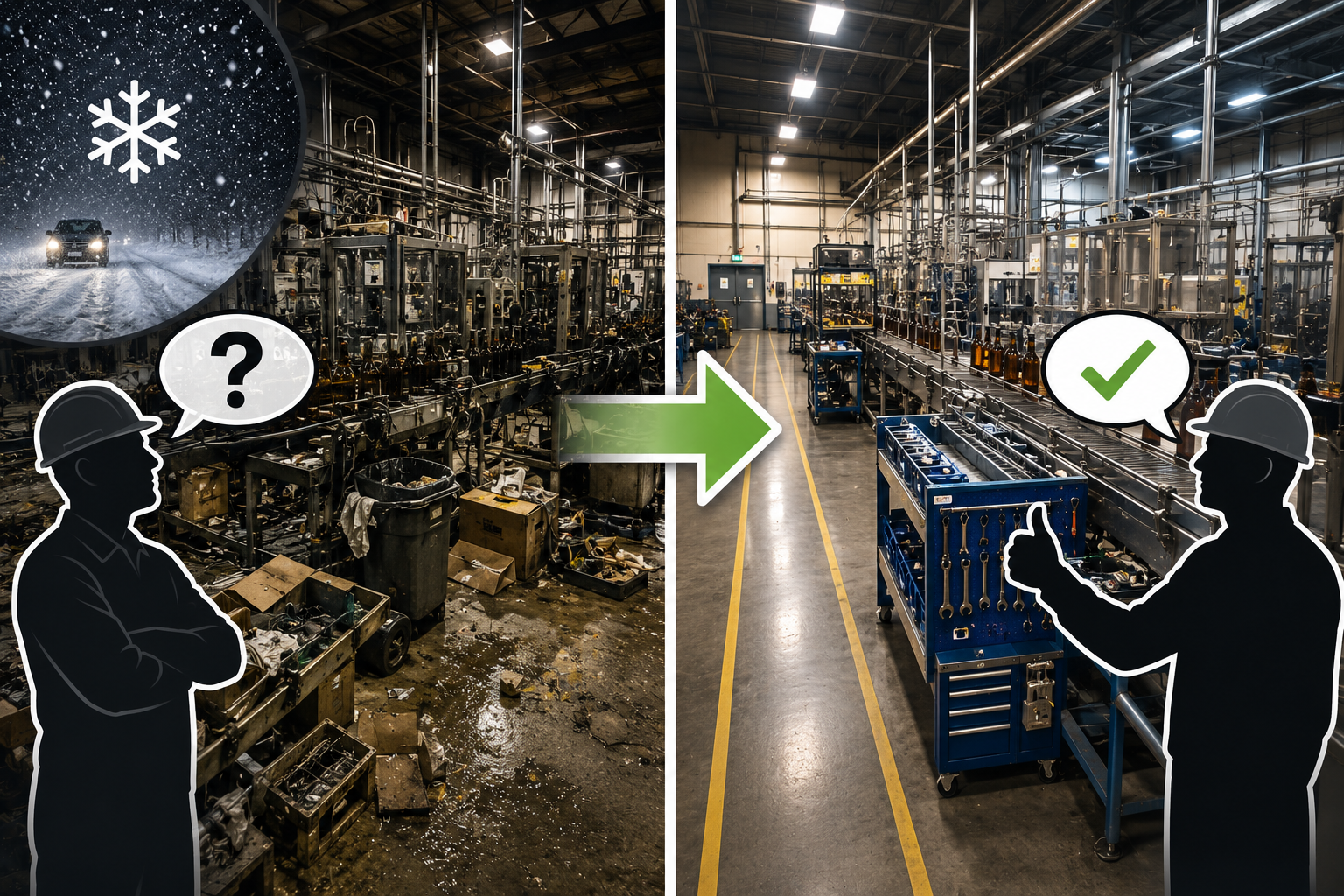
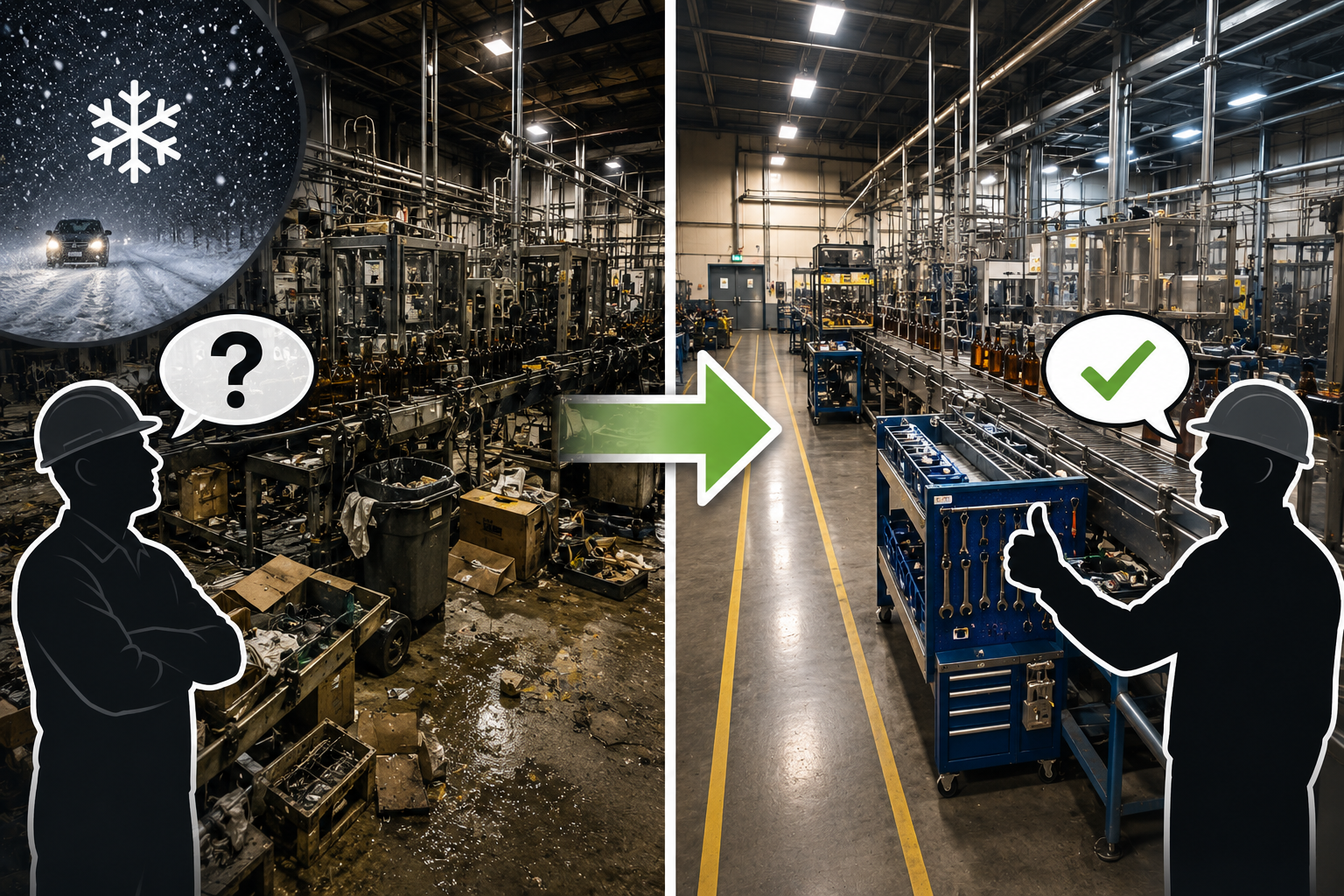
A historic winter storm shut down the plant, stranded team members, and cut a four-and-a-half-day Kaizen nearly in half. Most people would have postponed the event. Instead, the team cut changeover time by nearly 50% and turned one skeptic into one of its biggest supporters.
Kaizen Snapshot
Setting: Bottling line at a major beverage manufacturer
Challenge: Reduce lengthy changeovers despite losing nearly half the planned Kaizen to a historic winter storm.
Stakes: Limited time, missing team members, production pressure, and widespread skepticism about improvement efforts.
Approach: SMED training, operator-led process redesign, hands-on implementation, and coaching the production crew through the new process.
Outcome: Changeover time reduced by nearly 50%, operator travel reduced by an estimated 80–90%, and a skeptical employee became one of the strongest advocates for the improvement effort.
Key Lesson: You don't need perfect conditions to achieve breakthrough results.
What Are You Going to Screw Up Today?
The Situation
I was scheduled to facilitate a SMED (Single-Minute Exchange of Die) Kaizen to reduce changeover time on a bottling line at a major manufacturing facility. Like most changeover events, we had a carefully planned four-and-a-half-day schedule.
Then Mother Nature had other ideas. Weather forecasts predicted a major winter storm, so instead of flying in on Sunday as I normally would, I decided to leave a day early. That decision turned out to be the only reason I made it.
My connecting flight was canceled as snow began falling. After scrambling with the airline, I found a flight to Indianapolis, rented a car, and spent nearly three hours driving through a snowstorm to reach my hotel in Kentucky. When I arrived, the roads were covered with snow and ice. The town was nearly deserted. The plant had already shut down. At one point, we weren't even sure the Kaizen would happen.
What Was Getting in the Way
By Sunday, things had only gotten worse. The entire town was effectively closed. Restaurants were closed. The plant remained shut down. Employees couldn't leave their homes.
Our carefully planned schedule disappeared almost overnight. Eventually, leadership decided they would try to restart the facility late Monday afternoon, allowing us to begin the Kaizen on Tuesday if enough team members could safely make it to work.
Even then, several participants were still snowed in. We would have fewer people. Less time. And somehow, we still needed to deliver meaningful results.
What We Did
Tuesday morning finally arrived. The roads were passable. People slowly began making their way into the plant. Some looked genuinely happy just to have survived the drive. Instead of focusing on what we had lost, we focused on what we could still accomplish.
The team learned the principles of SMED before walking the Gemba to observe the current changeover. Operators mapped their movements using spaghetti diagrams. For many, it was the first time they had ever stepped back and looked at the entire process instead of just their own responsibilities. The waste quickly became obvious:
Long walks.
Poor organization.
Equipment that wasn't properly aligned.
No visual controls.
Little standard work.
The team generated improvement ideas and immediately began putting them into practice.
The Breakthrough
While we were observing the first changeover, a machine operator from the neighboring production line kept watching us. Finally, he walked over and asked, "What are you guys going to screw up today?"
Apparently, previous improvement efforts hadn't left him with much confidence. I smiled and replied, "Hopefully nothing. Our goal is simply to help this team make their work easier, safer, and better." He didn't look convinced. But our team was.
As they tested improvements during their own changeovers, something changed. Every success generated another idea. Every improvement inspired another. Despite losing nearly half the planned week, momentum kept building.
What Changed
By the final day, we made what many facilitators might consider a risky decision. Rather than spending the morning polishing our presentation, we invested those hours implementing a few final improvements. Then we handed the process back to the production crew.
Not to demonstrate it. Not to do it for them. To coach them through it. Each Kaizen team member partnered with a crew member, helping them follow the new process while explaining why each change had been made. The crew wasn't simply following instructions. They were learning the new standard from the people who had designed it. That investment paid off.
The production crew completed the changeover in just under half the original time. Spaghetti diagrams showed operator travel had been reduced by an estimated 80 to 90 percent. The line restarted smoothly. The crew looked confident. The improvements were no longer the Kaizen team's. They belonged to the operators.
The Moment That Said It All
Later that day, the same operator from the neighboring line walked over. This time he wasn't skeptical. He smiled and asked, "When can you help my line?"
That single question said more than any metric ever could. Trust had been earned.
The Report-Out
Despite the shortened week, the team delivered one of the most energetic report-outs I've ever witnessed. The excitement was genuine because every improvement had come from the people doing the work. The team leader later commented that in all his years participating in Lean projects and Kaizen events, he had never seen a team so engaged.
What began as a week threatened by weather had become one of the most successful changeover events they'd experienced. Even better, the improvements created a model that could now be replicated across the facility's other production lines.
The Takeaway
Kaizen isn't about having perfect conditions. It's about helping people solve real problems together. Snowstorms, compressed schedules, and missing team members. Those things make improvement harder. They don't make it impossible.
When people own both the problem and the solution, remarkable things can happen—even when the odds aren't in your favor.
Why This Matters
Many organizations delay improvement because they believe they need more time, more resources, or better circumstances. In reality, the greatest breakthroughs often happen when teams stop waiting for perfect conditions and begin improving with what they have.
The goal isn't perfection. The goal is progress. And when people experience that progress firsthand, skepticism turns into ownership—and ownership creates sustainable results.
Ready to Cut Your Changeovers in Half?
Long changeovers aren't usually caused by one big problem. They're the result of hundreds of small inefficiencies that have quietly become accepted over time.
A focused SMED Kaizen helps your team see those opportunities, eliminate unnecessary motion, create better standards, and dramatically reduce downtime—without sacrificing safety or quality.
Schedule a Breakthrough Assessment to discover how much hidden capacity is waiting inside your current changeover process.
From Compliance to Confidence
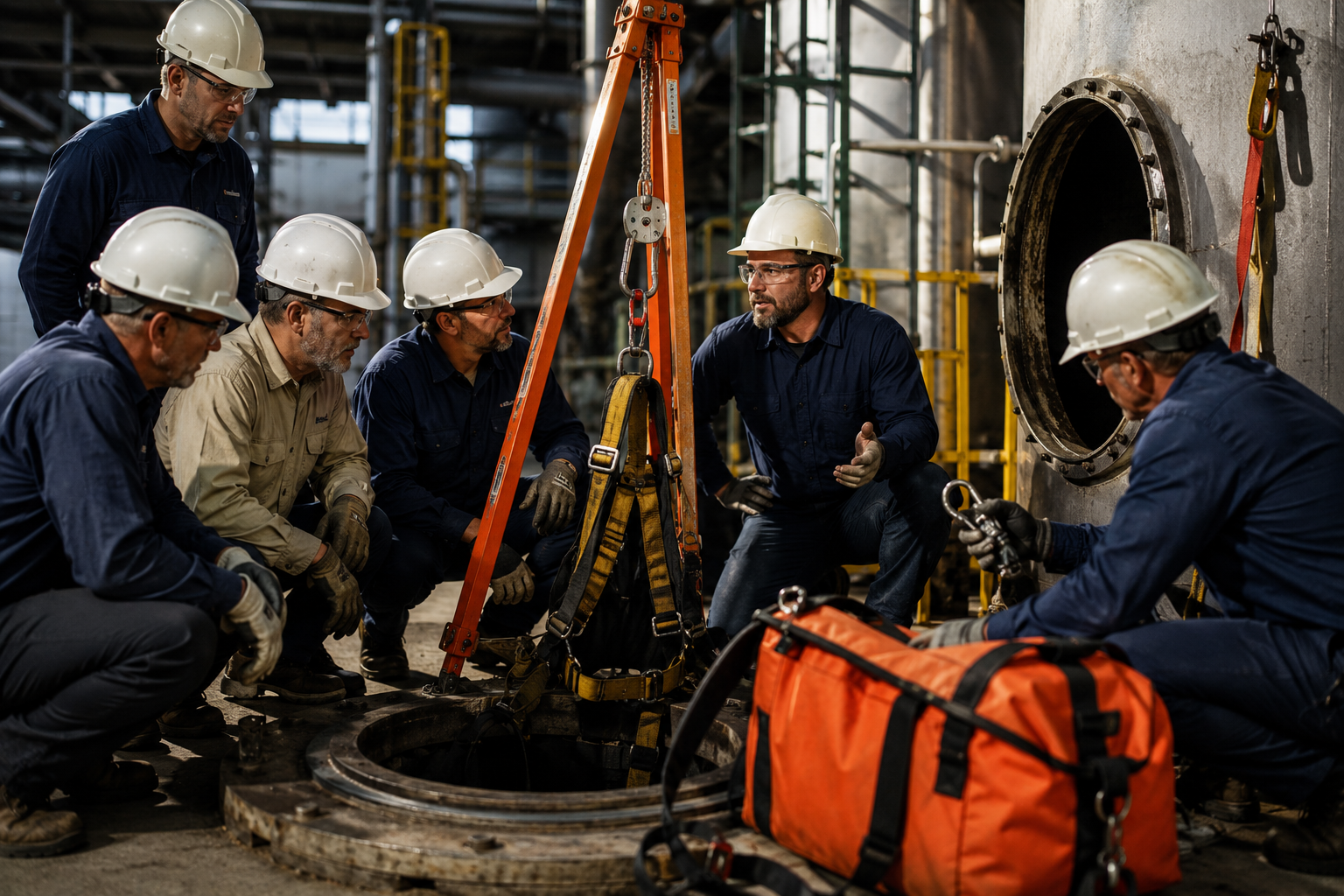
How a paper mill eliminated critical safety risks and created a sustainable confined-space system in one week
Kaizen Snapshot
Industry: Paper Manufacturing
Challenge: Confined Space Entry and Rescue Compliance
Approach: Kaizen Event Facilitation focused on standardization, risk reduction, and rapid implementation
Results:
90 confined spaces identified and brought into compliance
Approximately 15 previously unidentified confined spaces discovered
Standardized signage developed and installed
Training requirements defined and implemented
Hazard identification standards created for every confined space
Rescue capability improved for all employees, including specialized equipment for a 300+ pound team member
Rescue equipment organized using 5S for rapid access
The Situation
A paper mill in Oklahoma faced a significant safety challenge.
The facility needed to ensure that every confined space met entry and rescue requirements.
Before the Kaizen event began, the team believed they had identified between 75 and 80 confined spaces throughout the mill.
The goal seemed straightforward: verify compliance and close any gaps.
What the team discovered was something very different.
What We Found at the Gemba
After learning the fundamentals of Lean thinking and waste identification, the ten-person Kaizen team headed to the floor.
The facility consisted of two major operations:
The paper mill
The converting operation that produced tissue, paper towels, and toilet paper
The Oklahoma summer heat was relentless.
Temperatures exceeded 90 degrees as the team spent nearly four hours walking the entire facility.
They inspected every area, questioned assumptions, and challenged the existing inventory.
By the end of the walk, they realized the actual number of confined spaces wasn't 75 or 80.
It was 90.
Approximately 15 confined spaces had never been included in the official inventory.
The challenge had just become much larger.
What We Did
The team quickly identified three elements that were essential for compliance:
Signage
Every confined space needed clear, consistent visual identification and entry requirements.
Training
Employees needed a standardized understanding of confined space entry procedures and rescue expectations.
Hazard Identification
Each confined space required a clear understanding of the risks associated with entry.
The team divided into three focused sub-teams and developed standards for each area simultaneously.
Rather than tackling one confined space at a time, they built systems that could be applied across the entire facility.
The Hidden Safety Risk
As the team worked through compliance requirements, another issue surfaced.
One employee regularly worked in confined spaces and weighed more than 300 pounds.
The existing rescue equipment could not safely recover him in the event of an emergency.
Fortunately, a rescue had never been required.
But everyone recognized that hoping nothing would happen was not an acceptable safety strategy.
The team immediately addressed the issue.
They identified rescue equipment with a 500-pound capacity, secured approval, and purchased the equipment during the Kaizen event.
Before the week ended, the equipment had arrived on-site and was stored in a location where it could be accessed quickly if ever needed.
The team also applied 5S principles to organize all rescue equipment, making emergency response faster and more reliable.
The Results
By the end of the week:
MeasureResultConfined Spaces Identified90Previously Unidentified Spaces Found~15Confined Spaces Brought into Compliance90Standardized Signage Implemented100%Training Standards DevelopedCompleteHazard Identification Standards CreatedCompleteRescue Equipment UpgradedCompleteRescue Equipment Organized Using 5SComplete
What appeared to be an overwhelming challenge on Monday became a completed mission by Friday.
The Most Important Result
The biggest accomplishment wasn't compliance.
It was confidence.
At the beginning of the week, the team viewed the challenge as nearly impossible.
The scope was unclear.
The inventory was incomplete.
Critical rescue gaps existed.
Yet by working together, dividing responsibility, and focusing on solutions instead of obstacles, the team achieved something that initially seemed out of reach.
They didn't just identify problems.
They solved them.
And they left behind systems that would protect employees long after the event was over.
Key Lesson
Safety improvement doesn't happen because organizations care about safety.
It happens when teams translate good intentions into clear standards, proper equipment, and disciplined execution.
In one week, a team of ten people transformed an overwhelming compliance challenge into a sustainable safety system.
That's what becomes possible when the right people are empowered to solve the right problem.

When My Design Didn't Win
I believed I had designed a better solution. Leadership chose a different direction. What happened next taught me one of the most valuable leadership lessons of my career: once the decision is made, your job is no longer to be right, it's to help the team succeed.

Kaizen Snapshot
Setting: Armstrong World Industries – Pensacola Integration Project
Challenge: Help redesign and integrate multiple production lines into a single-flow manufacturing system while supporting a design direction I didn't believe was the best option.
Stakes: Millions of dollars in capital investment, worker safety, operational flow, changeover efficiency, and long-term plant performance.
Approach: Challenge the proposed design with a thoughtful alternative, support leadership's final decision, and focus on making the chosen solution as successful as possible.
Outcome: The integrated production system launched successfully, numerous changeover improvements were implemented, and several innovations were later adopted at other Armstrong facilities.
Key Lesson: Great leaders aren't defined by whether their ideas are selected. They're defined by what they do after the decision has been made.
When My Design Didn't Win
The Situation
Early in my career as a Corporate Industrial Engineer for Armstrong World Industries, I was invited to join one of the company's largest manufacturing redesign efforts.
Known as the Pensacola Integration Project, the initiative would connect multiple production lines into a single, continuous flow system at the Pensacola, Florida plant. Instead of moving product in batches between disconnected operations, the new design would allow material to flow much more smoothly through the manufacturing process.
It was an exciting project. It was also one where I quickly developed a different opinion than the rest of the design team.
What Was Getting in the Way
As the engineering team refined the layout, one section of the proposed design concerned me. I believed there was a safer, simpler, and more efficient way to accomplish the same objective. Rather than quietly disagreeing, I shared my concerns with the project manager and the plant's Industrial Engineering manager. To their credit, they listened.
Although the project was already well underway, they encouraged me to develop an alternative layout and present it to the leadership team. Over the next several weeks, I invested significant time refining what I believed would create better flow, improve safety, and reduce the need for elevated platforms throughout that section of the plant.
Eventually, I had the opportunity to present my proposal. Leadership appreciated the effort. They liked portions of the concept. But after careful consideration, they chose to stay with the original design.
The Decision
I'll be honest, I was disappointed. Like many engineers early in their careers, I was passionate about my ideas and believed they would create a better result. But I also recognized something important. Leadership had listened. They had seriously considered my recommendation. They simply made a different decision. At that moment, my responsibility changed.
Until that meeting, my job had been to improve the design. After that meeting, my job became making the chosen design as successful as possible.
What We Did
Once the decision was made, I stopped trying to convince people to revisit the debate. Instead, I redirected all of my energy toward improving the selected design. Working alongside the project team, we simplified work areas, improved changeover methods, and identified ways to make the new production system safer and easier for operators.
I was also given responsibility for designing changeover equipment that would support the new integrated manufacturing process. Rather than dwelling on the design that wasn't selected, I focused on making the design that was selected perform as well as it possibly could.
The Breakthrough
Something unexpected happened. Once I let go of proving my idea was better, I became a stronger contributor to the project. Instead of dividing the team by continuing yesterday's debate, we became united around tomorrow's success. The energy shifted from defending decisions to improving execution. And that's where the real breakthroughs occurred.
Several of the changeover improvements our team developed during the project proved so effective that they were later adopted at other Armstrong manufacturing facilities.
What Changed
When the integrated production system finally started up, the project was successful. The new manufacturing flow performed well. Operators appreciated many of the improvements incorporated into their daily work. The changeover innovations created during the project continued spreading throughout the company's manufacturing network.
Looking back, I'm proud of the design I proposed. But I'm even more proud of the decision I made after it wasn't selected. That lesson has stayed with me throughout my career.
The Takeaway
Every leader will eventually experience the same moment. You present your best idea. Leadership chooses another direction. At that point, you have a choice.
Continue fighting yesterday's decision or become fully committed to making today's decision successful. Alignment often creates more value than proving you were right.
Why This Matters
Many organizations lose momentum because people continue debating decisions that have already been made. Healthy disagreement is valuable. Strong debate produces better thinking.
But once leadership has listened, evaluated the options, and chosen a direction, organizational success depends on everyone pulling together. The strongest leaders aren't the ones whose ideas always win. They're the ones who help the team win even when the final decision isn't their own.
That lesson shaped the way I've approached leadership, Kaizen facilitation, and organizational transformation ever since.
Ready to Build Greater Leadership Alignment?
The biggest obstacles to transformation are rarely technical. More often, they're organizational. When leaders align around a shared direction and commit to making it successful, teams move faster, collaborate better, and sustain improvements longer.
If you're looking to strengthen leadership alignment before your next major initiative, let's start with a Breakthrough Assessment and identify the opportunities that will have the greatest impact.
The Week They Kept Moving the Goalposts
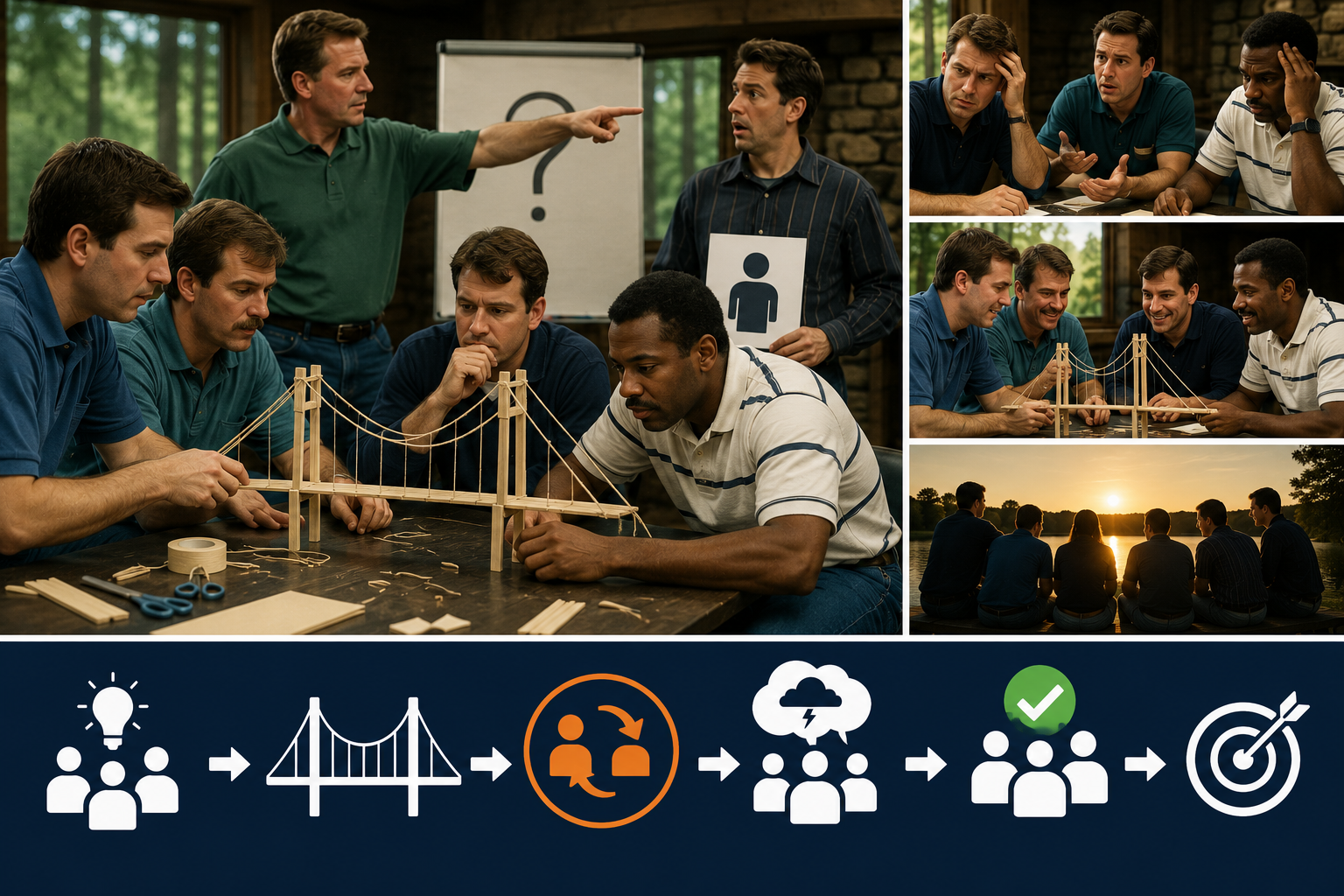
I expected a week of management training. Instead, I spent five days having the rules changed, my plans disrupted, and my assumptions challenged. It became one of the most valuable leadership lessons of my career and one that still shapes every Kaizen event I facilitate today.
Kaizen Snapshot
Setting: Worthington Armstrong Venture (WAVE) management development program
Challenge: Learn a new management philosophy through a week of constantly changing, unpredictable team exercises.
Stakes: Develop leadership skills, adapt to a new corporate culture, and learn how to lead effectively when plans don't go as expected.
Approach: Experiential learning, team challenges, unexpected changes, and continuous reflection instead of traditional classroom instruction.
Outcome: A completely different perspective on leadership, teamwork, and facilitation, one that has influenced every Kaizen event and leadership workshop I've led since.
Key Lesson: Great leaders don't avoid uncertainty. They learn to thrive in it.
The Week They Kept Moving the Goalposts
The Situation
A little over a year after becoming a plant supervisor at a small Armstrong World Industries facility near Chicago, my career took an unexpected turn. Armstrong and Worthington Steel formed a joint venture called the Worthington Armstrong Venture (WAVE), and I was transferred to a larger manufacturing facility near Baltimore as the Industrial Engineer and Quality Manager.
As the new organization began adopting Worthington's culture, I was selected to attend the company's management development program. I expected a typical week of management training with classrooms, lectures, overhead transparencies (no Power Point at the time), and a few role-playing exercises.
Instead, I found myself living at a camp in Ohio with managers from across the company. It wouldn't take long to realize this wasn't going to be anything like the management training I had experienced before.
What Was Getting in the Way
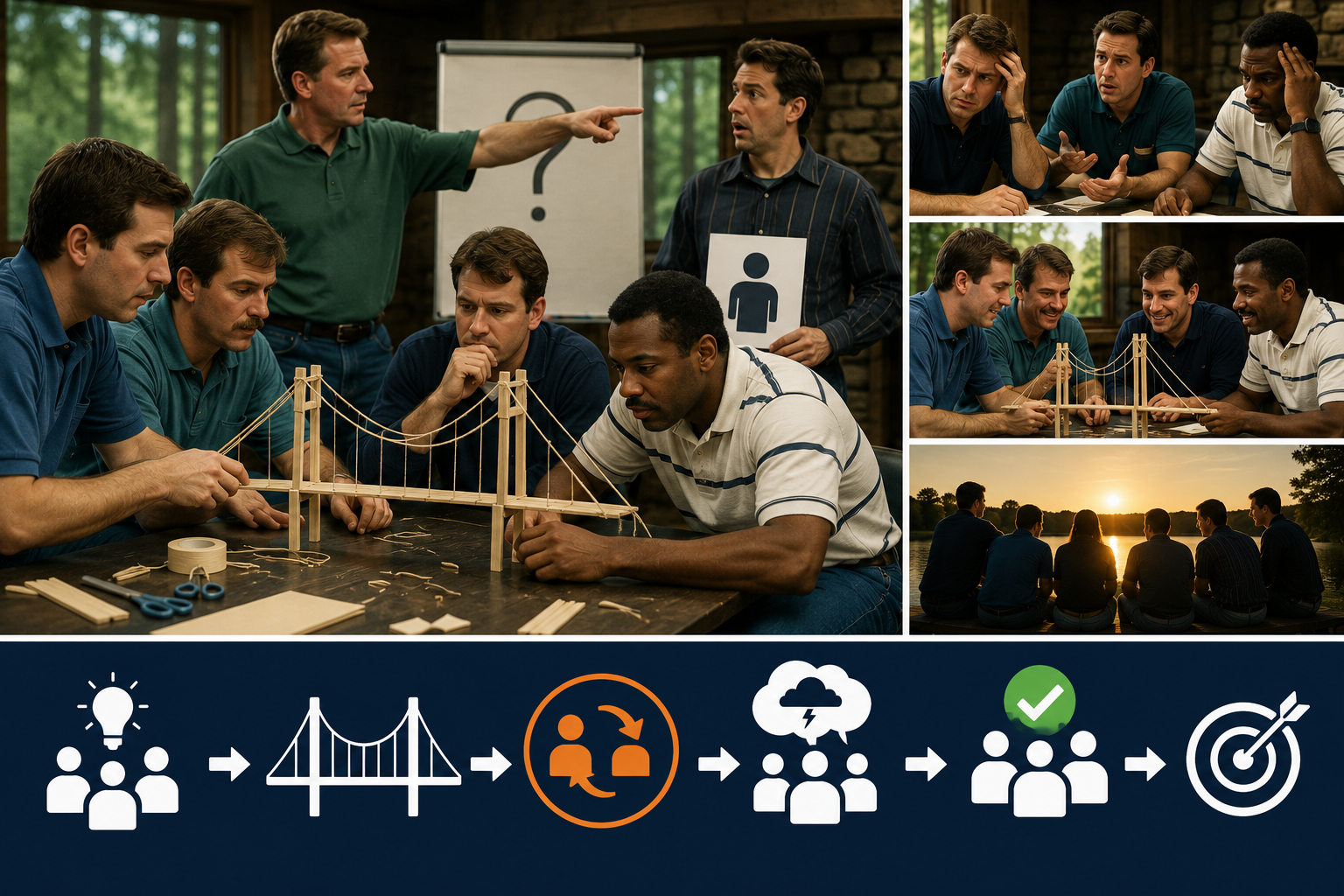
The first exercise seemed straightforward. Our team was asked to design and build the best suspension bridge possible using a limited set of materials. Like any engineering team, we quickly organized ourselves, assigned responsibilities, and developed a plan.
Then everything changed. About fifteen minutes into the exercise, an instructor walked into the room. Without warning, our team leader was removed. Someone we had never met was assigned to replace him. We weren't allowed to start over. We simply had to adapt. At first, it felt frustrating, then confusing, then interesting.
What We Did
As the week continued, the pattern repeated itself. Every time we thought we understood the assignment the rules changed, the team changed, the priorities changed, or the circumstances changed.
Every exercise included an unexpected twist. Eventually, our conversations shifted. Instead of asking, "Why do they keep doing this to us?" we began asking, "What are they trying to teach us this time?"
Without realizing it, we stopped expecting stability. We started expecting change. Something remarkable happened. We became much better at helping one another navigate uncertainty.
The Breakthrough
By the middle of the week, I realized this wasn't management training. It was adaptability training. The instructors weren't evaluating our original plans. They were watching how we responded after those plans stopped working.
Some participants struggled whenever a curveball appeared. Others became frustrated when their carefully constructed plans suddenly unraveled. I found myself naturally stepping into a different role. Helping people regroup, refocus, stay calm, and remember the real objective.
The goal had never been to build the perfect bridge. The goal had been learning how to lead when the unexpected happened.
What Changed
Looking back, that week changed the way I viewed leadership. It taught me something I've carried throughout my career. No matter how well you prepare, something will change. A key leader won't be available. Equipment will fail. Priorities will shift. Weather will interfere. Someone will challenge the plan.
The organizations that succeed aren't the ones that avoid those moments. They're the ones that adapt to them. That lesson has shaped every Kaizen event, workshop, and leadership engagement I've facilitated ever since.
The Takeaway
Today, people sometimes ask why I stay so calm when something unexpected happens during a Kaizen event. The answer goes back to that week in Ohio. I've learned that the plan is never the goal. Learning is the goal. The plan is simply where you begin.
Why This Matters
Organizations spend enormous amounts of time developing detailed plans. Planning is important. But no plan survives unchanged once real people, real equipment, and real business pressures enter the picture.
The strongest teams don't panic when circumstances change. They adjust. They learn. And they keep moving toward the objective together. That's one of the most valuable leadership skills any organization can develop.
Ready to Build Teams That Thrive Through Change?
Transformation rarely follows a perfectly written script. The organizations that consistently improve are the ones that develop leaders who remain calm, keep people aligned, and adapt quickly when the unexpected happens.
Whether through a Breakthrough Assessment, a Kaizen event, or leadership development, building that capability may be one of the greatest competitive advantages your organization can create.
One of my favorite sayings today is: "It's not a great Kaizen unless something goes sideways." I don't say that because I expect failure. I say it because some of the greatest breakthroughs begin the moment the original plan no longer works.

Don't Go Down the Rabbit Hole
How a tough day on the plant floor reshaped my understanding of leadership, focus, and trust.
Kaizen Snapshot
Setting: Armstrong World Industries – St. Helens, Oregon plant
Challenge: Multiple simultaneous operational issues overwhelming leadership
Stakes: Safety, uptime, morale, and credibility
Approach: Prioritization, delegation, team ownership
Outcome: Clear focus, aligned action, stronger leadership discipline
Key Lesson: You don’t win by fixing everything. You win by fixing the right thing
The Situation
One thing you learn quickly in manufacturing is this:
Even when things are going well, there’s no guarantee they’ll stay that way.
People, processes, equipment, weather, raw materials, any one of them can tip a good day into a bad one.
At the St. Helens ceiling tile plant, we were in the middle of one of those weeks. Equipment downtime was high. Safety concerns were surfacing. People issues were piling up.
As Operations Manager, I felt responsible for all of it.
What Was Getting in the Way
I approached the situation the way many engineers do, by trying to solve every problem at once.
I believed:
Every issue mattered equally
I needed to stay on top of everything
Speed meant touching everything personally
In our morning review meeting, I rattled off dozens of problems.
What I didn’t have was a clear direction.
The Moment That Changed Everything
As I started diving deep into a relatively small issue, one that wasn’t driving major loss, Olivia, our plant manager, stepped in.
“Adam, stop worrying about all the little details.
Let’s focus on the key problem, build the plan, and execute it.
Then we’ll move on to the next.”
It was obvious. And I had completely missed it.
What Changed
Olivia had the team identify the top three problems for the day.
Then she did something even more important. She had them self-assign ownership.
Suddenly:
Focus replaced overwhelm
The team leaned in
Progress accelerated
I took one of the assignments myself and learned more about leadership that day than I had in months.
The Takeaway
Trying to fix everything is a fast way to fix nothing.
Strong leaders create focus, trust their teams, and resist the pull to dive into every detail.
Why This Matters
When leaders chase every problem, teams hesitate.
When leaders create clarity, teams act.
Focus isn’t avoidance, it’s discipline.
Ready to Build Focused Improvement?
If your organization feels overwhelmed by competing priorities, Kaizen may not be the problem, focus might be.

Tearing Down the Monuments of Poor Leadership
How visible discipline and consistency helped reset culture in a struggling manufacturing plant.
Kaizen Snapshot
Setting: Armstrong World Industries’ Lancaster, Pennsylvania vinyl flooring plant
Challenge: Low morale, poor discipline, and eroding trust
Stakes: Productivity, safety, and plant survival
Approach: Visible leadership action, standards reinforcement, symbolic reset
Outcome: Behavior change, improved discipline, productivity lift
Key Lesson: Culture changes when leaders make standards visible and non-negotiable
The Situation
When I became Business Unit Manager at Armstrong’s Lancaster vinyl flooring plant, the history was obvious.
Demand was down. Trust was low. Discipline was inconsistent.
And when people lose confidence in the future, they find ways to disengage.
During a leadership rotation through all shifts, we decided to experience the plant the way every employee did, including nights.
That’s when I found something I didn’t expect.
What Was Getting in the Way
During an overnight walk, I noticed lines running with missing crew members.
Breakrooms were empty. Work areas were quiet.
So I started looking in unused areas of the facility, nine floors of old industrial space.
On the sixth floor, I found stacks of fabric arranged into makeshift “beds.”
The rumors were true.
What We Did
Instead of calling people out, accusing, or lecturing, we took a different approach.
We formed a “bed-hunting” team and searched the facility. Over several days, we found six sleeping areas.
On a Wednesday morning, without announcement, we gathered all the beds and dragged them outside where everyone could see them.
Then we destroyed them in a controlled burn.
No speeches.
No accusations.
Just a clear message: this is not how we work here.
What Changed
Sleeping on the job stopped.
Productivity improved.
The mood lifted.
People saw that leadership was serious about standards.
Sometimes discipline, applied consistently and respectfully, creates stability that people actually crave.
The Takeaway
Culture doesn’t change with posters and speeches.
It changes when leaders remove the monuments to poor behavior.
Why This Matters
When standards are unclear or inconsistently enforced, people fill the gaps.
Visible, consistent leadership resets expectations and restores trust.
Ready to Reset Culture?
If inconsistent standards are holding your organization back, disciplined Kaizen can help reset expectations.

How I Accidently Became a Paid Speaker
Why stepping outside your comfort zone can open doors you never expected.
Kaizen Snapshot
Setting: EPA Continuous Improvement Conference in San Francisco
Challenge: Transitioning from practitioner to professional speaker
Stakes: Personal credibility, brand growth, new opportunities
Approach: Coaching, preparation, value-driven content
Outcome: Paid keynote, workshops, expanded visibility
Key Lesson: Growth happens when you say yes before you feel ready
The Situation
I’ve spent decades in continuous improvement and nearly eight years as a business owner.
I’m known for Kaizen Ninja Facilitation and the Wheel of Sustainability, not for public speaking.
So when the EPA emailed me about speaking at their conference, I assumed it was a mistake.
What Was Getting in the Way
They found me through Google and the Gemba Academy podcast.
I was skeptical. They thought I spoke on sustainability. I don’t do environmental sustainability.
But curiosity won.
What We Did
I spoke with a professional speaker friend who coached me on pricing, scope, and positioning.
He gave me one piece of advice that stuck:
“Whatever price you set will feel too high to them.”
I proposed a fee. They negotiated. We agreed.
I also offered workshops and they accepted immediately.
The Moment on Stage
I prepared obsessively.
I opened with:
“I just read on the plane that the best speeches are 20 minutes or less—so I’ll be quiet for 70 minutes, then we’ll get started.”
They laughed. I relaxed.
The talk landed. Workshops were full. Conversations flowed.
What Changed
I realized something important:
People valued my perspective enough to pay for it.
And I enjoyed it.
The Takeaway
You don’t have to feel ready to take the next step.
You just have to be willing to step forward.
Why This Matters
Leaders often wait for perfect confidence before acting.
But confidence usually follows action, not the other way around.
Want Me to Speak or Work With Your Team?
If you’re looking for a speaker or facilitator who brings real-world Kaizen stories and practical frameworks:
What do you do when you’re the Industry Leader – you Improve!
Armstrong World Industries is the global leader in suspended ceilings. That might not seem like much to you, but when you sell over a billion square feet of ceiling tile and the grid to suspend it every year, you’re making a big impact in the construction and housing market.
Armstrong World Industries is the global leader in suspended ceilings. That might not seem like much to you, but when you sell over a billion square feet of ceiling tile and the grid to suspend it every year, you’re making a big impact in the construction and housing market.
One of the things that sets Armstrong apart is innovation and forward thinking in all of the things they do. Although other competitors are trying to influence building codes, Armstrong has the strongest presence and is leading the way in making sure office and other spaces are the healthiest, most energy efficient, and quietest they can be.
Paul, the head of codes and standards, was a big fan of my support to other areas of the technology department. We had many conversations on how Lean was helping his colleagues improve their processes and we often wondered how I could support his team’s efforts.
One day, we were talking about codes and standards and how Armstrong’s competitors were making inroads influencing the critical changes for building health and safety. Paul said it seemed Armstrong was losing its leadership position. People were participating on committees and submitting white papers, but weren’t moving the needle in the right direction. He felt we needed a breakthrough to retake our leadership position.
We both realized, almost at the same time, a strategy session could help drive the changes that would maintain our leadership presence. We agreed a Value Stream Mapping (VSM) session was the approach to take.
We plotted and planned. We chartered the event. We invited critical team members, including our internal customers, Sales and Marketing, manufacturing plant representatives, selected engineers and scientists, and members of Paul’s staff.
Our CEO kicked off the event and gave his support to the team. He told us what we were doing would be vital to the successful future for the company. No pressure at all! The team was enthusiastic and energized. But many of them wondered how using Value Stream Mapping would help them create a future that was any different than the path they were on.
There are two critical moments in any VSM event. The first is when you take a Gemba Walk (going to see) through your process. During this walk, the team saw many aspects of the current process that were overly complex and had opportunities for improvement. Many ideas were written down and shared.
The second critical moment happened when the team visibly mapped the current state process on a wall. There were so many steps and delays. There was waste and opportunity beyond anything they had imagined. Now that they could see it, they could do something about it. The ideas flowed even faster. There were so many things within the control of the team, and they prioritized the ideas they thought would make the most difference and could be implemented.
We built plans to attack the most impactful opportunities to drive codes and standards leadership. By the end of the week, we had a roadmap to distance ourselves from our competitors. Everybody won, as the changes would strengthen the health and safety of everyone who inhabits the office, school, and other business spaces. And, because of the alignment of the team and their sponsors, their customers would receive those benefits quickly.

Raising the bar for quality
Amstrong World Industries and Worthington Steel combined forces to create the number one ceiling grid manufacturer in the world. It didn’t start out that way, as employees of both companies were feeling their way through the combination of cultures.
Armstrong World Industries and Worthington Steel combined forces to create the number one ceiling grid manufacturer in the world. It didn’t start out that way, as employees of both companies were feeling their way through the combination of cultures.
I had been a team manager (shift supervisor) at our plant near Chicago. We shut down the plant and I moved to the Baltimore facility as the Industrial Engineering and Quality manager. It was a critical moment for our new company and my career. We had to establish ourselves as a quality leader, in order to build consumer confidence.
I spent many hours on the factory floor, understanding where we stood in regard to production reliability and quality control. We had each line leader measuring the grid that was being produced and comparing it to product standard drawings. My early observations were that each person was interpreting the drawings differently and also measured based on their “feel” for the product. This meant somebody might think a product was within tolerance limits, even though the customer didn’t agree. This was reflected in a higher than industry standard return rate. We were at risk of losing customers unless we corrected our quality problems quickly.
I reviewed the product quality drawings and realized they were confusing and written for engineers, not production workers. Also, depending on how hard the measuring device was handled, people could make their measurements vary by up to .020” (twenty thousandths of an inch). This was a huge problem for ceiling grid, as tolerances could be as small as .010”.
I reviewed my plan with the plant manager. I would reformat the product quality drawings so they would be easy to understand and interpret as intended. At the same time, I would develop a measurement training program to help all employees measure the same way, with the same “feel.” I got approval for new measuring equipment, that was more repeatable and accurate than what we currently had at the plant. I was off and running.
I did an informal survey of many of the production technicians to help me understand how to format the product quality drawings to be easily understood by them. Specifically, I wanted them to understand the tolerance limits for any critical measurement. Previously, an example measurement would say 24.025” +/- 0.15”. This forced employees to add and subtract and sometimes make errors. Through their feedback, I changed all measurements to look like this (for the prior example): 24.010” – 24.040”. Now there was no confusion. As long as the measurement was within the range shown, it was a good product.
There were literally dozens, if not hundreds of drawings to correct, so I prioritized my work by the products that ran the most frequently first. Then, time permitting, I would correct the lower frequency products. Sometimes, I would have to change my process, as a rare product would be ordered, and we didn’t want to take the chance it would be measured incorrectly.
Now it was time to improve measurement reliability. Some people had a “hard” hand, meaning they would squeeze the measuring device against the bar of grid with much force. Others had a “soft” touch, meaning they barely touched the bar with the measuring device. I had to come up with another way to consistently find the correct measurement and then verify the variation between operators would be acceptable.
After many tests and trials, I developed the 2-step touch technique. Basically, the technician would squeeze the measuring device to find the bar, then back it off, and then bring it back to just “touch.”
No matter how hard or soft a hand people had, they were very consistent when it came to the second touch. In fact, the variation between operators was reduced from .020” to .003”. I instituted an audit and follow-up process to ensure we sustained our consistent measuring technique.
Over time our returns rate was reduced drastically, and we became the number one grid producer in the world. I learned that systems must be designed for the people who use them, rather than the people who create them.

Never tell someone their baby’s ugly
I have been influenced by many pop-culture references over the years. During my Kaizen events, words or phrases come out of my mouth that are my attempt to make the situation relatable to the team and make them feel better about the situation they’re in and the problem they’re facing. I want them to realize it’s not the first time something bad happened in business and their problems aren’t insurmountable. I wasn’t always this way – maybe you can learn from my mistakes!
I have been influenced by many pop-culture references over the years. During my Kaizen events, words or phrases come out of my mouth that are my attempt to make the situation relatable to the team and make them feel better about the situation they’re in and the problem they’re facing. I want them to realize it’s not the first time something bad happened in business and their problems aren’t insurmountable. I wasn’t always this way – maybe you can learn from my mistakes!
Many years ago, I was taking a Gemba walk with a team from Armstrong’s Pensacola plant. During the walk, I saw build-up, dirt, and clutter on and around the production equipment. It really bothered me and I said out loud, “we should be ashamed of the way we are maintaining and operating our equipment.” I was immediately taken off to the side by the plant Lean manager and told I shouldn’t say these things out loud. I, of course, got respectfully defensive. Not really. I said, “Look at the state of the equipment. What does it say about how we feel about our employees, by setting such a bad example of leadership expectations?”
That didn’t sit well, and he walked me to the Plant Manager’s office. We had a mostly one-sided conversation. I was told I needed to watch my words and not make people feel bad about their working conditions. It wasn’t productive and brought down the mood of the team.
To this day, I still feel the same way about difficult working conditions, but I don’t speak my feelings out loudin front of the team. Instead, I think about how to get them to see their situation as unacceptable and motivate them to do something about it.
I am reminded of one of my favorite Seinfeld episodes, “The Hamptons.” The gang (Jerry, George, Kramer, and Elaine) goes to the Hamptons to see the new baby of their mutual friends, Carol and Michael. The baby is so ugly that upon seeing him, Kramer does an exaggerated double-take and says the little girl looks like Lyndon Johnson, who wasn’t attractive. The rest of the episode is about the gang trying to not make the parents feel bad about their baby. Hilarious, but it shares a parallel with my approach to improvement teams.
I want my team to see their baby, their process, as ugly, and then do something to it to make it beautiful. The way I do it now is to show an outrageous photo from the internet (there are so many of them) of a group of people doing something obviously unsafe. When I show the photo, I have the team members describe the safety risks they see. There are obvious ones, such as don’t put a ladder on top of another ladder on the forks of a forklift, in order to change a light bulb thirty feet in the air.
After they laugh at the absurdity of the photo (many of these are real situations), I point out the people doing the work think what they’re doing is ok and if we were to tell them we think it’s unsafe, they would probably run us off or worse. Then I tell the story of the Seinfeld episode and make the analogy that we can’t call the baby “ugly.” Once we make that connection, I tell them by the end of the Kaizen event, we will see our original process as the “ugly baby” and our job is to turn it into something beautiful we can be proud of.
This approach has improved the alignment and engagement of the team and has kept me from making my team members feel bad about their processes. By the end of the week, they’re talking about how they made their baby a beauty to behold and they own the changes that made that transformation.

The Ship that Didn’t Sail
Sometimes, even though you know you could help a prospect, they don’t feel the same way. This is one of those stories about my inability to create alignment with a business leader.
Sometimes, even though you know you could help a prospect, they don’t feel the same way. This is one of those stories about my inability to create alignment with a business leader.
I was referred to a yacht brokerage by the CEO of CITY Furniture and after a few months was able to set up a meeting with their CEO. We seemed aligned around my approach and soon he invited me to visit him at his business during one of my upcoming trips to Florida.
We met for dinner the evening before the official visit. He brought his second in command along and we quickly found common ground and shared stories about past work and personal adventures. When dinner was over, we parted ways and I was excited at the possibilities of helping a company who was focused on something I had zero experience with: yacht sales brokering. My only experience with yachting is the old Looney Tunes cartoon, where Bugs Bunny convinces Elmer Fudd that he’s “Elmer J. Fudd, millionaire, who owns a mansion and a yacht.”
The next morning, I met the CEO at his office, and he introduced me to his staff. Throughout the day, I had meaningful conversations with many of the people who worked there and learned about the biggest pain points they were facing. These included:
The lack of overall aligning metrics across the business – how did they know if they were winning?
The complexity and length of time it took to close a yacht sale – many of these transactions included more than one country, which multiplied the effort immensely.
Utilizing the in-house resources to identify and solve problems – this business was family operated and run by a few trusted executives. Others did their work to the best of their ability but didn’t get to make empowered decisions or changes.
I knew I could help, if only I could convince the CEO he could cede control of some critical decisions and let his employees be part of the improvement efforts.
He seemed interested and by the end of the day showed what I thought was a desire to operate his business differently in the future. We left with a plan to reconnect and develop a path forward.
Except that it never happened. I stayed in touch with the CEO for a while, but then realized my approach wasn’t aligned with his vision of how work should get accomplished. Even though he never told me directly, I knew he wouldn’t pursue further meetings with me. It would have been a huge leap of faith for him, and my image of continuous improvement couldn’t overcome years of management-engrained behaviors.
My approach isn’t for everyone. I have to understand that even though I know I can help many of the prospects I visit, they don’t always see it the same way as I do. Maybe I’ll get on a yacht one of these days. It would be fun to pretend to be “Elmer J. Fudd, millionaire.” Until then, I’ll continue to navigate the seas of change for clients, steering them in new and unchartered directions, knowing that if they’re willing, I can help bring them to a great destination.

Surviving a Brutal Work Environment
I have experienced two mergers/joint ventures in my corporate career at Armstrong. The first one was a ceiling grid venture between Worthington Industries and Armstrong. It was extremely positive and productive and is still doing well to this day. The second one was a ceramic tile venture between Armstrong’s American Olean Tile and Dal-Tile, based out of Dallas Texas. This one didn’t go nearly as well. I learned many lessons from the Dal-Tile experience, mainly about my ability to survive.
I have experienced two mergers/joint ventures in my corporate career at Armstrong. The first one was a ceiling grid venture between Worthington Industries and Armstrong. It was extremely positive and productive and is still doing well to this day. The second one was a ceramic tile venture between Armstrong’s American Olean Tile and Dal-Tile, based out of Dallas Texas. This one didn’t go nearly as well. I learned many lessons from the Dal-Tile experience, mainly about my ability to survive.
When the “merger” was announced, I investigated other opportunities for my career, including a chance to go back to Thomasville Furniture as an assistant plant manager in Winston Salem, and an offer to do work at Armstrong’s corporate center. My recent experience with the Worthington and Armstrong joint venture was positive and I learned a lot at the beginning of the venture, so I thought I would see a similar approach to this combination of companies. Boy was I wrong.
Our Plant manager left us without saying a word. We only found out a week or so later he had gone to the Dal-Tile headquarters to prepare for the merger through a mysterious sounding voicemail. On the official first day of the merger, executives came to our plant and told the acting plant manager he had to fire five staff members by the end of the day.
I was the industrial engineering manager at the plant, and the only way I survived was that I was named as a supervisor. Dal-Tile only staffed their plants with plant managers, supervisors, and ceramics engineers. Any other staff was excess in their view.
I took the supervisory role because I was promised a job at the corporate headquarters in Dallas Texas. My favorite manager from American Olean would be my manager in Dal-Tile corporate. Even though things were challenging at the plant, I had something exciting to look forward to.
When I got to Dallas Texas, I found out we were in charge of assuring environmental, health, safety, and mining compliance across the entire company. There was a department responsible for this already. But they weren’t very helpful to the manufacturing and mining sites. The VP of operations put us in the middle of the plants and them.
We tried to work with the existing EHS and mining group, but they went to great lengths to avoid us. One time, my manager and I walked over to their offices to meet with them impromptu. Instead of meeting with us, they locked their offices and refused to talk with us. What a culture!
Another thing Dal-Tile was proud of was their firing practices. The employee manual started off with a paragraph explaining that Texas was an “at-will” state, which meant they could fire you at any moment, with or without justification. This was on the first page of the manual! I met many people who had been fired and then re-hired and then fired again. Amazing.
I knew the only way I was going to survive this brutal culture was to make myself as valuable and helpful as possible. I took every assignment, put in outrageous hours, and traveled at the drop of a hat, to support any of our twelve manufacturing facilities and multiple mining sites.
I had good relationships with the plant staff. Once they got to know me, they trusted me. They didn’t trust the EHS and mining group, that was for sure. They knew when I arrived, I would be there to help. Nothing more and nothing less.
I had many amazing experiences I would never have had in a more positive working environment. But, after 18 months, I was free to return to Armstrong (there was an agreement that we were off limits for that period of time). I made a few calls and was able to join the corporate group in Lancaster, working for the same manager I followed to Texas. He had left a month or so earlier and was able to convince his manager to hire me.
When I returned to Armstrong, I realized most people wouldn’t believe how we were treated at Dal-Tile. They never experienced a brutal corporate culture. So, I kept the stories to myself or commiserated with those few who survived their time in Dallas Texas and returned to Armstrong like me. Very few made it through unscathed. Those that did had some scars from the battles we fought but were also proud that we made it.
To this day, Dal-Tile is my example of “if you think your job is bad, check this out.” No one should be treated the way we were. Because of this, I really appreciate what I have and my determination to survive.

Do Your Due Diligence
Midway through my corporate career, I was a senior industrial engineer at Armstrong World Industries. I spent most of my time providing support to our many manufacturing facilities all over the world. I have always been fascinated by manufacturing and it never ceases to amaze me how good (and bad) decisions can immediately impact performance.
Midway through my corporate career, I was a senior industrial engineer at Armstrong World Industries. I spent most of my time providing support to our many manufacturing facilities all over the world. I have always been fascinated by manufacturing and it never ceases to amaze me how good (and bad) decisions can immediately impact performance.
I thought I would someday be a plant manager and told my manager I wanted the opportunity to take the next step to get me there, as a business unit manager. I thought all my continuous improvement experience would serve me well and I would make more good decisions than bad ones.
One day, the week before Easter, my manager informed me that the plant manager at the Lancaster flooring plant wanted to talk to me about a position in his plant. I was excited for two reasons. One was my opportunity to learn manufacturing from the inside. The other was it would be a two-grade promotion. More money was never a bad thing, or so I thought!
I met Rob, the plant manager, on the Friday before Easter weekend. The plant wasn’t running, but he gave me a short tour of the areas I would be responsible for. All of the hourly workers were gone and I never met anyone on the staff. I thought it was odd, but I was enamored with the idea of the next step towards plant manager.
At the end of the tour, Rob offered me the job and told me that he wanted my answer by the end of the weekend. Even though I knew my answer, I told him I would talk things over with my family and get back with him on Monday morning.
I really didn’t think too much about it. I knew I was going to take the job. My wife was supportive and knew this new role would keep me home more. But the hours were going to be long. It was a tradeoff, but it seemed like the right choice to make. I did mention it was odd that I hadn’t met anyone during the tour, but tried not to read too much into it.
On Monday, I called Rob and told him I would take the job. My manager and I agreed on a transition plan, as I had some projects to wrap up or hand over to others. For the next four weeks, I tried to do both jobs, spending half of my time at my new factory, watching the staff conduct business.
One week before I started my new job full-time, Rob was promoted and left the plant. His replacement wouldn’t arrive for six more weeks. In addition, my counterpart in the factory who ran a different business had a three-week National Guard deployment. I would essentially be on my own, learning as I went.
I had a staff, but they didn’t know me. I also had the vice president of manufacturing to discuss issues with, should things get out of hand. I really didn’t want to have to use his support, but there were a few times that I had to. There were some union/management issues to be resolved and I didn’t have the historical perspective to help me out. So, I swallowed my pride and met with the VP. He was very helpful and supportive. He understood my lack of experience.
For the next few weeks, I barely survived. Finally, my counterpart came back and helped me deal with some issues and then our new plant manager arrived. Things got better, but they were tough. This plant had been in decline for many years and the management and union relationship was strained, to say the least. I did my best to improve things throughout my two years as business unit manager.
Would I have chosen a different path if I had known what was in front of me? Maybe. More likely, I would have tried to gain perspective on what I was agreeing to well before accepting the job. It would have eliminated some of my early bad decisions. It was an amazing learning experience. I like to think I gained twenty years of experience during my time on the job.

Leadership Commitment in a Most Challenging Situation
Last year, Dave, a network connection, reached out to me to see if I could help him in his continuous improvement journey. His wife had worked with me at Armstrong, and one evening he was talking with her about some of his frustrations at work. She said, “If you want to get the right help, call Adam. He is tenacious and won’t let you or your team fail.”
Last year, Dave, a network connection, reached out to me to see if I could help him in his continuous improvement journey. His wife had worked with me at Armstrong, and one evening he was talking with her about some of his frustrations at work. She said, “If you want to get the right help, call Adam. He is tenacious and won’t let you or your team fail.”
Dave invited me to his factory, which was quite large and had several furnaces that smelted and poured molten metal into ingots for high value customers. They had a problem with tools and equipment going missing, which led to significant productivity losses. He wanted to reinitiate and strengthen their 5S program. I knew I could help, and wrote a proposal for the work, which was approved quickly.
We scheduled the Kaizen event for eight weeks from my initial visit. This would allow Dave to prepare leadership and gather the proper team for the Kaizen. We had already chartered and scoped the event to cover one of the furnaces. Our idea was that our improvements could be replicated to the other furnaces in the facility.
In the meantime, I spent a day at the facility getting required safety training and preparing Dave for the event. We picked a conference room and identified the supplies necessary during the week.
Three days before the Kaizen event, Dave called to tell me he had contracted COVID. I asked him if he wanted to postpone the Kaizen. He told me no and if I could pick up the supplies from his home (in his driveway), one of the team members would fill in as team leader until he could participate at the facility. He would use Zoom to attend and participate on the first day of the Kaizen. His five-day isolation period would then end, and he could attend in person on the second day, but would have to wear a mask.
I wasn’t sure what to make of this. All my Kaizen events (up to that time) were in-person, and I didn’t really know how engaged Dave could be attending virtually. But I was willing to give it a try and make the best of it.
On the Sunday before kick-off, I met Lisa, who was going to fill in for Dave as team leader. She helped me prepare the meeting room. We talked about how we could engage all team members, including Dave on the first day of the Kaizen. We set up a laptop for Dave that we could point toward the team and the screen, so that he could engage with the team and keep up with the discussions. Luckily, he and I had spent time in the workspace, so he had a list of ideas to share during that portion of the Kaizen.
At kick-off on Monday, we introduced everyone and shared Dave’s story and said we were going to make the best of a difficult situation. For Dave’s part, he stayed on Zoom the entire time, engaging and speaking with the group at appropriate moments. When we went out to the facility floor, Dave waited for us to text him that we were returning to the meeting room. The team had many ideas and Dave was able to share his as well. When we prioritized the many ideas into a vital few, Dave was able to participate as if he were in the room. We took the laptop over to the list of ideas and Lisa voted on Dave’s behalf.
Now it was time to work on the high priority projects. Dave couldn’t really do that, so he signed off until we met to wrap up for the day. He listened intently to the team’s progress and gave them encouragement and told them he couldn’t wait to come in the next day and help them in their work.
The second day, Dave showed up with a facemask and kept his distance from the team members. He jumped on one of the project teams and was able to participate in the improvement work. Throughout the week, the team felt more comfortable letting Dave engage in the work and by the end of the week, he was able to help complete many critical tasks.
At the end of the week, the team had made significant improvements to their furnace area. We did a quick estimate on the impact on productivity and changeovers and felt we had made a huge impact on both. Time would tell, of course. For his part, Dave earned the respect of the team and had his first true win in his position as Continuous Improvement Manager. I was impressed by his dedication and commitment and was thankful we didn’t have to postpone or cancel this Kaizen event. I also learned it was possible to engage remote team members in Kaizen events.

Carrying a Heavy Weight on My Shoulders
When you are in the heat of battle, you don’t realize the toll it’s taking on your health. I was the business unit manager for a vinyl flooring operation for Armstrong World Industries for two years. During that time, we were in a continual state of downsizing. This didn’t help the relationship with our union. It seemed like everything we tried to do to improve safety, cost, quality, or customer service was met with resistance.
When you are in the heat of battle, you don’t realize the toll it’s taking on your health. I was the business unit manager for a vinyl flooring operation for Armstrong World Industries for two years. During that time, we were in a continual state of downsizing. This didn’t help the relationship with our union. It seemed like everything we tried to do to improve safety, cost, quality, or customer service was met with resistance.
Because our business was shrinking, we were under constant pressure to reduce costs. It wasn’t unusual for upper management to threaten your job or to be told if you couldn’t get it done, someone else would be happy to take your place.
I decided the best course of action was to open a dialogue with our shop steward, lay out the situation, and work together to make the best decisions for our employees. For the first few months, he spoke with me, but little changed in our relationship. I was as transparent with him as possible, explaining the business environment and the reasons for the changes we were making. He didn’t trust me. Apparently, prior managers had burned him a few times and he wasn’t willing to forgive and forget what had happened.
We got to a point where traditional operating schedules weren’t practical for the amount of production we were required to make. We needed to make sure everyone had equal opportunity to work full-time, but providing a 40-hour workweek required us to rotate some of our established crews and revise our overtime policies.
I knew I couldn’t do this on my own. It was going to be complicated and if anyone made errors in assigning overtime, we’d be open to employee grievances and back pay. We couldn’t afford that. I called a meeting with the shop steward and my staff. I laid out the situation and my desire to be equitable for all remaining employees (we had to lay off some of our employees, which didn’t improve people’s moods).
In the past, when everyone worked a traditional schedule, overtime was offered by seniority. If the most senior employee didn’t want overtime, the next most-senior employee was offered the opportunity. This continued until someone accepted the overtime assignment. In our new schedule, it wasn’t going to be obvious who should be offered the overtime.
The group argued for a while, and I realized it would be too easy to make a mistake offering overtime unless we came up with a set of rules we all agreed to. I said I’d take a crack at it, and we could meet again to review my efforts.
After much deliberation and advice from others, I developed a table showing the various schedules and twelve situations where overtime might be required. The idea was to check each situation in order and once you found the correct situation, it told you how to assign overtime.
It was complicated, but the team only found a few flaws that would leave us open to grievances. Once corrected, everyone agreed that if we followed it, it would be a fair approach to assigning overtime. Besides, it was so complicated most people wouldn’t understand it well enough to file grievances.
Once our shop steward saw I was fully including him in our processes and wasn’t trying to take advantage of anyone, our relationship changed. Not outwardly to the rest of the employees, as he still had to play the role of “management buster.” But we collaborated often on critical issues.
Five days after I transferred back to a corporate role, I was cutting my lawn. My neighbor came over and stopped me to say, “You look different.” I never realized that all the stress of my job was easily seen by everyone but me.

The Littlest Negotiator
There is always a compromise that can be made. You just must know what you want and figure out how it will benefit both parties. I have been negotiating since as far back as I remember. Sometimes it was bedtime, eating my dinner, or putting off homework to go outside and play. Parents don’t typically cherish those negotiations and kids rarely win (at least I didn’t most of the time).
There is always a compromise that can be made. You just must know what you want and figure out how it will benefit both parties. I have been negotiating since as far back as I remember. Sometimes it was bedtime, eating my dinner, or putting off homework to go outside and play. Parents don’t typically cherish those negotiations and kids rarely win (at least I didn’t most of the time).
I started collecting coins and baseball cards when I was three years old. Early on, I was able to convince other collectors (kids) that what I was offering was more enticing (or valuable) for them than what I was asking for in return. I don’t think it was always true, but it seemed to me both sides were getting what they wanted (or at least thought they wanted).
My uncle Morrie ran Zerns Farmers’ Market in eastern Pennsylvania. We used to visit him and my Aunt Adeline on their “gentleman’s farm” every summer. Uncle Morrie was a shrewd businessman, and he loved to tell stories of the amazing deals he made throughout his career. I was intrigued, and by the time I was eight, I was asking him questions that led him to think that there might be a little entrepreneur he could develop.
He was particularly interested in my love of coins. He didn’t think there was money to be made in baseball cards. This was the 1970s, after all. He told me there were three coin dealers at the farmers’ market and suggested I try to get something I wanted from them at a reduced price. “Never pay full price,” he told me.
He took me to the market and walked with me to the first coin dealer. I had ten dollars to spend. Uncle Morrie asked, “Do you see anything you like?” I told him I did, but I couldn’t afford it. It was priced at fifteen dollars. He said to the dealer, “My name is Morris Lipton, and I run this farmers’ market. I’d like to introduce you to my nephew, Adam.”
The coin dealer told me I could have the coin I coveted for ten dollars. I couldn’t believe it – he took five dollars off of the price. On subsequent trips, Uncle Morrie would walk with me to the coin dealers and encourage me to ask for a better price. I didn’t always get my price, but more often than not, I did. This built my confidence, and I learned how to determine a price that suited me, ask respectfully for it, be willing to hear the word “no,” and know when to walk away from a deal that didn’t suit me.
Eventually, I went to the various coin and baseball card dealers without Uncle Morrie by my side. I think some of them recognized me. But others were willing to negotiate with a child who was confident, respectful, and informed.
To this day, I use the same principles in all my dealings with vendors, suppliers, and customers. I understand when somebody wants to negotiate with me on my services as well. These principles have served me well and I believe they can help you too. Be willing to ask. You are more likely to get what you want if you do.

Go to the Source to Get the Correct Information
I was working at the American Olean ceramic tile facility in Olean, New York as the Industrial Engineering manager when we merged with Dal-Tile. I was offered a position as an industrial engineer at the corporate offices in Dallas, Texas. I was very impressed with the manager who I was going to report to, so I took the opportunity and moved my family south.
I was working at the American Olean ceramic tile facility in Olean, New York as the Industrial Engineering manager when we merged with Dal-Tile. I was offered a position as an industrial engineer at the corporate offices in Dallas, Texas. I was very impressed with the manager who I was going to report to, so I took the opportunity and moved my family south.
When I arrived, I learned our mission was to improve factory environmental, health and safety (EHS) compliance across twelve facilities in the United States. Although there was an EHS department, they weren’t hands-on or helpful for the facility managers. My manager and I would function as internal consultants and help improve the approach, relationships, and overall performance.
I had no prior experience in EHS and attended many workshops and training sessions with the EPA, OSHA, and other agencies. We took tours of every plant and identified areas where we could help. Our focus was on annual safety training and environmental and safety reporting.
Over time, we built strong relationships with plant management at all locations, and they came to trust our work and invited us to help frequently. So much so, I got assigned the submission of the annual environmental reports for all facilities.
There were twelve reports that were all due at the same time. There were different requirements based on the state the facility was located in. Reading through all twelve documents, I noticed many similarities and some critical differences. With one month to go, I created a plan to complete all reports properly and on time. I would be signing each report and would be legally bound for completeness and correctness for the next seven years. I wasn’t willing to take any chances.
The first step I identified was to understand each form. Although I thought I knew what most of the questions meant, I decided it would be better to confirm my interpretations. The best way I knew was to call the state agencies and ask for assistance.
I started making calls, and invariably, was not able to reach a live person most of the time. I left many messages at most agencies. I put a sticky note on each report I had a question on and waited (and waited) for my calls to be returned.
When a call finally came, the first thing I did was ask the person what state they were calling from. Then, I pulled out the report for that state. Looking at the sticky note, I knew what I had to confirm. From there, getting the information was simple. Most state workers were happy to help me fill out their form, beyond my first question(s). They had a vested interest in completeness and accuracy and weren’t used to people asking for help. They were more familiar with fixing problems after it was too late.
I learned that these agencies work for us, the public. But some people don’t see it that way and think they’ll get in trouble for asking questions. I’m convinced it’s the best way to get these critical tasks done and avoid errors. I was able to complete all twelve reports on time, to the best of my ability and knowledge, and sign each document. Many years later, I am confident I provided the proper information to every agency. I also feel better knowing that the seven-year statute of limitations has expired.

Perfection Isn’t Always a Good Idea
In the 1980’s, Thomasville Furniture was the market leader in high-end furniture. They were extremely focused on process improvement in all areas of the business. I worked on a staff of industrial engineers. Each of us supported one or more of the many manufacturing facilities. We were tasked with finding ways to improve safety, quality, productivity, and customer service.
In the 1980’s, Thomasville Furniture was the market leader in high-end furniture. They were extremely focused on process improvement in all areas of the business. I worked on a staff of industrial engineers. Each of us supported one or more of the many manufacturing facilities. We were tasked with finding ways to improve safety, quality, productivity, and customer service.
One of my colleagues worked at the plant that made tables and chairs. They took great pride in the finish of their tabletops. To achieve the desired look, many workers used powered sanding and rubbing devices. It was an extremely labor-intensive process. We had many muscle strains as a result from all the hand sanding and rubbing to get the desired look.
We heard about companies using robots to reduce labor intensity and safety risk. It seemed like an opportunity for us. If we could figure out how to get robots to sand and rub each tabletop, we could realize significant labor cost reduction and eliminate one of our top safety risks.
My colleague, Frank, connected with a robot supplier who brought in some of his robots for a 30-day “test drive.” The first few weeks were spent teaching the robots how to find the surface and perimeter of the table, apply the proper pressure, and cover the entire surface of the table consistently.
Eventually, they were able to achieve their objectives. The robot was able to sand and achieve a rubbed finish on the tabletops, without human intervention. The tabletops looked great. We were ready to roll out robots to take over the sanding and rubbing process.
Before fully committing to the robots, they decided to show the results to a focus group, to get their reactions to the results. The feedback was surprising. Initially, the group loved the finish and look of the tables. In fact, they said the finish was better than anything they had ever seen. But, after more review and conversation, there was something that bothered them. A series of questions drew out the issue: the tops were too perfect. There was no variation across the surface. We had lost the “handmade” look and feel of the furniture. Instead, the lack of variation made the tables look mechanically made, plastic, or unreal.
We couldn’t give up the thing that made Thomasville Furniture a market leader. Frank and his team went back to the robot vendor to see if he could program variability into the process. After many attempts, they gave up. The technology at the time wouldn’t allow the robots to randomize the pressures applied across the tabletops.
The team removed the robots and returned to the time-tested approach to hand sand and finish tables. Over time, robot technology improved, but it was never given another chance at Thomasville Furniture. Instead, we worked on ways to simplify and reduce the safety risk of hand finishing tables.

An Unlucky Break
Critical problems seem to happen over a holiday weekend when there is less coverage. For me, Thanksgiving provided many challenges. Early in my career, I had to come into the ceramic tile factory the day after Thanksgiving to supervise a crew trying to clear a jam in the kiln. Many years later, a water main in St. Helens Oregon broke and shut down the ceiling tile plant. Once again, I was the one covering, and had to respond quickly and deal with a near disaster.
Critical problems seem to happen over a holiday weekend when there is less coverage. For me, Thanksgiving provided many challenges. Early in my career, I had to come into the ceramic tile factory the day after Thanksgiving to supervise a crew trying to clear a jam in the kiln. Many years later, a water main in St. Helens Oregon broke and shut down the ceiling tile plant. Once again, I was the one covering, and had to respond quickly and deal with a near disaster.
I got a call late on Thanksgiving night. The plant had been running very well, and then water stopped flowing. In ceiling tile manufacturing, water is the main ingredient. Ceiling board starts out as 98% water, then as it passes over vacuum and then through a 400-foot dryer, the water is removed. If too much water is removed prior to the dryer, the crew must dump all materials into a pit located prior to the dryer and hope the water comes back on before the pit fills up. It can be messy and difficult to recover from.
The water didn’t come back on. The pit filled up. The crew shut the plant down and was cleaning up a big mess. Some of the material had entered the dryer and they were using 14-foot-long rakes to clear the jammed material out of the dryer.
I arrived at 10 pm and joined the crew. Nobody knew what caused the water to shut off. The EHS (environmental, health, and safety) manager was out of town. I had to figure out who to contact with the city. There was a Rolodex on her desk (I had no access to her computer). In it, I found the number of the city manager. To my surprise, he answered his phone immediately.
He told me the main water line had burst and water had to be shut off for all residences and businesses. He was trying to use back-up systems to get water on for the residents first. I reminded him we employed almost 200 people at our plant and without water we couldn’t operate. I asked him to keep me updated as they brought their back-up water system on line. He said he would and considered us a priority, as we were the number one employer in the area.
I stayed most of the night and helped the crew clean up the mess. We developed a plan for what to do when the water situation was resolved. It wasn’t just the water that we worried about, but also the pressure with which it was delivered. At too high a pressure, it could damage sensitive equipment in our process. I had several calls with the city manager and he assured me he’d let us know when the water was scheduled to be turned back on.
Except he didn’t. All of the sudden, water pressure went up and we thought we were in business again. We started up and began making ceiling board. And then the water was shut off again with no warning. I placed a call and asked the city manager to give us a warning when the next attempt to start the water system would occur. He assured me he would this time. But again, he didn’t. We devised our own plan. We watched our water meters and sent a crew member to monitor the valves in the basement of the process.
For the next 2 days, we played the “start and stop” game with the water. This kept the damage to the process and product at a minimum. In the middle of the third day, the water stayed on, and we could operate as normal.
We learned a valuable lesson about contingency planning: the more you can control in an “uncontrollable” situation, the better.

A Challenging Place to Work
During Armstrong’s Lean transformation, we took many benchmarking trips to learn from companies that were further along in their Lean journeys. One memorable trip included visits to Boeing and Nucor Steel in South Carolina on an extremely hot day in July.
During Armstrong’s Lean transformation, we took many benchmarking trips to learn from companies that were further along in their Lean journeys. One memorable trip included visits to Boeing and Nucor Steel in South Carolina on an extremely hot day in July.
At the Boeing plant, we were amazed by the one million square feet of air-conditioned space where the newest Dreamliners were being assembled. These amazing aircraft were filled with the latest technologies and miles of wiring. Using Lean principles, everything came together in a choreographed way. The area was bright, everyone wore clean clothes, and no one looked like they didn’t know what to do. At the end of the tour, we were escorted through a gift shop and many of our attendees bought souvenirs to take home with them.
Our next stop was Nucor Steel. As we walked into the facility, the environmental contrast with Boeing was stark. It was dark, dirty, and hot. No air conditioning to be found. The Lean approach was almost the same as at Boeing. People were clearly aligned around critical metrics. They were following standard work, and everyone knew what was most important during their workdays.
We entered the furnace control room (which was air-conditioned) and were shown many cameras and monitoring devices that assured the steel wouldn’t have any contaminants. Everyone’s pay and bonus was dependent on the amount of quality tons of steel produced during the day. This aligning metric kept everyone focused on the most important thing their customer valued.
From the control room, I watched a worker on the deck of the furnace wearing a Tyvek suit. He was using a ladle to take a sample of molten steel to test its purity. As hot as it was in the plant, wearing a Tyvek suit had to add to the discomfort of his task. To make matters worse, there was a hole where the molten steel was sampled from. The heat coming off it almost pushed me back when I walked by.
I had to believe this task was one where workers rotated throughout the day, as no one could take the heat for extended periods of time. When I asked our tour guide about the job, he told me it was a high paying position. People in the plant coveted it. They would work anywhere from 8 to 12 hours a day.
I couldn’t believe it was humanly possible to survive a full day doing that job! I would’ve passed out in the first hour. Surely this was a mistake. I was told I could speak with the technician in-between the samples he was taking. My curiosity was strong, and I asked him about his experience. He told me it was his favorite job in the plant. He was assuring their customers were getting the highest quality steel possible. He did admit it was extremely hot, but he was used to it, having worked there for three years. I thanked him and rejoined the tour group, my mind blown.
As we walked out of the plant to our cars, I was struck by the cooling wind outside. It wasn’t until I saw the car register 103 degrees that I realized just how hot it was in the plant and the extreme lengths people go through to do their jobs.