
Kaizen Success Stories
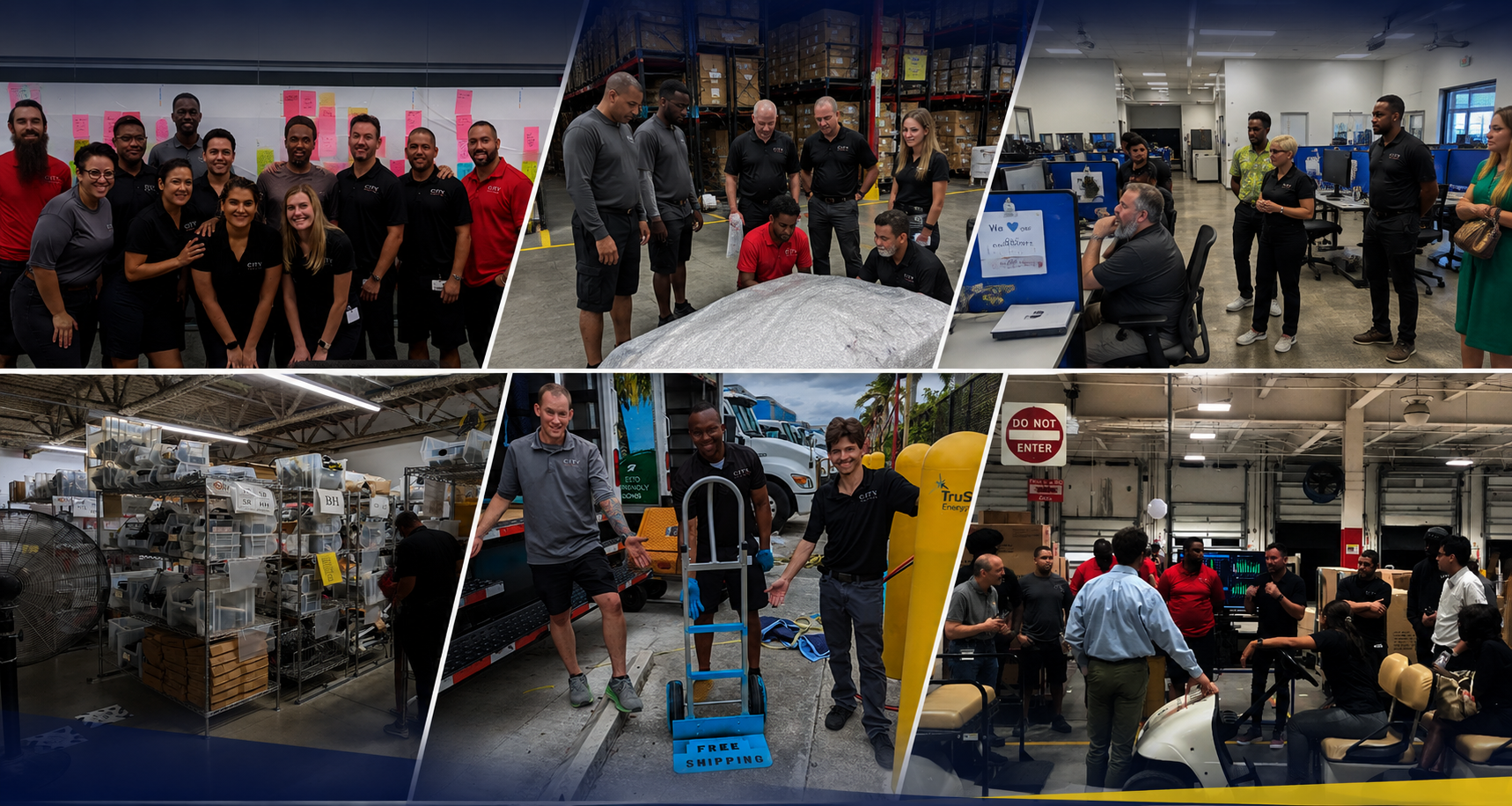
Real Manufacturing Results. One Kaizen at a Time
Explore real-world Kaizen success stories showing how manufacturing teams solved critical problems, improved performance, and created sustainable results.
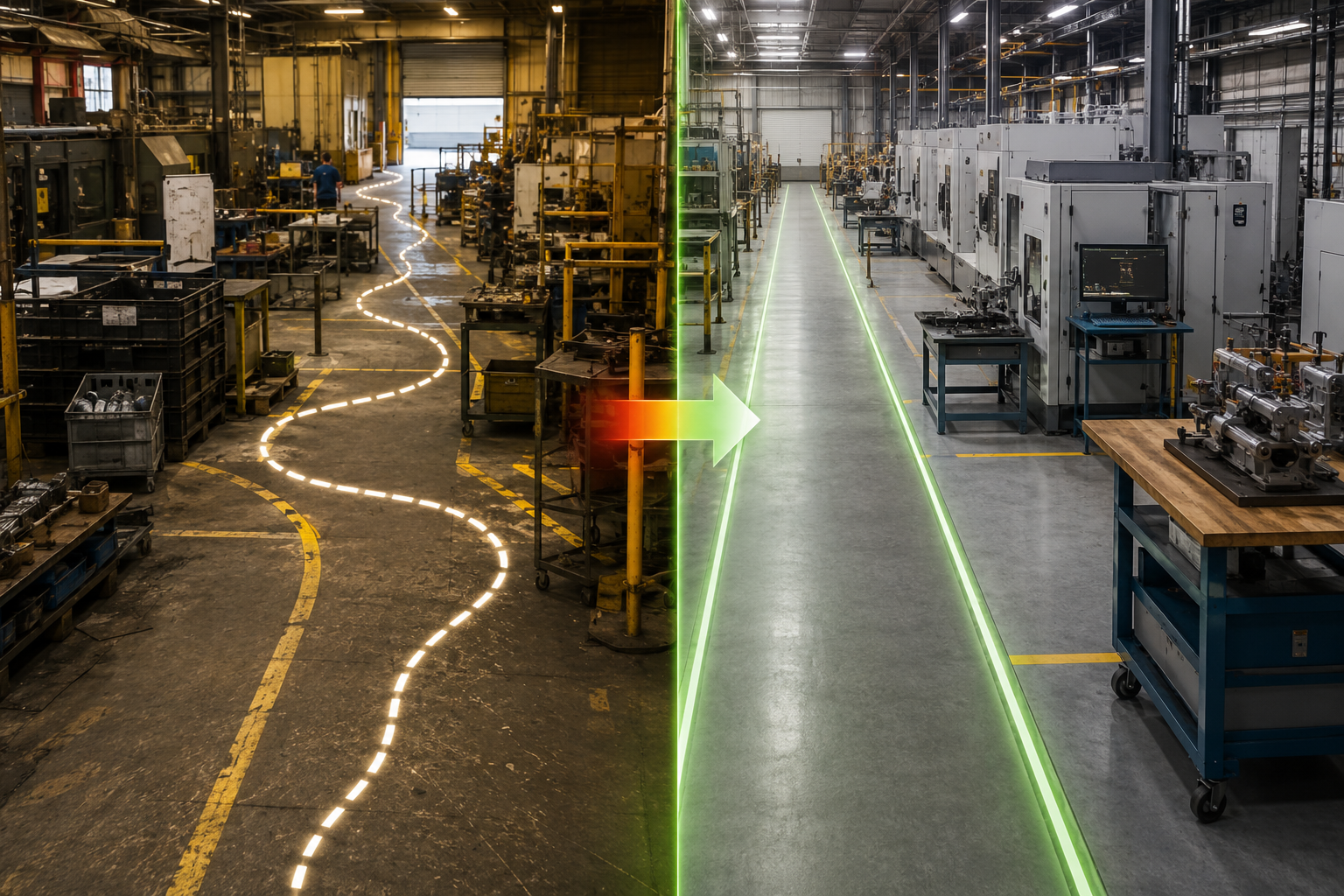
From 330 Feet to 4 Feet in 3 Days
A manufacturing team spent years living with an inefficient quality testing process. In just three days, they reduced travel distance from 330 feet to 4 feet, cut processing time in half, and uncovered a solution worth millions in additional capacity.
Kaizen Snapshot
Industry: Manufacturing
Challenge: Excessive travel, batching, safety risk, and delayed quality feedback
Approach: Kaizen Event Facilitation using rapid experimentation and team-led design
Results:
Distance traveled per part reduced from 330 feet to 4 feet
QC travel reduced from 175 feet to 4 feet
Batch size reduced from 6 pieces to single-piece flow
Processing time cut from 40+ minutes to approximately 20 minutes
Part lifts reduced from 4 to 1
More than 95% reduction in travel
More than 95% reduction in safety risk
Wastewater stream eliminated
Potential to double capacity
The Situation
A manufacturing team had been struggling with the same problem for years.
Every part required a quality test, but the process was designed around batching and distance. Parts were tested away from the production line, which meant multiple additional parts could already be in process before quality issues were identified.
The process had become accepted as "the way we've always done it," even though everyone knew it was inefficient.
The baseline measurements told the story:
330 feet of travel per part
175 feet of travel for QC per batch
Batch size of 6
More than 40 minutes of processing time
Multiple lifts of an 18-pound component
The team knew improvement was possible. They simply had not found a way forward.
What We Did
Rather than spending days discussing solutions, the team focused on building and testing them.
On Day 1, seven team members generated seven ideas each, creating forty-nine potential solutions.
The team quickly narrowed those ideas to seven concepts worth testing and immediately built prototypes using materials already available on-site.
On Day 2, the team established evaluation criteria and test procedures. They ran experiments, challenged assumptions, and narrowed the field to two leading concepts.
On Day 3, they combined the strongest elements of both approaches into a single design and implemented it directly in the production environment.
Equipment was relocated.
Material flow was redesigned.
The new process was tested using an actual production part.
The Results
The impact was immediate.
MeasureBeforeAfterDistance Traveled per Part330 ft4 ftQC Travel175 ft4 ftBatch Size61Processing Time40+ min~20 minPart Lifts41
Additional benefits included:
More than 95% reduction in travel
More than 95% reduction in safety risk
Complete elimination of waste entering the wastewater stream
Potential capacity increase worth millions annually
The Most Important Result
The numbers were impressive.
The people impact was even more powerful.
One operator, who had never participated in a Kaizen event before, looked at the redesigned process and said he couldn't believe how much easier his job had become.
At the final report-out, he stood in front of senior leadership and confidently explained what the team had accomplished.
It was the first time he had ever presented to leadership.
The pride, ownership, and confidence in the room were impossible to miss.
The team didn't just improve a process.
They proved to themselves what they were capable of accomplishing.
Key Lesson
Sustainable improvement happens when people stop talking about solutions and start building them.
In just three days, a team that had struggled with the same problem for years transformed its process, dramatically improved safety and efficiency, and created a solution they were excited to own.
That's the power of a well-facilitated Kaizen event.

Squarely in the Middle of the Action
How asking a better question and slowing things down unlocked a stubborn reliability problem.
Kaizen Snapshot
Setting: Armstrong World Industries’ Pensacola ceiling tile plant
Challenge: Inconsistent board squareness affecting downstream processes
Stakes: Reliability, quality, and future changeover success
Approach: Observation, cross-functional collaboration, high-speed analysis
Outcome: Root causes identified and eliminated, lasting reliability gains
Key Lesson: Some problems aren’t solvable until you ask the right question
The Situation
During my corporate career at Armstrong, I was known as someone who would do whatever it took to help the team win.
In the late 1990s, we were reconfiguring the Pensacola plant to dramatically expand the range of ceiling tile sizes and shapes we could produce.
That meant one thing: far more changeovers.
Before we could make changeovers fast, we had to make the process reliable.
What Was Getting in the Way
After the dryer, large ceiling boards were cut down to size by a massive panel saw. We called it the Dry Saw.
I noticed something subtle but concerning.
The boards appeared to enter and exit the saw at a slight angle. That small misalignment was enough to create downstream quality problems and it was happening consistently.
Bob, a highly experienced engineer, was scheduled to rebuild the saw. I shared what I was seeing.
At first, he was skeptical. Then he looked and saw it too.
Going Where the Problem Lived
We locked out the saw and climbed onto the table.
We raised the blades and lay directly beneath them, close enough that I could see the teeth inches above my face. Nothing obvious appeared out of square.
Then Bob had an idea.
“What if we use high-speed cameras and slow everything down?”
At the time, this was cutting-edge technology.
We rented the equipment, set up cameras at critical points, and recorded the process.
What We Learned
When we slowed the footage down, three issues became obvious:
The pusher bar feeding the first saw was slightly misaligned
The conveyor chains feeding the second saw weren’t square
The saw shaft slipped slightly with each full rotation
None of this was visible at full speed.
What Changed
All three issues were corrected during the next maintenance downday.
Immediately:
Boards ran square
Downstream processes stabilized
Changeovers became predictable
Bob designed the fixes into the rebuild and added preventative maintenance to keep it that way.
The Takeaway
Until we slowed the process down, we were guessing.
Once we asked a better question, the answer became obvious.
Why This Matters
Many reliability problems persist not because teams lack skill, but because they haven’t found the right way to see the problem.
The right question changes everything.
Want More Predictable Changeovers?
If reliability issues are undermining your improvement efforts, it may be time to look at the problem differently.

Technology Doesn't Have to be Scary
For two years, I facilitated monthly Kaizen events at CITY Furniture. These weren’t just about fixing specific problems. They were about strengthening their culture of continuous improvement. By the time we completed six events, people were lining up to be on the next teams.
One memorable event focused on organizing a chaotic repair parts storage area. We removed 75% of the clutter and built ownership that became a model for future teams.
What I didn’t tell you was this: the team also automated the entire inventory tracking system. And the person who made it happen was a 17-year-old hourly employee named Rob.
Rob was the son of one of the supervisors on the team. During our Gemba walk, it was clear the cluttered space wasn’t the only problem. Our area owner was drowning in paperwork and unreliable data.
While most team members focused on the physical mess, Rob saw a deeper issue: fractured information streams, disconnected reports, and no real-time visibility.
His idea? Consolidate everything into one digital report, accessible on an iPad. Then, take it further by barcoding every bin and tracking inventory in and out with a scan.
The team loved it but had no clue how to make it happen. Rob just smiled and said, “I’ve got this.” And off he went.
By day three, he had a prototype. He coordinated with IT, repurposed a company iPad, and built a working application. By week’s end, barcodes were in place, the app was live, and the team could track every part in real time.
I personally told the CEO about Rob and urged him to nurture this rising star. “Don’t let him get away,” I said.
Today, Rob’s a sales rep for CITY Furniture with a stellar track record and the same customer-first mindset that powered his Kaizen breakthrough.
Innovation doesn’t care about age, title, or tenure. Sometimes, your quietest contributor holds the loudest solution if you’re willing to listen.
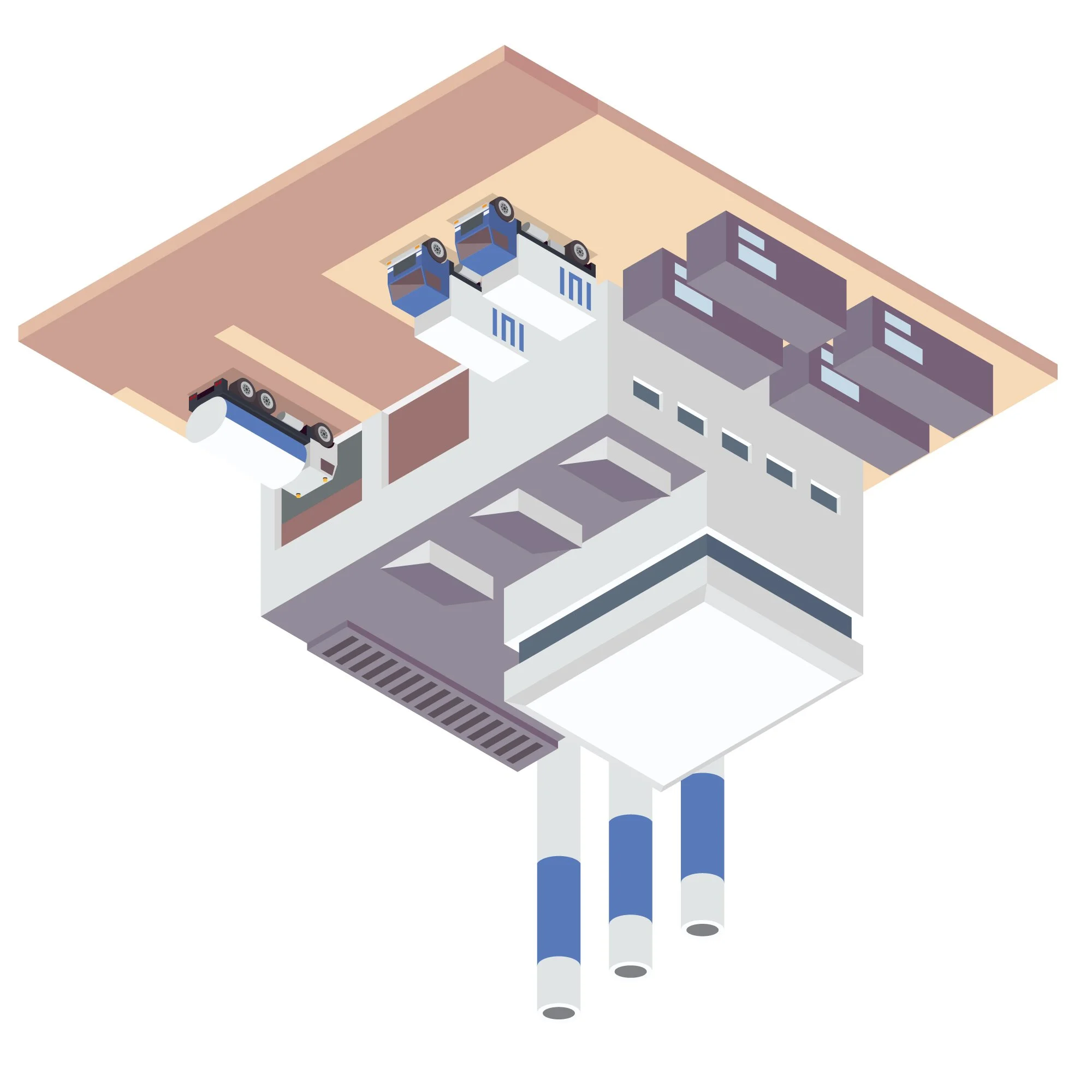
Turning the Factory Upside Down
When a packaging company reached out to me about facilitating a 3P (Production Preparation Process), I was intrigued. It’s the most advanced Kaizen approach I offer. They wanted this to be their very first experience.
Fortunately, I had an ally. Brett, a longtime colleague from my Armstrong days, had joined the company and believed 3P was the only way to address the plant’s design and operational constraints. The plant was bursting at the seams, and their lease made change feel impossible. But Brett believed they could break through.
Our goal: Develop 1–3 bold options to get the plant back on budget and positioned for growth, without relocating, if possible.
As expected, day one brought skepticism. In 3P, we ask people to suspend their constraints and imagine possibilities no one has yet seen. That’s a tall order.
The team followed the process, even when it didn’t fully make sense to them. At one point, I had to give tough love to a company veteran who wanted to skip a step and revert to his usual methods. He didn’t talk to me for a few hours, but by day three, everything changed.
The energy flipped. They saw it. They believed it. They were building something new and it could work.
By week’s end, we had two viable plans. One that reconfigured the current space and one that required a new building. Both met the business goals and sparked new thinking across the team.
At the report-out, the excitement was contagious. Brett strengthened his credibility and standing in the company. The team felt empowered. Some have since moved on, but they still reach out to say how much that 3P experience shaped them.
Breakthroughs don’t come from doing what you’ve always done. When you trust the process and your people new possibilities come into view.

Our Quest for the Holy Grail
This might sound dramatic, but in the world of suspended ceilings, we had a Holy Grail: a ceiling that looked like drywall but performed like an acoustical system. No visible grid. Total sound control. Full accessibility.
For decades, teams tried and failed. The problem? Suspended ceilings require grid for structure and access. Drywall doesn’t offer that and it also lacks acoustic performance.
Then our innovation manager had a bold idea: use the 3P Kaizen (Production Preparation Process) to tackle the problem. He knew we might not solve it in one go, but believed 3P could reveal the path forward.
I was asked to facilitate. The first sessions focused on hiding the visible grid. After many sketches and prototypes, the team landed on a clever idea: use overlapping fabric between tiles. It wasn’t perfect, but it disguised the seams better than anything we’d seen.
Some were disappointed it didn’t fully solve the challenge. But that first step revealed the next: develop a coating that could bind tiles together and create a seamless look without destroying acoustical performance.
The next 3P sessions pushed us farther. Dozens of experiments later, the team found a spray coating that did the trick. We brought in drywall contractors to test it. With their feedback, the final system was born.
After decades of struggle, we had invented a seamless, acoustical, accessible ceiling system. Within months, it hit the market. Today, that innovation drives a growing product category and is a cornerstone of the company’s success.
Breakthroughs rarely come in one giant leap. They’re built through persistence, process, and problem-solving. Sometimes the “Holy Grail” is one prototype away.
The Birth and Quiet Death of Definitions
The research and development team created a product that they thought would change the ceiling grid market. The bad news is that it was hard to produce and no one bought it. The good news is that it lead to future innovations that the market loved.
Early in my career, I was the Quality Assurance Manager at the Sparrows Point, Maryland ceiling grid plant. Grid is the metal framework that supports ceiling tiles, and it’s a product where precision matters. The slightest variation in length—thousandths of an inch—can keep the tiles from fitting correctly, especially in long ceiling runs like you’d find in airports or large office buildings.
Most of the time, ceiling grid is meant to disappear into the background. Our corporate team was working on a product they believed would change that—a grid that would intentionally stand out. The idea was to improve the aesthetics of the ceiling using a three-dimensional face.
The product was called “Definitions.” It was a plastic cap, molded into various profiles, designed to snap onto the face of the ceiling grid to give it a bold, new look. Marketing was confident they could sell millions of feet of it. Our plant was chosen to be the first to bring it to life.
There was a technical challenge. Ceiling grid is made of metal and produced in a continuous process—roll formed, pressed, and finished all in one line. The plastic cap couldn’t be added as part of that process. It would have to be applied in a separate, manual operation.
We cleared out a section of the plant and set it up as the Definitions production area. Because the white plastic cap was highly susceptible to dirt and grime—and our main lines used lubricants—we enclosed the area with plastic curtains to keep it isolated and clean. Finished grid would be brought over, the caps snapped on, with the final product packaged and stored in a dedicated warehouse area.
Our first attempts to attach the plastic caps were unsuccessful. It wouldn’t locate properly and stay on the grid. Eventually, we designed simple fixtures to help guide and secure the cap during the process. Once we figured that out, we developed standard operating procedures and set up a two-person team: one to place the caps in position on the grid, and the other to apply the pressure, using a special piece of equipment.
Even with the process in place, everything had to be almost perfect. The cap had to be placed with pinpoint accuracy, and its width had to match the grid within .002” (less than the width of a human hair) or it would pop off.
Progress was painfully slow. Contamination, inconsistency, tight tolerances, and poor productivity constantly worked against us. Producing Definitions took many times longer than making standard grid.
We produced 250,000 linear feet of the product. By the time we wrapped up the first run, every operator on the line made it clear—they didn’t want to do it again. It was just too tedious, too frustrating, and too slow.
The product sat in our warehouse for years. If anyone ever bought a box, I don’t remember it. Feedback from installers was brutal: the caps were too delicate, required gloves to handle, and slowed them down so much that using it actually lost them money.
While Definitions itself was a failure, it sparked a line of thinking that led to real innovation. The idea of a dimensional grid look lived on—and eventually, we developed new products that achieved a similar aesthetic directly on the main manufacturing lines. Those products were far easier to make, faster to install, and went on to become successful alternatives to standard grid. They’re still sold today.

Simpler is Safer, Lighter, and Better
I was in Florida, working with a residential building products manufacturer on our second Kaizen event together. This time, we focused on improving materials delivery to the production lines. The tasks were challenging, physically demanding, and slow, leading to high turnover in the material handling position.
I was in Florida, working with a residential building products manufacturer on our second Kaizen event together. This time, we focused on improving materials delivery to the production lines. The tasks were challenging, physically demanding, and slow, leading to high turnover in the material handling position.
Our ultimate goal was to make the job safer and easier, reducing turnover and its associated costs while boosting employee satisfaction across the organization.
We started the week with a Lean Principles workshop, followed by a Gemba Walk to observe the current processes. The good news? There were plenty of opportunities for improvement. The better news? Together, we’d brainstorm and implement solutions to reduce waste and achieve our goals.
The team divided into three sub-teams, each focusing on a specific area:
Delivery and loading of granular materials to the line
Organization of raw materials
Delivery and loading of rolled materials to the line
Granular Materials Team
This team observed workers shoveling materials into buckets, carrying them up a ladder, and pouring them into bins for processing—a labor-intensive and risky process. Could it be automated?
With creativity, quick thinking, and the repurposing of existing equipment, they modified a shop vacuum to draw materials directly from containers into the bins. They added a simple sensor to stop the vacuum when the bin was full and another to alert the operator when it was time to restart.
Organization Team
Using spaghetti diagrams, they mapped operator movements during daily tasks. The diagrams revealed a chaotic system: materials were stored wherever space was available, with no clear organization.
By rearranging the workspace, they created a visual and logical storage system, reducing unnecessary movement by over 75%.
Rolled Materials Team
This group tackled three main issues:
Placing rolls on a carrier
Placing the carrier on the production line’s framework
Moving and removing rolls when empty
To address the first issue, they replaced the heavy, cumbersome threaded rod and collar system with a smooth rod and spring clamps, similar to those used in weightlifting. This eliminated the time-consuming process of centering the roll and screwing collars into place. It also removed the need for heavy end plates, reducing the roll’s weight by over 10 pounds.
For the second and third issues, eliminating the end plates allowed them to redesign the system. They replaced the cradles on the framework with pinned locations, enabling rolls to slide directly into place and be securely pinned. This made centering effortless and eliminated the need to lift rolls over cradle points.
The Results
By the end of the event, every team had developed solutions that made the work safer, simpler, and more efficient. Even better, the changes were cost-effective and could be easily replicated across other lines in the facility.
Early feedback has been overwhelmingly positive. Employees report higher satisfaction and engagement, and we anticipate this will lead to significantly lower turnover in the material handling role.
Sometimes, the simplest solutions really are the best.

Creative Problem Solving Happens at Any Age
Problems are everywhere. It’s easy to feel overwhelmed and give up, thinking there are more problems than solutions. While it’s true we can’t solve everything—and some things are simply out of our control—my advice is to focus on the problems you can solve and be willing to experiment until you get the results you’re looking for.
Problems are everywhere. It’s easy to feel overwhelmed and give up, thinking there are more problems than solutions. While it’s true we can’t solve everything—and some things are simply out of our control—my advice is to focus on the problems you can solve and be willing to experiment until you get the results you’re looking for.
If you have small children, once had small children, or were a child yourself, you know they approach problem-solving in their own way. Want to build a fort but lack proper materials? A sofa and a bedsheet—BOOM—instant fort. Scribble wildly with crayons and declare it’s the solar system? Why not?
Growing up, my parents encouraged me to experiment and try things. My father was a patent examiner, and he often shared stories about the inventions he reviewed. He was also an inventor himself. Most of the time, I thought his ideas were silly, but that didn’t stop him from coming up with new ways to solve old problems.
We had a blue 1965 Dodge station wagon (yes, I’m that old). This was before seatbelt laws, and it wasn’t unusual for kids to stand up in the back seat to get a better view of the road. Honestly, it’s amazing we survived. We used the station wagon for family trips, with Mom and Dad in the front seats and my brother and me in the back. Dad had put foam mats back there to “protect” us from the road’s bumps and potholes.
Cars in those days were noisy, and it was hard to communicate from the back to the front. My brother and I, being little boys, spent most of the ride fighting, playing, and constantly needing something: snacks, drinks, bathroom breaks, or help breaking up fights. Mom and Dad couldn’t hear us over the road noise, so Dad decided to invent a solution.
After a few failed attempts, he cut a long vacuum hose down to an eight-foot length and ran it from the back of the wagon to the front seat. If we needed something, we’d speak into the hose, and Mom or Dad could (hopefully) hear us. Amazingly, it worked. For years, we had a cutting-edge communication system that no other car—or wagon—could match.
Eventually, cars got quieter, and the need for the hose disappeared. More likely, we got too big to ride in the back of the wagon, or someone finally realized tossing two boys into the back of a car without restraints wasn’t the best idea.
These days, when I facilitate Kaizen events, I encourage my team members to think like kids: try new things, embrace curiosity, and don’t be discouraged if an idea doesn’t work on the first try. There’s always something to learn, and often, they solve problems no one else has been able to tackle. Who knows? Maybe they’ll even come up with the next advanced communication system.

A Good Story Provides a Good Opportunity
I’ve always been a storyteller. Some people enjoy my stories, while others wish I’d get to the point faster. I get it—my approach isn’t for everyone. But storytelling is how I communicate my ideas. Sometimes, it even helps me get my way or stumble into an interesting adventure. Here’s one of those adventures.
I’ve always been a storyteller. Some people enjoy my stories, while others wish I’d get to the point faster. I get it—my approach isn’t for everyone. But storytelling is how I communicate my ideas. Sometimes, it even helps me get my way or stumble into an interesting adventure. Here’s one of those adventures.
I was working with a team on a project at Armstrong’s St. Helens, Oregon, plant. Our goal was to reduce changeover time across the facility using Lean techniques and some capital investments. Things were going well, but the project required the team to spend many weeks away from home.
When you travel a lot, routines develop—familiar hotels, restaurants, bars, and, of course, the facility you’re helping. But sometimes, you just want to break out of that routine. One trip, we flew into the Seattle airport, arriving midday, and didn’t need to be at the plant until the next morning.
Someone suggested dining at the Space Needle, about 30 minutes away. It seemed like a great idea, even though we didn’t have reservations. Fueled by a spirit of adventure, we decided to drive over and see if we could talk our way into a table.
On the way, we tracked down the phone number and called to see if there were any openings. Unsurprisingly, dinner was fully booked. But we weren’t deterred.
I decided to try my hand at persuasion. I told the host a bit of a half-truth: “We’ve just arrived in Seattle, traveling all the way from Pennsylvania specifically to dine at the Space Needle. Isn’t there any way you could find seating for four people who have always dreamed of dining with you?”
To my surprise, the response was warm and accommodating: “Of course we can. You’ve come all this way; we’d hate for you to be disappointed.” Thrilled, I asked for a contact name so we could personally thank them when we arrived.
Thirty minutes later, we walked into the Space Needle, where it seemed everyone knew about “the four travelers from Pennsylvania.” They were impressed that we had flown 3,000 miles just for dinner.
We stuck to our story the entire evening and soaked in the experience. The dinner was fantastic, the views from 500 feet above Seattle were stunning, and it became a memory we’d treasure for years.
As a bonus, the experience brought our team closer. We worked together more cohesively, and we started seeking out new adventures to share throughout the project.
These days, I encourage my Kaizen teams to create shared experiences during event weeks. Whether it’s through solving problems together, team dinners, or happy hours, I’ve noticed these moments rapidly build engagement and camaraderie.
I wouldn’t necessarily recommend stretching the truth often, but this felt like a victimless crime—unless someone lost their reservation because of “four travelers from Pennsylvania.” If that’s you, this story never happened!
What do you do when you’re the Industry Leader – you Improve!
Armstrong World Industries is the global leader in suspended ceilings. That might not seem like much to you, but when you sell over a billion square feet of ceiling tile and the grid to suspend it every year, you’re making a big impact in the construction and housing market.
Armstrong World Industries is the global leader in suspended ceilings. That might not seem like much to you, but when you sell over a billion square feet of ceiling tile and the grid to suspend it every year, you’re making a big impact in the construction and housing market.
One of the things that sets Armstrong apart is innovation and forward thinking in all of the things they do. Although other competitors are trying to influence building codes, Armstrong has the strongest presence and is leading the way in making sure office and other spaces are the healthiest, most energy efficient, and quietest they can be.
Paul, the head of codes and standards, was a big fan of my support to other areas of the technology department. We had many conversations on how Lean was helping his colleagues improve their processes and we often wondered how I could support his team’s efforts.
One day, we were talking about codes and standards and how Armstrong’s competitors were making inroads influencing the critical changes for building health and safety. Paul said it seemed Armstrong was losing its leadership position. People were participating on committees and submitting white papers, but weren’t moving the needle in the right direction. He felt we needed a breakthrough to retake our leadership position.
We both realized, almost at the same time, a strategy session could help drive the changes that would maintain our leadership presence. We agreed a Value Stream Mapping (VSM) session was the approach to take.
We plotted and planned. We chartered the event. We invited critical team members, including our internal customers, Sales and Marketing, manufacturing plant representatives, selected engineers and scientists, and members of Paul’s staff.
Our CEO kicked off the event and gave his support to the team. He told us what we were doing would be vital to the successful future for the company. No pressure at all! The team was enthusiastic and energized. But many of them wondered how using Value Stream Mapping would help them create a future that was any different than the path they were on.
There are two critical moments in any VSM event. The first is when you take a Gemba Walk (going to see) through your process. During this walk, the team saw many aspects of the current process that were overly complex and had opportunities for improvement. Many ideas were written down and shared.
The second critical moment happened when the team visibly mapped the current state process on a wall. There were so many steps and delays. There was waste and opportunity beyond anything they had imagined. Now that they could see it, they could do something about it. The ideas flowed even faster. There were so many things within the control of the team, and they prioritized the ideas they thought would make the most difference and could be implemented.
We built plans to attack the most impactful opportunities to drive codes and standards leadership. By the end of the week, we had a roadmap to distance ourselves from our competitors. Everybody won, as the changes would strengthen the health and safety of everyone who inhabits the office, school, and other business spaces. And, because of the alignment of the team and their sponsors, their customers would receive those benefits quickly.

Building Their Future
A leading global building products company reached out for assistance with a strategy session. When I spoke with Vince, the sponsor/team leader, I listened to his pain points and suggested facilitating a Value Stream Mapping (VSM) session for his team. He told me VSM wasn’t how he wanted to proceed. Even though I thought it would be the best approach, I listened to his concerns and modified my approach for his needs. I’m glad I did.
A leading global building products company reached out for assistance with a strategy session. When I spoke with Vince, the sponsor/team leader, I listened to his pain points and suggested facilitating a Value Stream Mapping (VSM) session for his team. He told me VSM wasn’t how he wanted to proceed. Even though I thought it would be the best approach, I listened to his concerns and modified my approach for his needs. I’m glad I did.
In the weeks leading up to the event, we strengthened our alignment on approach and expected outcomes and Vince engaged his team in preparation for this critical event. You see, they were intending to build their roadmap for the next 3 to 5 years. This could be worth millions of dollars and significant market share growth. We had to do it right.
The session was to begin on Tuesday, so I flew in and met Vince at the airport on Monday morning. We spent the first part of the day touring their local manufacturing facility. During the tour, I identified many improvement opportunities I thought might tie into the strategy session. Vince was intrigued by some of my ideas, including reliability and changeover improvements.
On Monday afternoon, we set up the meeting room and met some team members. We continued to talk about the upcoming session and some of the ideas from the plant tour. In the evening, we continued the conversation and alignment over dinner.
On Tuesday morning, we kicked off the session with a Voice of the Customer review. We then developed aspirational statements for the business. We would use these to help us design our strategy around for critical categories: safety, employee experience, customer experience, and manufacturing cost structure. The statements were impactful and compelling and inspired the team members.
Next, team members identified pain points and gaps in their current process keeping them from achieving their aspirational vision. Afterwards, they brainstormed actions and projects to eliminate those pain points and gaps. Many ideas were generated, including some thoughts around reliability and changeover reduction. We filled the walls with ideas. The room looked like a Post-it tornado had come through.
The team prioritized their many ideas down to the vital few they could develop and implement in the next three to five years. Reliability and changeover reduction made the cut. Following this, they created concept sheets to describe the critical work to achieve their future. After reviewing and aligning around most of them (2 were eliminated), they built a road map for the work on the one remaining wall in the room that wasn’t covered in Post-its.
As with many road mapping exercises, the team saw they had front-loaded the work in the most recent quarter and year, and some people were overloaded. This isn’t unusual and that’s why I like to make this process visual. They rearranged the work, and it looked more manageable.
Satisfied, the team felt they had built a compelling future they could stand behind. Proud of their work, they decided to keep everything on the walls for a corporate leadership review to be held the following week.
During the report out, they talked about their experience and how the visualization helped them align around a future they could be proud of. They also mentioned how they were able to focus and accomplish in one week what typically would take months to do.
Following the session, I was asked to support their reliability and changeover reduction efforts. I am looking forward to helping them achieve their vision.

A Brilliant Invention
In my early corporate days at Thomasville Furniture, I was given the opportunity to try many things to improve the performance and quality of the operation. This story isn’t about me, but another engineer, who came up with something so creative, he saved the company millions of dollars and improved quality of the product for our customers.
In my early corporate days at Thomasville Furniture, I was given the opportunity to try many things to improve the performance and quality of the operation. This story isn’t about me, but another engineer, who came up with something so creative, he saved the company millions of dollars and improved quality of the product for our customers.
We used many types of wood to create the fancy veneer tops of tables, cabinets, drawer fronts, and other parts of the furniture. The most expensive wood we used was burled walnut. It’s wood that has many swirls in it and multiple knots. Because of this, it’s prone to damage easily, and much of it has defects and cracks.
Some of the cracks could be “filled” using tape. This tape, when applied, would add moisture to the wood, causing it to grow and actually join one cracked side with another. After gluing and pressing onto a wooden core, the tape was sanded off and most of the time, the crack would be invisible to the eye.
Some of the defects couldn’t be repaired using tape. Because of this, full sections of the burled walnut veneer would have to be removed, leaving very little usable material. Our yield numbers were quite low, and even though we were making money on furniture with burled walnut veneer, we knew there was huge opportunity to reduce scrap and improve our profitability.
Jack, a mechanical engineer, thought there might be an answer, based on our ability to bring cracks together with tape and moisture. He wondered what would happen if defects could be cut out and replaced with non-defective material, and taped in place before pressing. Some of the operators were using this technique by hand with mixed results.
Jack realized doing this by hand was challenging, as the cut-out defect had to be the same size as the replacement material. Our most experienced operators could get pretty close, but less-experienced operators weren’t successful.
Jack built a small punch press in our maintenance shop and then tried different shaped punches to see if the defects could be hidden with tape and pressing. He started with a few basic shapes: square, rectangle, and circle. These shapes could cut out the defect cleanly and then create the replacement of the same size. When the new material was applied, taped, pressed, and sanded, you could “see” the line between the insert and the original hole. We weren’t sure why, but Jack had an idea. What if he created a random shape the naked eye wasn’t used to?
After a number of experiments, he came up with a shape that looked like a bumpy potato. We had all sorts of funny names for it, some I can repeat, others I can’t. My favorite was the “Doody Punch”! We stopped making fun of his idea when he showed us the results and challenged us to find the original defect. We couldn’t!
After showing his invention to the quality control director and other leadership, he got approval to implement his solution in the veneer plant. He created a variety of sizes for the Doody Punch and from then on, we were able to salvage almost every square inch of burled walnut veneer. Jack went on to invent many more devices and solutions for our manufacturing operations. This is the one that inspired me the most in my early problem-solving efforts.

The Unexpected Benefit
It was my first Kaizen event with a new client in Florida. They make building products for the residential market. On my first visit with Brian, my sponsor, I saw many opportunities to apply Kaizen to and made my recommendations. He picked his current pain point, which was labor utilization at the end point of a multi-line operation. The goal of the Kaizen event would be to balance work across all lines and require less labor to support the operation. The people wouldn’t be sent home, they would be redeployed to other parts of the plant where overtime was being used to keep things running.
It was my first Kaizen event with a new client in Florida. They make building products for the residential market. On my first visit with Brian, my sponsor, I saw many opportunities to apply Kaizen to and made my recommendations. He picked his current pain point, which was labor utilization at the end point of a multi-line operation. The goal of the Kaizen event would be to balance work across all lines and require less labor to support the operation. The people wouldn’t be sent home, they would be redeployed to other parts of the plant where overtime was being used to keep things running.
Brian was the plant manager and Jeff, our team leader, was the operations manager. We built the team with top players, as this first Kaizen event would set the tone for future efforts. We wanted a strong win. Our goals were challenging. Besides improving safety, we needed to reduce labor required by 30 percent.
Messaging to the team had to be supportive and reassuring. No one would lose their jobs by reducing labor required. I worked with Brian and Jeff to write the charter and communicate to the team in ways to strengthen their message and not make them fearful they would be blamed for labor reductions.
Our first day included a Gemba walk to a very hot production floor. It must have been 100 degrees. We watched team members do a lot of waiting and a few quality and cleaning tasks, except at one critical moment: When the pallet was full, it had to be wrapped, strapped, labeled, and removed. All while the next products were coming through the line (albeit at a very slow rate).
There were a few other tasks that took time away from the line, including a quality check every 30 minutes. This required the operator(s) to take a long part from the line, bring it to a saw, cut it to a specified length, and verify density of the product through a weighing process. Operators didn’t like this task for many reasons, including the transport of the product, time away from the line (which could happen at the moment packaging had to occur), and the use of the saw in the hot environment.
When we finished our Gemba walk, the team returned to the meeting room to brainstorm ways to improve things and simplify tasks. They prioritized three activities they thought could reduce effort and labor required: housekeeping, palletization, and product sampling and quality checks.
The housekeeping team created a cart with everything operators needed to maintain and keep the lines clean. All supplies were provided that typically would be searched for during the day, reducing time and effort for all operations.
The palletization team created locations for supplies, developed simpler palletizing methods, and created standard work that greatly reduced the time it took to wrap and palletize the product. This not only simplified things, but also reduced the stress the operators felt when finalizing each pallet of material.
The product sampling and quality check team wanted to reduce the time and effort it took to cut and weigh parts of the finished product. They experimented with relocating the saw, possibly buying a new saw or two, and buying another scale or two. All of those ideas would have helped. But then, someone asked, “Why do we need to cut the product at all?” The light bulb came on. What if they didn’t, and could weigh the finished product, without losing the critical quality information necessary for certification?
Inspired, they found an extra scale and weighed dozens of products, verifying the correlation between their results and the prior method. They met with the quality manager to align around their approach. He helped them build a plan to ensure their method could work. With the statistics confirming their method, the team had to come up with a simple way for operators to do the sampling without having to leave the line.
They mounted a scale to a cart that had height adjustments. Once they configured it properly, the cart could be brought up to the stack of products and one piece (up to 30 feet long) was slid onto the scale to get a quick reading. If too heavy for one person (identified in the standard work), they would get assistance from another operator or the section lead.
This new method turned a messy, hot, heavy, and minutes-long process into mere seconds. It was a huge win. But, even more than that, the need to destroy finished product had been eliminated, saving many hundreds of thousands of dollars annually.
Why didn’t they come up with this solution before the Kaizen, you may ask? We only know what we know. For the many years of the prior approach, no one had ever questioned it. People just did what they had been trained to do. Kaizen opened our eyes to possibilities and gave us the latitude to try new things. And because of this, we won.

My first VSM for a non-manufacturing process
I applied Lean thinking exclusively to manufacturing processes for many years of my career. I wasn’t able to stretch my thinking beyond what I could see – the production of a physical product and how it impacts the customer, business, and employees. I conducted Value Stream Mapping (VSM – a strategic planning approach based on the view of the customer) sessions for many manufacturing facilities and we were able to identify countless opportunities to significantly improve safety, productivity, quality, and customer service. I developed a reputation for my ability to engage teams and facilitate complex sessions.
I applied Lean thinking exclusively to manufacturing processes for many years of my career. I wasn’t able to stretch my thinking beyond what I could see – the production of a physical product and how it impacts the customer, business, and employees. I conducted Value Stream Mapping (VSM – a strategic planning approach based on the view of the customer) sessions for many manufacturing facilities and we were able to identify countless opportunities to significantly improve safety, productivity, quality, and customer service. I developed a reputation for my ability to engage teams and facilitate complex sessions.
I was approached by Henry, a coworker, to see if I would be willing to use my VSM approach and apply it to his marketing department. This was an intriguing request and a risky one. He had a strong Lean background and the vision to take what he learned beyond the manufacturing arena. I told him that if he was willing to take a chance, then so was I.
I took a session plan for a manufacturing VSM session and started tinkering with it to make it apply to a non-manufacturing process. It didn’t take long to realize the approach didn’t have to change much. The challenge was to help the team visualize their process in a way that would expose the waste, pain, and opportunities for improvement.
During a typical VSM, we take a Gemba walk of the process, to go and see what’s happening and what gets in the way of delivering for the customer. For the marketing department, the process wasn’t something we could easily see. How would I deal with that, I wondered. I talked it through with Henry and we bounced many ideas back and forth.
Then one of us (I’d like to say it was me, but I really don’t remember) suggested we didn’t have to physically see the process in order to visualize it. We had the experts in the room who knew what role they played in the overall process. We could have them talk us through their part, map it on a wall, and then visualize the entire process once all the experts had their say. As long as we started with the customer and worked our way back to the beginning, we could find the waste, pain points, and opportunities.
This was a brilliant revelation. Now the true test was to try it out in a real situation. And that’s what we did. The team engaged and gave their all. We visualized the current state of the marketing process and identified many wastes, pain points, and opportunities to provide an improved customer experience.
My mind opened to the possibilities. I could now apply Lean principles and Kaizen events to any process, not just manufacturing. Through the years, I learned the benefits in non-manufacturing settings can be multiples of manufacturing processes, as most groups haven’t pursued Lean thinking in these settings. There is so much opportunity it’s almost too easy to provide a winning experience for the teams I support.
I now apply VSM visualization to any process teams are trying to improve. It generates many “a-ha” moments and I often get comments like, “I didn’t realize our process was so complex. Now, by seeing it, I know what to do about it.” I recommend using Lean and VSM when you’re improving a process. You’ll be glad you did.

Raising the bar for quality
Amstrong World Industries and Worthington Steel combined forces to create the number one ceiling grid manufacturer in the world. It didn’t start out that way, as employees of both companies were feeling their way through the combination of cultures.
Armstrong World Industries and Worthington Steel combined forces to create the number one ceiling grid manufacturer in the world. It didn’t start out that way, as employees of both companies were feeling their way through the combination of cultures.
I had been a team manager (shift supervisor) at our plant near Chicago. We shut down the plant and I moved to the Baltimore facility as the Industrial Engineering and Quality manager. It was a critical moment for our new company and my career. We had to establish ourselves as a quality leader, in order to build consumer confidence.
I spent many hours on the factory floor, understanding where we stood in regard to production reliability and quality control. We had each line leader measuring the grid that was being produced and comparing it to product standard drawings. My early observations were that each person was interpreting the drawings differently and also measured based on their “feel” for the product. This meant somebody might think a product was within tolerance limits, even though the customer didn’t agree. This was reflected in a higher than industry standard return rate. We were at risk of losing customers unless we corrected our quality problems quickly.
I reviewed the product quality drawings and realized they were confusing and written for engineers, not production workers. Also, depending on how hard the measuring device was handled, people could make their measurements vary by up to .020” (twenty thousandths of an inch). This was a huge problem for ceiling grid, as tolerances could be as small as .010”.
I reviewed my plan with the plant manager. I would reformat the product quality drawings so they would be easy to understand and interpret as intended. At the same time, I would develop a measurement training program to help all employees measure the same way, with the same “feel.” I got approval for new measuring equipment, that was more repeatable and accurate than what we currently had at the plant. I was off and running.
I did an informal survey of many of the production technicians to help me understand how to format the product quality drawings to be easily understood by them. Specifically, I wanted them to understand the tolerance limits for any critical measurement. Previously, an example measurement would say 24.025” +/- 0.15”. This forced employees to add and subtract and sometimes make errors. Through their feedback, I changed all measurements to look like this (for the prior example): 24.010” – 24.040”. Now there was no confusion. As long as the measurement was within the range shown, it was a good product.
There were literally dozens, if not hundreds of drawings to correct, so I prioritized my work by the products that ran the most frequently first. Then, time permitting, I would correct the lower frequency products. Sometimes, I would have to change my process, as a rare product would be ordered, and we didn’t want to take the chance it would be measured incorrectly.
Now it was time to improve measurement reliability. Some people had a “hard” hand, meaning they would squeeze the measuring device against the bar of grid with much force. Others had a “soft” touch, meaning they barely touched the bar with the measuring device. I had to come up with another way to consistently find the correct measurement and then verify the variation between operators would be acceptable.
After many tests and trials, I developed the 2-step touch technique. Basically, the technician would squeeze the measuring device to find the bar, then back it off, and then bring it back to just “touch.”
No matter how hard or soft a hand people had, they were very consistent when it came to the second touch. In fact, the variation between operators was reduced from .020” to .003”. I instituted an audit and follow-up process to ensure we sustained our consistent measuring technique.
Over time our returns rate was reduced drastically, and we became the number one grid producer in the world. I learned that systems must be designed for the people who use them, rather than the people who create them.

Diving into the Deep End
Armstrong World Industries was forced to open a mineral wool plant, in response to the loss of a critical supplier of this vital raw material for ceiling tile manufacture. Because of this, they relied on more outside vendors to design and build the plant than they were comfortable with. They had never spun molten stone (slag) into fibers before and therefore couldn’t use their experience to reduce the potential for errors and inefficiencies in their process.
Armstrong World Industries was forced to open a mineral wool plant, in response to the loss of a critical supplier of this vital raw material for ceiling tile manufacture. Because of this, they relied on more outside vendors to design and build the plant than they were comfortable with. They had never spun molten stone (slag) into fibers before and therefore couldn’t use their experience to reduce the potential for errors and inefficiencies in their process.
The plant started up late, over the capital budget, and at greatly lower performance than required to meet the demand of the ceiling tile plants in the network. Things got so bad that management was shuffled, project team members were removed, and highest-level management was getting involved on a daily basis.
I was “asked” to help the plant achieve budget performance. Knowing this was a politically charged situation and that people who were involved were under intense scrutiny, I convinced my manager to let me visit the facility before committing to the work.
I spent three days at the plant, getting to know the workers, managers, and the process. What I saw was a very concerned and engaged workforce, committed managers, and a process that was absolutely horrible to run. How did we get here, I wondered. I knew I couldn’t fix the past. All I could do was try to improve the future.
There were so many problems, but we identified the biggest one that was causing significant safety, quality, and productivity risk. The molten slag (rock with metal components in it) was designed to fall into a pit and then be scooped up and delivered into a bin. If the slag hit any moisture, it would superheat the water and cause small explosions within the confines of the building. And, the pit was exposed to the outside elements, which naturally allowed moisture in. Another issue was that the front-end loader used to scoop up the molten slag barely fit between the walls of the pit. I saw evidence of damage to the walls of the plant that was less than one-year old. Someday, someone was going to hit a wall with such force that the entire structure would come down.
I spoke with my sponsors and told them incremental improvement wasn’t going to help. We had to figure out a way to keep the slag from falling into the pit in the first place, eliminating the moisture and equipment issue. They looked at me in a way that felt like, “Well, duh, but how the heck can we do that?” I suggested we run a Production Preparation Process (3P) Kaizen in order to tease out and develop breakthroughsolutions to this problem. 3P is the most challenging kaizen event I facilitate. It forces structured minds to get unstructured, go to their childhood mindset (an 8-year-old can solve any problem) and use nature’s influence for ideas. Many engineers and scientists find this difficult to participate in, but their input is essential.
A month later, we assembled a team of operators, managers, engineers, and outside vendors to take the 11-step creativity journey that happens during a one-week 3P Kaizen. We framed the problem in this way: Deliver the molten slag directly to the process without any outside intervention by equipment or the environment. Initial skepticism gave way to creativity, and by the second day, everyone was in it to win it.
By the end of the week, there were two practical solutions for the business to choose from. Both looked promising and reasonably priced, and in the months that followed, one was implemented. From then on, molten slag never hit moisture and the building walls were spared further damage.
More impressive was the feeling of engagement, teamwork, and pride permeating the workforce. They solved the problem, participated fullyand even identified other possible Kaizen events to run in the future.
The plant is still operating and is now the benchmark in the mineral wool industry. Armstrong was able to produce more mineral wool than internally necessary and then sell the wool to other companies. The workforce is highly engaged and continues to drive improvement on a daily basis.
I was amazed by the feedback of the team, who took on a monumental task and slayed their dragon. To a person, they were positively inspired by the effort and ready to take on the next challenges.

Experimenting in Europe
I was asked to co-facilitate a regional cost-reduction session with my Armstrong mentor, Fred, in Europe. He had facilitated many of these sessions over the years with great success. I was excited for the opportunity to work with him and tour around countries I wasn’t familiar with.
I was asked to co-facilitate a regional cost-reduction session with my Armstrong mentor, Fred, in Europe. He had facilitated many of these sessions over the years with great success. I was excited for the opportunity to work with him and tour around countries I wasn’t familiar with.
We planned the session together for a month before we left for Europe. It wasn’t unusual for these sessions to identify tens of millions of dollars of actionable improvement opportunities, so the investment of time was well spent. I was always impressed with Fred’s attention to detail and the way he was able to get strong engagement when he facilitated. I knew I was going to learn more about facilitation and strengthen my skills.
We flew to Europe on the weekend and spent a day looking at some castles and the little town we were staying in. Then, on Monday, we went to the corporate office and set up the conference room for the next day’s session.
Fred shared portions of the agenda with me to facilitate. He wanted me to gain experience leading this important session. He took most of the critical elements, including brainstorming and prioritization, as these were the areas in which he truly shined.
During the brainstorming session, I could tell Fred was getting a little tired and running out of ideas on how to draw more creativity out of the room. I suggested a short break and Fred was open to it. I asked Fred if he would be willing to let me step in for a few minutes, changing the tone of the session, by changing facilitators. He allowed me to do so, and I was able to squeeze a few more ideas out of the group.
Then, we took a lunch break. We were about to get into what Fred thought was going to be a lengthy session: the prioritization of the hundreds of ideas that had been generated. During lunch, Fred and I talked about his approach to prioritization. He was going to compare ideas against all others, generating an “A vs. B vs. C vs. all alternatives” matrix. Basically, the ideas that won the comparisons the most times would be the highest priority ideas to work on for the rest of the session.
I told Fred I thought it could take many hours to accomplish this and I may have a quicker way to complete the prioritization. He told me he’d like to try it his way first, but we could talk about adjusting if necessary.
After lunch, Fred drew a complex matrix on a whiteboard and explained his approach to prioritization. The team understood and was engaged as he took them through the initial stages of comparisons.
About thirty minutes in, I noticed some of the participants looked distracted and tired. I also realized we hadn’t finished the first set of comparisons. There were literally dozens more to be completed. I started thinking about how I could help get all these ideas prioritized in a shorter time. Then, an idea hit me. I asked Fred if we could take a short break and regroup. He accommodated my request.
During the break, I explained what I was noticing, did a quick calculation of how long it would take to finish it the way he had started, and asked if he was willing to try my suggestion. He asked for more details, and I explained I would like to try multi-voting with criteria. Using this process, each team member would pick the top 10 ideas they thought would provide the best cost-savings, be easiest to implement, and do no harm to anyone from a safety or quality perspective. Even though this approach didn’t seem scientific, I believed it was a way to utilize the diverse perspectives in the room and quickly build consensus around the many ideas generated.
Fred gave me the go-ahead, with a caveat. If this concept didn’t generate the results the team needed, from their perspective, we’d go back to his method.
I framed out the approach and explained multi-voting with criteria in detail to the team. They asked a few questions and even added an additional criterion to the list. I knew this approach had a chance because they were owning it!
Thirty minutes later, we had prioritized the many ideas into the top 20 to develop further for the company. We took the temperature of the room and by an overwhelming majority they agreed these 20 ideas were truly the top ones out of the total group. We documented all the other ideas, just in case they might be needed in the future.
Fred agreed this quicker approach likely got to the same conclusion that the “A vs. B v. C vs. all alternatives” comparison approach would have. I don’t think either of us could prove that, but we were relieved we had completed the prioritization in a way the team owned.
Over the years, I have refined my multi-voting with criteria approach to cut the prioritization time in half. I can explain it, facilitate it, and train others to do it. I am convinced I have found something to save precious time, even in the most complex ideation and prioritization sessions.

Zigging and Zagging Along the Way
I developed a Kaizen facilitator training program for CITY Furniture. Once I realized I could train others in facilitation techniques I had developed over many years of experience, I decided to share the program with my network.
I developed a Kaizen facilitator training program for CITY Furniture. Once I realized I could train others in facilitation techniques I had developed over many years of experience, I decided to share the program with my network.
The program contains experiential learning topics covering my top facilitation principles, facilitation practices, Chartering to Win, the Wheel of Sustainability, and other topics I utilize to ensure Kaizen teams have a sustainable, winning experience. I reviewed this with a potential client who was extremely interested.
One month later, with a purchase order in hand, I modified the program to meet some specific needs, as defined in a series of meetings leading up to the training. We even developed a charter for the training, making sure it aligned with the leadership vision of the company.
Although I had previously trained 4 high-potential candidates with CITY Furniture, I was confident I could offer the training to a class of up to 8 participants. In order to give everyone the opportunity to participate in all training exercises, I recommended we expand the course from 2 ½ days to 3 ½ days.
On the first day, I covered critical foundational topics, such as:
· The separate roles of facilitator, team leader, and team sponsor.
· My top 12 facilitation principles
· Top facilitation techniques with exercises for all participants
I was hoping to cover prioritization techniques, but realized things shouldn’t be rushed, so I moved it to the following day. The team was asked to provide feedback on how the day went and while most was positive, there was some discussion about other topics to cover, including a demonstration of a facilitated Gemba Walk.
I reviewed the feedback with my sponsor and he agreed the team needed a Gemba walk demonstration to help them understand the role of the facilitator during this critical Kaizen exercise. I agreed and had to determine which other topics might have to be shortened or removed. Luckily, the extra day built into the training gave me some flexibility.
On day 2, we began by discussing chartering. We had eight real Kaizen events, with sponsors waiting “on-call” for chartering discussions with the trainees. This was to occur between 10:15 and 11:30 am. At 10:30, facilitators met in-person and virtually with their sponsors and worked on charters for upcoming Kaizen events. This made the training real and compelling. All participants learned how critical it was to properly charter their upcoming events and that getting their sponsors to be clear, concise, and aligned wasn’t as easy as it appears to be.
I scheduled the facilitated Gemba walk after lunch. The trainees were given an assignment to identify improvement opportunities on a production line, while I facilitated them to stay on task and engage with the technicians working on the line. After 45 minutes, I brought them back into the meeting room to demonstrate idea gathering and prioritization, which had been delayed from the prior day.
Once this exercise was completed, I had time for one more critical topic, even though the agenda had two in the plan. I chose the one that would be easiest to retain, as it was extremely interactive.
At the end of the day, the feedback was once again mostly positive, with appreciation for the addition of the Gemba walk. There were still thoughts about topics that weren’t included in the agenda. I had to determine how to deal with those. My decision was to utilize any remaining time on the third day for “Bonus Topics” that hadn’t been covered and would be chosen by the trainees.
Day 3 went smoothly and allowed two hours for “Bonus Topics.” I was even able to get the trainees to practice the brainstorming and prioritizing techniques to choose the topics. We covered everything on the list and still had a few minutes to spare. With that, I let the team share their feedback again and then adjourn early. They were exhausted and so was I.
The feedback was very appreciative of the bonus topics and there was still concern about other things we weren’t able to cover. I realized no matter how many topics we covered, there would still be something someone wanted or needed. I had to use my best judgement around what would give them the best foundation for their next steps as Kaizen facilitators.
On day 4, we practiced a panel-discussion report out and when it was delivered to our audience, was extremely well received.
I got so much valuable feedback from the participants and sponsors that I am sure the next version will be even better. But I will also leave some time for adjusting based on the feedback of the next training class. I know it’s more important to meet their specific needs than just cover topics I think are the most important.

A Picture is Worth More than a Thousand Words – It’s Priceless
Earlier this year, I received an email from someone I never met, asking about my approach to 5S – organizing a workspace to improve safety and productivity. He heard about me from another location in his company, who I helped six months earlier. Later that week, we were in a Zoom meeting, and he invited me to his factory in Oregon to see if I could help jump-start their 5S efforts.
Earlier this year, I received an email from someone I never met, asking about my approach to 5S – organizing a workspace to improve safety and productivity. He heard about me from another location in his company, who I helped six months earlier. Later that week, we were in a Zoom meeting, and he invited me to his factory in Oregon to see if I could help jump-start their 5S efforts.
Three weeks later, I was on a plane, heading to the west coast. I arrived early in the afternoon and met with Ben, my sponsor. We took a tour of the factory and strategized about my approach with the leadership team the next day. I saw many places where 5S and other Lean tools could help them out. People in the factory were engaged and appeared ready to take a first step on their continuous improvement journey.
That evening at dinner, Ben told me about past continuous improvement efforts. There weren’t many success stories shared. I was told one consultant had visited and said he couldn’t help them. I couldn’t understand how that was possible.
The next morning, Ben and I walked around the factory again. It helped ground me and remind me of the complexity of their processes. A little later, I attended the morning leadership walk around the factory. Although there were a dozen staff members attending, only one or two were engaged at any time. I took a risk and gave Roy, the facility manager, some feedback about how he might engage his staff more effectively. He took my feedback in stride (he didn’t kick me out of the plant, so that was a good sign).
After the leadership walk, Ben and I talked about what I had seen, and we prepared for the leadership review at lunch. We created a list of the top three areas that could use my help. There were unlimited opportunities for improvement at the facility.
At lunch, we crammed into a small conference room. There may have been a dozen people seated around a table designed for six. I introduced myself and thanked them for giving me the opportunity to visit and learn about their processes. I spoke about what I saw and where I thought I could help. I wasn’t getting much engagement from the leadership team and realized my words weren’t connecting with them. With a less than successful history of continuous improvement efforts at their factory, they were naturally skeptical.
That’s when it hit me – talk about the successful Kaizen event from their sister facility. I started describing the work I did with the team. We were able to reduce a critical changeover by many hours, leading to substantial savings for the company. The leadership team started asking some questions. Then, I asked Ben if he had the report out from the Kaizen. He projected it on the screen. Now the questions were flowing. People were amazed at the “before” and “after” photos. How did we do this? Is it still working? How might we apply a similar approach locally?
Next, Roy asked where I would start. I reviewed the three areas Ben and I had prioritized. Roy said those were good choices, but he preferred to start at the beginning of the process, where quality would be most affected. I was happy to oblige, as it was much more important to gain alignment than to worry about where to start. Ben agreed and now we were talking about when we could kick-off the first Kaizen event.
I said I would charter the event with Ben, and then we could review it for approval. From there, I would write a proposal and then, once receiving a purchase order, the work could begin. I normally like to think for 24 hours before writing my proposal. But speed was critical. After chartering with Ben, I found a quiet office to write my proposal for the Kaizen. Then, Ben and I met with Roy and we were met with enthusiastic approval. I left the facility with a purchase order. The following month, I ran their first “successful” Kaizen event. But that’s another story for another day.
Go With Your Gut
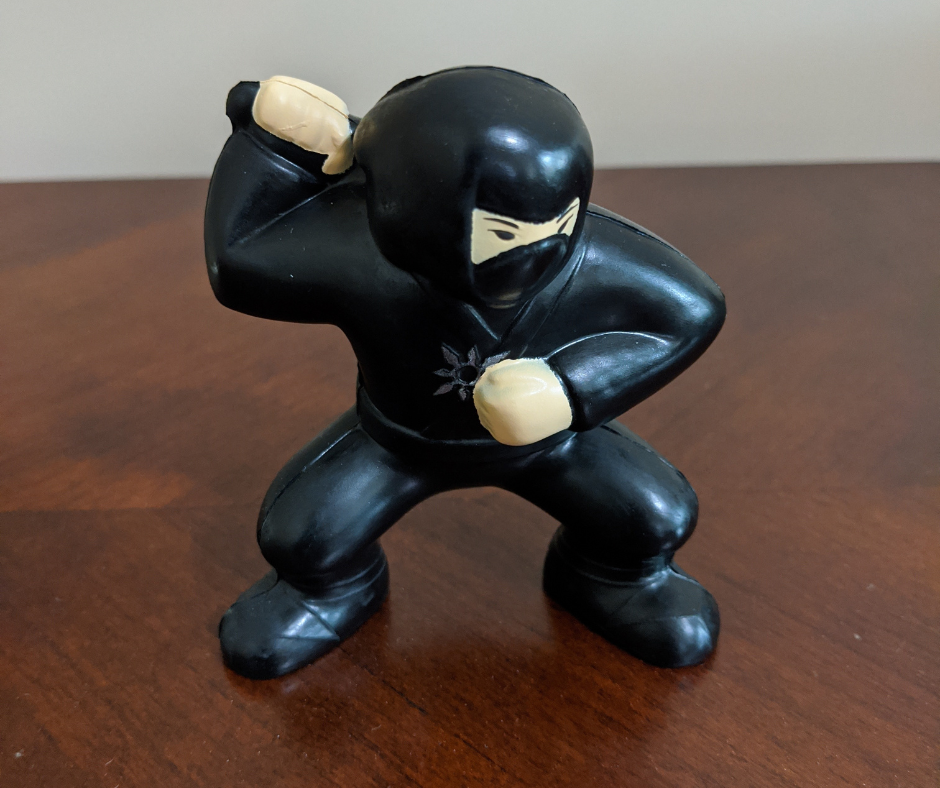
I love giving out little trinkets. It’s fun to see people’s reactions to the things I hand out – coins, ninjas, books. This story is about ninjas.
I love giving out little trinkets. It’s fun to see people’s reactions to the things I hand out – coins, ninjas, books. This story is about ninjas.
I consider myself a Kaizen Ninja. Many years ago in Japan, Ninjas came out of the shadows to deal with a situation (usually violently), and then return to their home base, unseen. I’m not violent, but when I facilitate, I want the team to solve their problem and own their solution. It can’t be my idea. Don’t get me wrong, with over 350 Kaizen events under my belt over these many years, I have seen so many problem-solving techniques and ideas it’s almost impossible not to have a solution to offer to my team members.
Instead of telling, I influence team members to come up with ideas and solutions that may elude them otherwise. Sometimes, I must be direct, but most times, I can guide them from the side to a solution. Thus, I am a Kaizen Ninja.
I signed up to be a sponsor for the BTOES2021 (Business Transformation and Operational Excellence Summit) conference in Orlando, Florida. As part of my sponsorship, I was scheduled to run several workshops and was given a small booth on the conference floor. I had to decide what to bring with me. I was going to be doing a book signing, so that was an obvious choice – bring a bunch of books. Others had books, so what else could I bring? Working with a local promotional item company, we came up with a ninja stress-reliever. I ordered 200 and planned on bringing all of them to the conference.
Two months later, during a meeting with my marketing mentor, a retired marketing executive with Armstrong World Industries, I reviewed my plans for the conference. After talking about how to maximize the value of my time at the conference, I showed her a ninja. She wasn’t impressed. She told me, “Adam, people don’t really use the swag they pick up at conferences. They take it to be nice, and then they get back to their hotel rooms and throw everything away.” She liked some of my other ideas – sticky notes with ninjas imprinted on them, and my books too.
I was floored. I had just spent hundreds of dollars on my ninjas. I was committed to the idea. I knew she was probably right, but I was determined to make the best of my decision. I decided to go with a ninja theme and see if I could attract attention and make many connections during the conference.
I arrived at the conference and found my booth. There was a lot more space than I realized to place items. After putting books on the table, I started lining up ninjas. Sixty of them were set up like a little army of process improvers. I also had ninja-themed signage for my book signing, workshops, and roundtables I would be hosting.
Once the conference opened, people started milling around the booths. The first few asked me sheepishly about my ninjas and I told them about my talents as a “Kaizen Ninja.” They seemed amused. By the middle of the conference, ninjas were being shared with almost every attendee. They were a hit! I almost ran out. I realized it wasn’t the item attracting people, it was the backstory and the energy I was bringing to it. While most booths were very dry and professional, I was having fun and people seemed to appreciate my approach.
After the conference, with newfound confidence, I started bringing ninjas to all my Kaizen events. I would make team members earn them. By the end of the week, every team member had received at least one. Walking around offices, I found about half of all ninjas given out were displayed on desks. This continues to validate my choice of giveaways.
I reviewed the “ninja-effect” with my marketing mentor, and she said she was happy to be wrong about my ninjas. I was just happy that my investment didn’t go to waste and that people enjoyed having a “ninja-moment” with me.