
Kaizen Success Stories
Real Manufacturing Results. One Kaizen at a Time
Explore real-world Kaizen success stories showing how manufacturing teams solved critical problems, improved performance, and created sustainable results.

Squarely in the Middle of the Action
How asking a better question and slowing things down unlocked a stubborn reliability problem.
Kaizen Snapshot
Setting: Armstrong World Industries’ Pensacola ceiling tile plant
Challenge: Inconsistent board squareness affecting downstream processes
Stakes: Reliability, quality, and future changeover success
Approach: Observation, cross-functional collaboration, high-speed analysis
Outcome: Root causes identified and eliminated, lasting reliability gains
Key Lesson: Some problems aren’t solvable until you ask the right question
The Situation
During my corporate career at Armstrong, I was known as someone who would do whatever it took to help the team win.
In the late 1990s, we were reconfiguring the Pensacola plant to dramatically expand the range of ceiling tile sizes and shapes we could produce.
That meant one thing: far more changeovers.
Before we could make changeovers fast, we had to make the process reliable.
What Was Getting in the Way
After the dryer, large ceiling boards were cut down to size by a massive panel saw. We called it the Dry Saw.
I noticed something subtle but concerning.
The boards appeared to enter and exit the saw at a slight angle. That small misalignment was enough to create downstream quality problems and it was happening consistently.
Bob, a highly experienced engineer, was scheduled to rebuild the saw. I shared what I was seeing.
At first, he was skeptical. Then he looked and saw it too.
Going Where the Problem Lived
We locked out the saw and climbed onto the table.
We raised the blades and lay directly beneath them, close enough that I could see the teeth inches above my face. Nothing obvious appeared out of square.
Then Bob had an idea.
“What if we use high-speed cameras and slow everything down?”
At the time, this was cutting-edge technology.
We rented the equipment, set up cameras at critical points, and recorded the process.
What We Learned
When we slowed the footage down, three issues became obvious:
The pusher bar feeding the first saw was slightly misaligned
The conveyor chains feeding the second saw weren’t square
The saw shaft slipped slightly with each full rotation
None of this was visible at full speed.
What Changed
All three issues were corrected during the next maintenance downday.
Immediately:
Boards ran square
Downstream processes stabilized
Changeovers became predictable
Bob designed the fixes into the rebuild and added preventative maintenance to keep it that way.
The Takeaway
Until we slowed the process down, we were guessing.
Once we asked a better question, the answer became obvious.
Why This Matters
Many reliability problems persist not because teams lack skill, but because they haven’t found the right way to see the problem.
The right question changes everything.
Want More Predictable Changeovers?
If reliability issues are undermining your improvement efforts, it may be time to look at the problem differently.

Hope is a Precious Commodity
I’m passionate about helping teams improve the reliability of their processes, using basic yet effective techniques to immediately boost the performance of their manufacturing lines. The best part is that the team can see and feel the results, and the techniques I teach are easy to learn and transferable to other lines and processes within the facility.
In a previous story, I described how a strategy session for a building products company led to several reliability improvement Kaizen events. This story focuses on one of those events in Mississippi.
I’m passionate about helping teams improve the reliability of their processes, using basic yet effective techniques to immediately boost the performance of their manufacturing lines. The best part is that the team can see and feel the results, and the techniques I teach are easy to learn and transferable to other lines and processes within the facility.
I flew into Memphis early on a Sunday morning, with no plant commitments until the afternoon, so I decided to tour Graceland and learn more about Elvis Presley. Although I wasn’t a fan before the visit, I gained a lot of respect for the man, his philanthropic efforts, and his impressive cars and eccentric outfits. It was quite the experience.
Afterwards, I met my contact at the plant, and we set up the meeting room for the upcoming week. He mentioned that many of the team members were hourly operators and mechanics who were skeptical about what could be achieved, and whether their voices would truly be heard. We walked through the plant, and he showed me the line we would be working on. Based on what I saw, I was confident we could make a real difference and engage the team in a way that would be meaningful to them.
On Monday morning, we kicked off the session with safety expectations, introductions, a charter review, and an overview of Lean and reliability principles. I quickly learned that most of the team members had no prior experience with Lean or Kaizen, so I had to start with the basics. This typically takes about 2 to 3 hours, and I present it using PowerPoint and activities. I know that people aren’t always excited about slides, but in my experience, some foundational understanding is necessary before we take our Gemba Walk. It used to take a full day, so I think I’ve gotten more efficient at it.
During the Gemba Walk, the team members were able to connect the reliability concepts I was teaching them to the issues on the line. If they were unsure about something, I could point out specific opportunities for improvement.
Back in the meeting room, we identified and prioritized the areas we would focus on. We broke into three sub-teams, and I worked with two mechanics and an operator to begin with the most basic tasks: centerlining and leveling the equipment.
They were shocked to see how much of the equipment was misaligned and out of level. The good news is that by the second morning, everything had been leveled and centered. The better news was that when we restarted the line, it ran better than anyone could remember.
Excitement began to fill the team, and improvements were happening across the board. By Wednesday, Jake, a mechanic who had been with the plant for over 20 years and was initially skeptical, came up to me, tapped me on the shoulder, and said, “Adam, you messed up (not exactly what he said, but you get the idea)! You gave me hope!”
I told him, “I’d like to say I’m sorry, but I’m not! Now that you know what’s possible, your job is to share it with your coworkers on the other lines!”
The rest of the week flew by, and by Friday, we had achieved something we were all proud of. The difference between this line and the others in the plant was striking. Now, the only thing shutting the line down was planned maintenance.
Jake took on the role of Area Owner, proudly holding himself and others accountable for following all of the reliability and safety requirements on the line. During a recent visit to the plant, he even demonstrated the principles of reliability to my original sponsor, the vice president of manufacturing.
Skepticism had been replaced by optimism, and the plant has already begun transferring what they learned to other lines. Before long, they should have all of their lines operating at higher reliability levels.

Simpler is Safer, Lighter, and Better
I was in Florida, working with a residential building products manufacturer on our second Kaizen event together. This time, we focused on improving materials delivery to the production lines. The tasks were challenging, physically demanding, and slow, leading to high turnover in the material handling position.
I was in Florida, working with a residential building products manufacturer on our second Kaizen event together. This time, we focused on improving materials delivery to the production lines. The tasks were challenging, physically demanding, and slow, leading to high turnover in the material handling position.
Our ultimate goal was to make the job safer and easier, reducing turnover and its associated costs while boosting employee satisfaction across the organization.
We started the week with a Lean Principles workshop, followed by a Gemba Walk to observe the current processes. The good news? There were plenty of opportunities for improvement. The better news? Together, we’d brainstorm and implement solutions to reduce waste and achieve our goals.
The team divided into three sub-teams, each focusing on a specific area:
Delivery and loading of granular materials to the line
Organization of raw materials
Delivery and loading of rolled materials to the line
Granular Materials Team
This team observed workers shoveling materials into buckets, carrying them up a ladder, and pouring them into bins for processing—a labor-intensive and risky process. Could it be automated?
With creativity, quick thinking, and the repurposing of existing equipment, they modified a shop vacuum to draw materials directly from containers into the bins. They added a simple sensor to stop the vacuum when the bin was full and another to alert the operator when it was time to restart.
Organization Team
Using spaghetti diagrams, they mapped operator movements during daily tasks. The diagrams revealed a chaotic system: materials were stored wherever space was available, with no clear organization.
By rearranging the workspace, they created a visual and logical storage system, reducing unnecessary movement by over 75%.
Rolled Materials Team
This group tackled three main issues:
Placing rolls on a carrier
Placing the carrier on the production line’s framework
Moving and removing rolls when empty
To address the first issue, they replaced the heavy, cumbersome threaded rod and collar system with a smooth rod and spring clamps, similar to those used in weightlifting. This eliminated the time-consuming process of centering the roll and screwing collars into place. It also removed the need for heavy end plates, reducing the roll’s weight by over 10 pounds.
For the second and third issues, eliminating the end plates allowed them to redesign the system. They replaced the cradles on the framework with pinned locations, enabling rolls to slide directly into place and be securely pinned. This made centering effortless and eliminated the need to lift rolls over cradle points.
The Results
By the end of the event, every team had developed solutions that made the work safer, simpler, and more efficient. Even better, the changes were cost-effective and could be easily replicated across other lines in the facility.
Early feedback has been overwhelmingly positive. Employees report higher satisfaction and engagement, and we anticipate this will lead to significantly lower turnover in the material handling role.
Sometimes, the simplest solutions really are the best.

Plant Reliability Rollout – the Story of Mobile
I was a corporate industrial engineer at Armstrong World Industries. From time to time, I was given projects that impacted all facilities around the world. John, our manufacturing VP, was hired from an outside company. He was determined to have an accurate measure of performance, to compare facilities, and identify the highest value opportunities for improvement and investment.
I was a corporate industrial engineer at Armstrong World Industries. From time to time, I was given projects that impacted all facilities around the world. John, our manufacturing VP, was hired from an outside company. He was determined to have an accurate measure of performance, to compare facilities, and identify the highest value opportunities for improvement and investment.
John developed a metric he called Plant Reliability. I was tasked to help ensure Plant Reliability (PR) was properly calculated and implemented everywhere we made ceiling tiles. Working with the IT department, we were able to capture the components of PR automatically and set baselines for the many different products produced globally.
John wasn’t satisfied with just creating the metric. He wanted to change the culture around PR, so people could see how they could impact it in a positive way. He wanted the whole organization talking about and strategizing around Plant Reliability. John was trying to move us to a culture of performance and accountability. He was determined to do it one leader at a time.
After working with each plant’s staff and measuring Plant Reliability for a few months, John was confident it was correct and there was a positive correlation between PR and profitability at the facility level. Now it was time to assess whether the leadership teams were utilizing PR in a way that engaged their employees. John’s vision was that anyone in the facility should be able to connect their work to the overall metric so they could understand how they impacted it and then adjust their actions to drive PR in a positive way.
John took me with him on a tour of Armstrong’s North American facilities to perform a Plant Reliability audit. At each facility, we planned to meet with the leadership team, production operators, mechanics, electricians, and other staff. We wanted to find out how well they understood Plant Reliability and if it was being used to drive performance and accountability.
Our first stop was Mobile, Alabama. Early in the morning, we met with the leadership team. They regaled us with graphs and charts, showing us how Plant Reliability was on a positive trajectory. They told us how everyone in the plant was aligned and engaged in their role to increase PR. After the presentation (dog and pony show), we took a walk through the facility with the Plant Manager.
We stopped at a production line, where an operator was struggling with a downtime issue. He had just called for assistance. John asked him what the problem was that he was dealing with.
“Oh, this equipment always shuts down intermittently. I just called the electrician to reset the control systems,” he said. He told us he experienced shutdowns like this three or four times a week.
John asked him if he had heard about Plant Reliability. The operator said he had heard the term used in crew meetings, but little elsewhere. He was then asked if he could describe what the term meant. He said, “I think it’s a measure of performance, but I’m not sure how it’s calculated. I don’t really understand it.”
John held his composure and thanked the operator and asked him if there was anything we could do to help. We were told no, and we walked on. The Plant Manager excused himself and walked to a meeting.
Five minutes later, we noticed an electrician sitting in a small office with his feet on a desk. We walked in, introduced ourselves, and asked his name and what he did at the plant. He told us his name was James and he did a little bit of everything. Right now, he was trying to diagnose the intermittent breakdown we had observed earlier. John said that it didn’t seem like he was too urgent about it, with his feet up on the desk.
“Well,” James told us, “Them operators aren’t too smart, and it takes some strong thinking to figure out these problems.” The anger was welling up in John as he wrote something in a notepad. I asked the electrician if he could tell us anything about Plant Reliability. He said, “That’s for the suits. Not for us real workers. It’s not important. What is important is making the line run.” With that, John stormed off and wrote more notes in his notepad.
Something bad was coming. We walked to the Plant Manager’s office. John told me to wait outside. I heard the yelling and scolding. It sounded one sided.
After we left the plant, I drove us to a Waffle House for dinner. John was a big fan of their simple Southern menu. While we ate, John told me what had happened and what made him so upset. “Plant Reliability isn’t for the leaders, it’s for everyone. We’re trying to help people do the right thing every day and if we withhold information from them, they won’t know what the right thing is.”
From that moment, I knew I needed to help plant leaders truly understand PR and how they could communicate and align their organizations around it. I created separate meetings with plant leaders and guided them through this journey, acting as a liaison and buffer from John. Follow-up visits went much better and I would soon get the opportunity to apply what I learned when I was promoted to Operations Manager at the St. Helens plant.
Things Aren’t Always What They Seem
In 2011, Armstrong’s Marietta ceiling plant was utilizing technical resources and replacement workers to run the plant. Management and the labor union were unable to come to an agreement around their contract, and for seven months, the union workers were locked out.
In 2011, Armstrong’s Marietta ceiling plant was utilizing technical resources and replacement workers to run the plant. Management and the labor union were unable to come to an agreement around their contract, and for seven months, the union workers were locked out.
During that time, I assisted with day to day production operations, maintenance activities, and many process improvements. I worked all over the plant, identifying and implementing as many improvement projects as possible. I was extremely motivated, as the projects improved safety, quality, and productivity for the rest of the plant. The work helped me through the long days, energizing me as I could see instant results from my efforts. Others were mostly happy with my work. I say mostly, because not everything worked as planned or as expected. This one of those stories.
The Lamination Line
One of the most critical lines in the plant was the lamination line. It put a top layer on the ceiling tiles. Customers were willing to pay a premium for these tiles. The lamination line was producing at a lower than budgeted rate and had a large amount of downtime. I decided to see if I could help reduce the downtime and increase the production rate.
When I arrived at the line, I met with Wayne, an innovation scientist who was running the line and teaching others to operate it efficiently. We discussed the issues causing line downtime and reduced output rate, then he gave me a tour of the line. On the tour, it became apparent that the position of the board as it enters the laminating process was most critical. I noticed boards were entering the process at an angle. Wayne told me most of the time the angled board could be cut into usable pieces and when it appeared to be too much of an angle, he would stop the line and make adjustments.
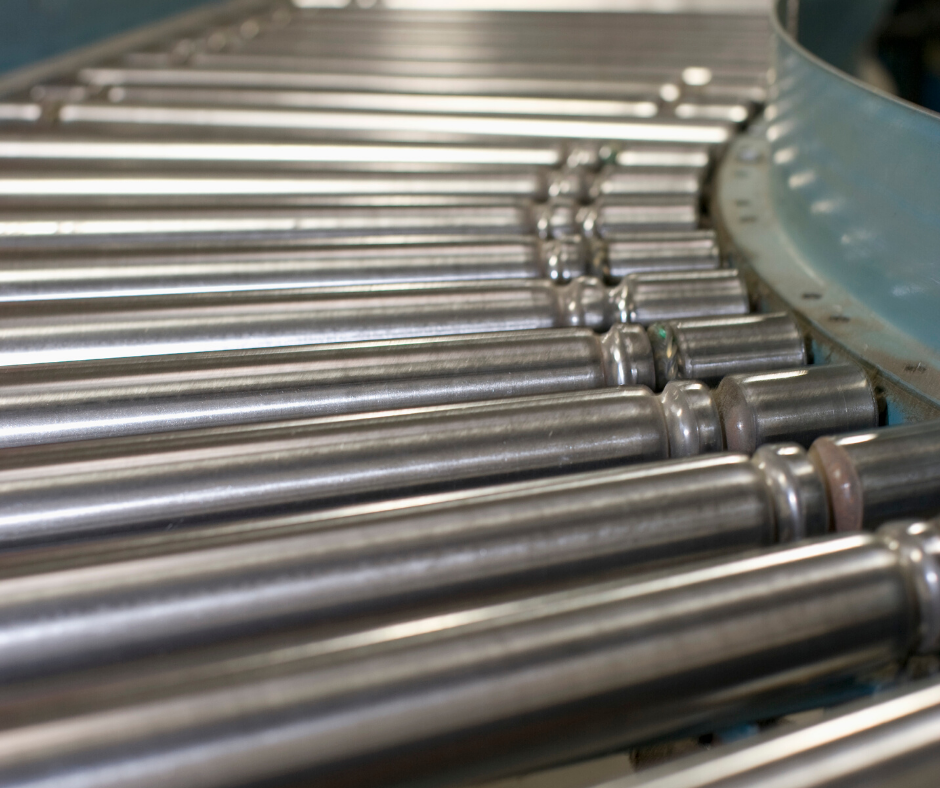
I took a look at the conveyer before the laminating process and noticed a series of angled rolls. These rolls were angled to move the board over to one side of the conveyer and keep it against a guiding rail. There were 36 total rolls along the conveyer, and of those, 28 were angled. I believed there were too many angled rolls. They were driving the board at an angle past the guide rail, keeping the board from entering the laminating process squarely.
A New Way to Roll
I asked Wayne if he was willing to try an experiment. I wanted to straighten out most of the rolls, leaving just a few angled rolls. The board would be driven to the guide rail using the angled rolls and then the straight rolls would keep it straight as it entered the laminating process. Wayne asked me how long it would take. I estimated four hours of effort with his help and the help of a mechanic. The line was scheduled to be down for maintenance the next day. If we could do the work then, he would be happy to help.
The next day we started the work with the help of a mechanic. We identified the center of the laminating process and positioned the guide rail parallel to the direction of travel of the board into the process. Next, we moved the guide rail to the optimal position to guarantee the board would be centered entering the process. We marked the original position and current position, just in case we had any issues. Next, we started straightening the rolls.
An engineer came by to see what we were doing. When I explained, he told me he had installed the laminator a few years back and was responsible for all of the angled rolls. He didn’t agree with what we were doing and tried to convince us to stop our work and put everything back. I assured him we were experimenting and were willing to put everything back to its original position if necessary. Although he didn’t seem satisfied, he decided to go elsewhere while we did our work.
Sometimes Less is More
After just under four hours, we were done. Before starting up the line, I called the engineer to see if he wanted to see the results of our experiment. He said he would come over later that day. We didn’t want to wait, so we started up the line and sent some test boards down the line. The first time, we had a jam. When we looked at the cause, we realized the new position of the rolls and the guide rail had an adverse effect on equipment on the other side of the line. We shut down the line and made some adjustments to take into account the new arrangement.
On our next attempt, the test boards entered the laminating process in a straight and square fashion. We were excited, but weren’t ready to declare victory. We started up the line and put it into production. We were amazed, the boards were not only going in exactly as we hoped, but they were spaced out more evenly as they came down the line. Wayne was excited and now wanted to speed up the line. He made small changes to speed until the line was running 20% faster than it had ever run. Right in the middle of this, the engineer came by to see what had happened. He was surprised things were going so well, but admitted he had angled so many rolls without considering the impact on the overall process. He then said, “Maybe less is more - too much of a good thing may be a bad thing.”
Over the next few months, we made additional improvements to the laminating process and the plant had a much more productive and safe operation than before we started.