
Kaizen Success Stories
Real Manufacturing Results. One Kaizen at a Time
Explore real-world Kaizen success stories showing how manufacturing teams solved critical problems, improved performance, and created sustainable results.
The Day I Stopped Fixing Barcode Readers
I thought my job was to fix barcode readers. Instead, a warehouse full of employees taught me one of the most important lessons of my career: the best improvements begin by listening to the people doing the work.
Kaizen Snapshot
Setting: Thomasville Furniture corporate warehouses, late 1980s
Challenge: Support an aging barcode inventory system that was becoming increasingly frustrating and inefficient for warehouse employees.
Stakes: Inventory accuracy, warehouse productivity, employee frustration, and making better use of emerging barcode technology.
Approach: Observe the work firsthand, listen to warehouse employees, understand their daily challenges, and redesign the system around their needs rather than the technology.
Outcome: New scanning barcode readers were implemented throughout the warehouse network, inventory work became faster and easier, accuracy improved, and warehouse managers began viewing Industrial Engineering as a partner in solving operational problems.
Key Lesson: The best improvements don't begin by fixing technology. They begin by listening to the people who use it.
The Day I Stopped Fixing Barcode Readers
The Situation
When I graduated from Virginia Tech with a degree in Industrial Engineering, I accepted a position as a Corporate Industrial Engineer with Thomasville Furniture in North Carolina. One of my first responsibilities was supporting the company's barcode inventory system across multiple warehouses.
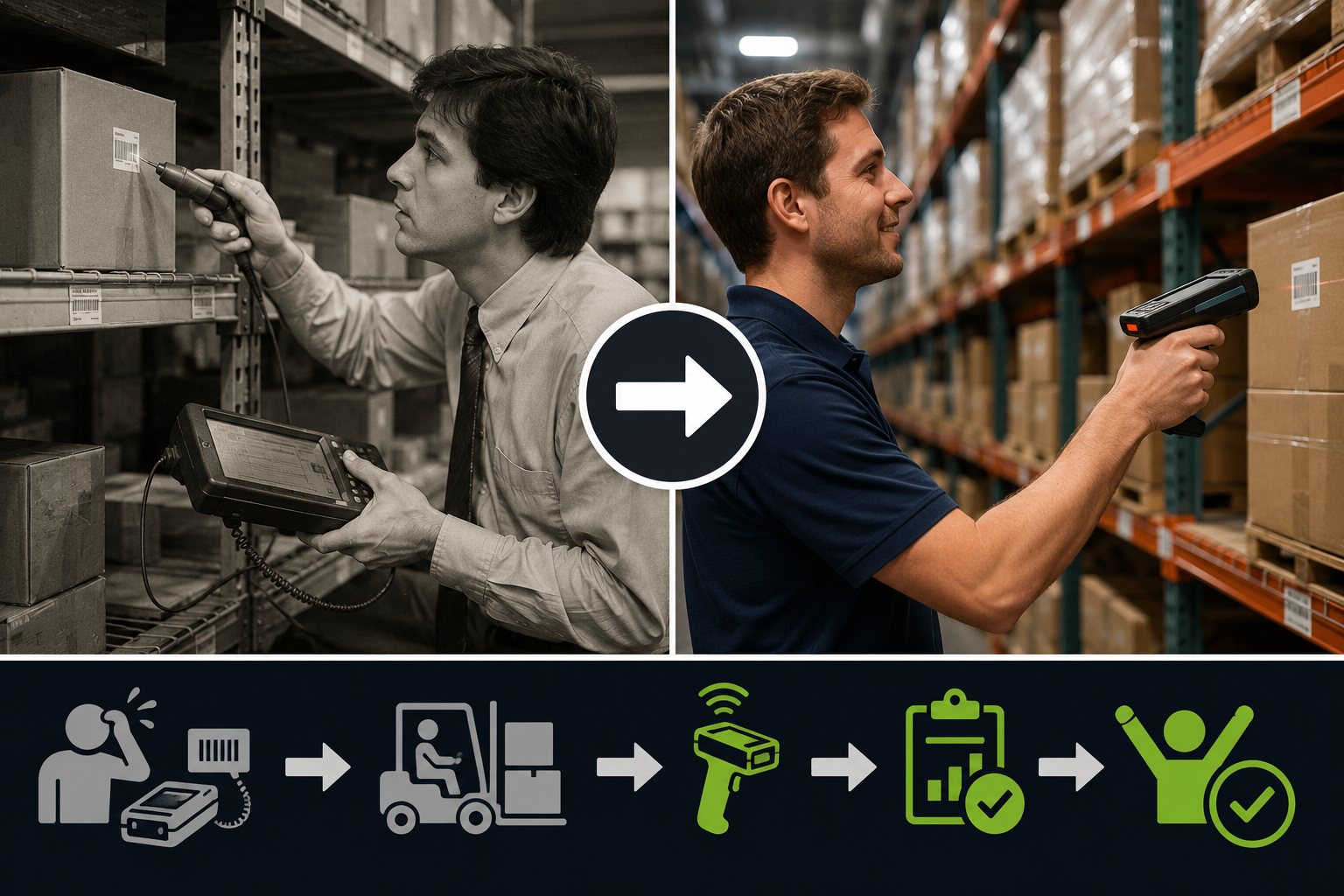
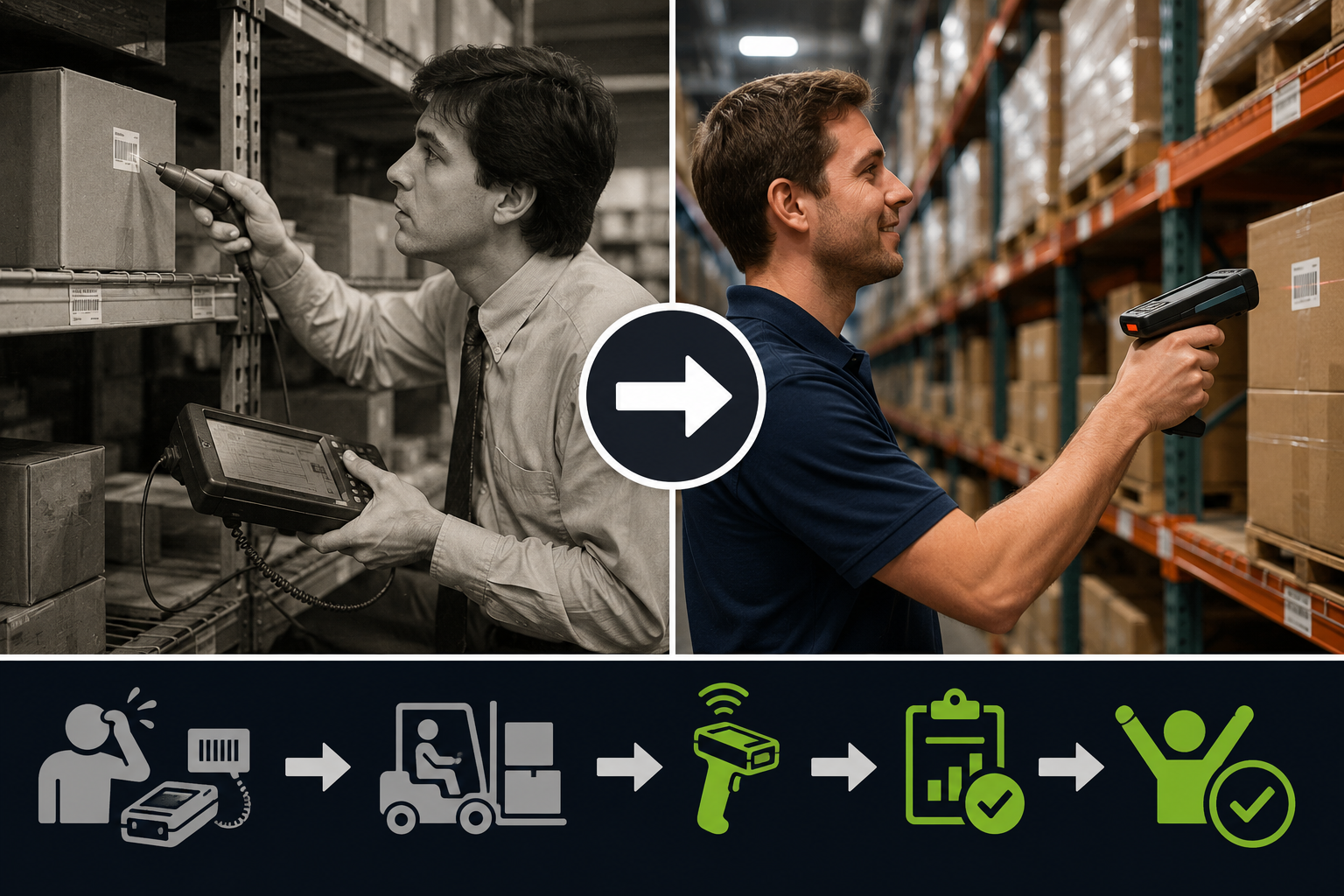
At the time, barcode technology was still in its infancy. There were no wireless scanners. No QR codes. No handheld devices like we know today. Warehouse employees carried readers about the size of a tablet with a cord attached to a lighted wand. To scan a barcode, they had to physically drag the wand across each label.
The engineer before me gave me a quick overview before moving into a leadership role. His advice was practical. "You'll get calls when the readers don't work. Sometimes people don't know how to reboot them or use them correctly. Just help them get back up and running." At first, I thought that was my job. Keep the barcode readers working.
What Was Getting in the Way
Instead of waiting for phone calls, I spent time walking through the warehouses. I watched people receive inventory, move furniture, store products, and retrieve orders. Most importantly, I watched how they actually used the barcode system.
The technology worked, but the work didn't. Employees often had to climb off forklifts or reposition large pieces of furniture simply to touch a barcode with the scanning wand. Sometimes they struggled with the equipment. Other times they struggled with the process itself. One warehouse employee jokingly told me, "This thing is almost like Braille."
He wasn't criticizing the technology. He was describing the experience. That comment stuck with me. The more time I spent in the warehouse, the more I realized I wasn't hearing complaints, I was hearing opportunities.
What We Did
Rather than asking, "How do we fix the barcode readers?" I began asking, "How do we make the inventory process easier?" That simple shift changed everything.
As I researched emerging barcode technology, I discovered a company developing one of the first scanning barcode readers that could read labels from a distance instead of requiring physical contact. Today that sounds ordinary. In the late 1980s, it was anything but. Suddenly, warehouse employees wouldn't have to reposition furniture or climb down from forklifts just to scan a label.
Even better, the new technology opened the door for entirely new capabilities. Instead of simply recording items entering or leaving inventory, we could create additional applications and reports that made warehouse operations more useful and informative. After presenting the opportunity, leadership agreed to invest in the new scanning technology.
The Breakthrough
The scanners solved a problem. Listening solved many more. As employees began using the new equipment, inventory became faster. Accuracy improved. Physical effort decreased. The technology removed frustrations that had quietly become accepted as "just part of the job." But something even more important happened.
Warehouse managers stopped seeing me as the person who fixed barcode readers. They started calling with ideas. "Could we use barcodes to help us do this?" "Would this process work better another way?" Instead of fixing equipment, we were improving systems together.
What Changed
By the time I left Thomasville Furniture, the new scanning barcode readers had been deployed throughout the company's warehouse network. Inventory management had become faster, easier, more accurate, and less physically demanding.
But looking back, those weren't the biggest improvements. The biggest change happened in me. Without realizing it, I had learned one of the most important lessons of my career. The people doing the work usually understand the problems better than anyone else.
If you're willing to spend time where the work happens:
Watch carefully
Ask questions
Truly listen
They'll often tell you exactly where improvement should begin.
The Takeaway
At the time, I thought I was learning about barcode technology. In reality, I was learning something much more valuable. Technology rarely solves the right problem by itself. People do.
The best improvements begin by understanding the work through the eyes of the people doing it every day.
Why This Matters
Organizations often invest in new technology hoping it will solve operational challenges. Sometimes it does. But technology alone rarely creates lasting improvement. Real improvement starts by understanding the frustrations, obstacles, and opportunities experienced by the people closest to the work.
Only then can technology become an accelerator instead of a substitute for good process design. Although I didn't realize it at the time, this early experience became the foundation for how I would approach every Kaizen event, leadership engagement, and improvement effort throughout the rest of my career.
Ready to Discover What Your Team Already Knows?
The people closest to your processes often have the best ideas for improving them. A Breakthrough Assessment helps uncover those opportunities by combining observation, employee engagement, and practical problem solving to reveal improvements that reports and dashboards alone can never find.
Sometimes the answers aren't hiding in the data. They're already being experienced every day by the people doing the work.

Technology Doesn't Have to be Scary
For two years, I facilitated monthly Kaizen events at CITY Furniture. These weren’t just about fixing specific problems. They were about strengthening their culture of continuous improvement. By the time we completed six events, people were lining up to be on the next teams.
One memorable event focused on organizing a chaotic repair parts storage area. We removed 75% of the clutter and built ownership that became a model for future teams.
What I didn’t tell you was this: the team also automated the entire inventory tracking system. And the person who made it happen was a 17-year-old hourly employee named Rob.
Rob was the son of one of the supervisors on the team. During our Gemba walk, it was clear the cluttered space wasn’t the only problem. Our area owner was drowning in paperwork and unreliable data.
While most team members focused on the physical mess, Rob saw a deeper issue: fractured information streams, disconnected reports, and no real-time visibility.
His idea? Consolidate everything into one digital report, accessible on an iPad. Then, take it further by barcoding every bin and tracking inventory in and out with a scan.
The team loved it but had no clue how to make it happen. Rob just smiled and said, “I’ve got this.” And off he went.
By day three, he had a prototype. He coordinated with IT, repurposed a company iPad, and built a working application. By week’s end, barcodes were in place, the app was live, and the team could track every part in real time.
I personally told the CEO about Rob and urged him to nurture this rising star. “Don’t let him get away,” I said.
Today, Rob’s a sales rep for CITY Furniture with a stellar track record and the same customer-first mindset that powered his Kaizen breakthrough.
Innovation doesn’t care about age, title, or tenure. Sometimes, your quietest contributor holds the loudest solution if you’re willing to listen.
Turning the Factory Upside Down
When a packaging company reached out to me about facilitating a 3P (Production Preparation Process), I was intrigued. It’s the most advanced Kaizen approach I offer. They wanted this to be their very first experience.
Fortunately, I had an ally. Brett, a longtime colleague from my Armstrong days, had joined the company and believed 3P was the only way to address the plant’s design and operational constraints. The plant was bursting at the seams, and their lease made change feel impossible. But Brett believed they could break through.
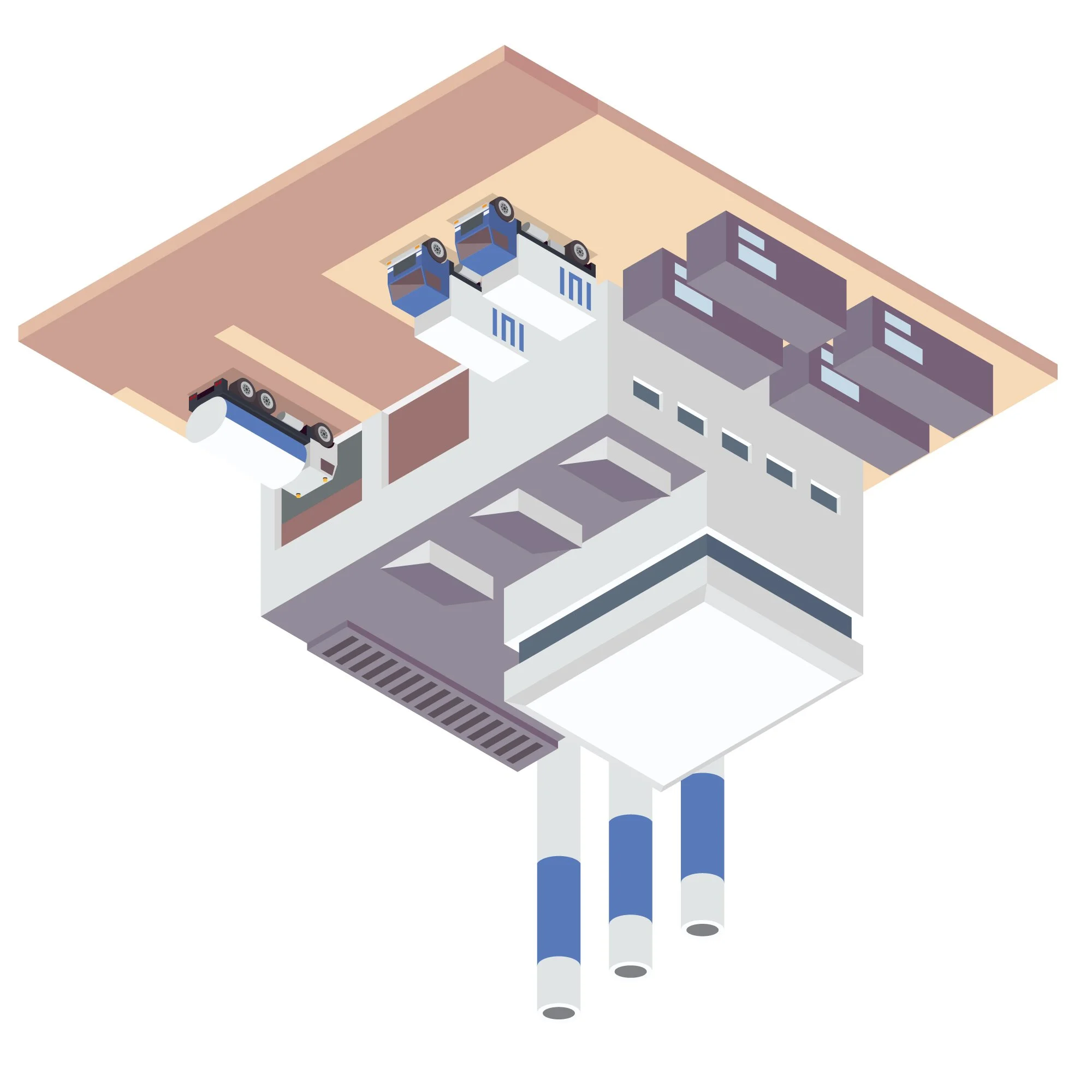
Our goal: Develop 1–3 bold options to get the plant back on budget and positioned for growth, without relocating, if possible.
As expected, day one brought skepticism. In 3P, we ask people to suspend their constraints and imagine possibilities no one has yet seen. That’s a tall order.
The team followed the process, even when it didn’t fully make sense to them. At one point, I had to give tough love to a company veteran who wanted to skip a step and revert to his usual methods. He didn’t talk to me for a few hours, but by day three, everything changed.
The energy flipped. They saw it. They believed it. They were building something new and it could work.
By week’s end, we had two viable plans. One that reconfigured the current space and one that required a new building. Both met the business goals and sparked new thinking across the team.
At the report-out, the excitement was contagious. Brett strengthened his credibility and standing in the company. The team felt empowered. Some have since moved on, but they still reach out to say how much that 3P experience shaped them.
Breakthroughs don’t come from doing what you’ve always done. When you trust the process and your people new possibilities come into view.

Our Quest for the Holy Grail
This might sound dramatic, but in the world of suspended ceilings, we had a Holy Grail: a ceiling that looked like drywall but performed like an acoustical system. No visible grid. Total sound control. Full accessibility.
For decades, teams tried and failed. The problem? Suspended ceilings require grid for structure and access. Drywall doesn’t offer that and it also lacks acoustic performance.
Then our innovation manager had a bold idea: use the 3P Kaizen (Production Preparation Process) to tackle the problem. He knew we might not solve it in one go, but believed 3P could reveal the path forward.
I was asked to facilitate. The first sessions focused on hiding the visible grid. After many sketches and prototypes, the team landed on a clever idea: use overlapping fabric between tiles. It wasn’t perfect, but it disguised the seams better than anything we’d seen.
Some were disappointed it didn’t fully solve the challenge. But that first step revealed the next: develop a coating that could bind tiles together and create a seamless look without destroying acoustical performance.
The next 3P sessions pushed us farther. Dozens of experiments later, the team found a spray coating that did the trick. We brought in drywall contractors to test it. With their feedback, the final system was born.
After decades of struggle, we had invented a seamless, acoustical, accessible ceiling system. Within months, it hit the market. Today, that innovation drives a growing product category and is a cornerstone of the company’s success.
Breakthroughs rarely come in one giant leap. They’re built through persistence, process, and problem-solving. Sometimes the “Holy Grail” is one prototype away.

Simpler is Safer, Lighter, and Better
I was in Florida, working with a residential building products manufacturer on our second Kaizen event together. This time, we focused on improving materials delivery to the production lines. The tasks were challenging, physically demanding, and slow, leading to high turnover in the material handling position.
I was in Florida, working with a residential building products manufacturer on our second Kaizen event together. This time, we focused on improving materials delivery to the production lines. The tasks were challenging, physically demanding, and slow, leading to high turnover in the material handling position.
Our ultimate goal was to make the job safer and easier, reducing turnover and its associated costs while boosting employee satisfaction across the organization.
We started the week with a Lean Principles workshop, followed by a Gemba Walk to observe the current processes. The good news? There were plenty of opportunities for improvement. The better news? Together, we’d brainstorm and implement solutions to reduce waste and achieve our goals.
The team divided into three sub-teams, each focusing on a specific area:
Delivery and loading of granular materials to the line
Organization of raw materials
Delivery and loading of rolled materials to the line
Granular Materials Team
This team observed workers shoveling materials into buckets, carrying them up a ladder, and pouring them into bins for processing—a labor-intensive and risky process. Could it be automated?
With creativity, quick thinking, and the repurposing of existing equipment, they modified a shop vacuum to draw materials directly from containers into the bins. They added a simple sensor to stop the vacuum when the bin was full and another to alert the operator when it was time to restart.
Organization Team
Using spaghetti diagrams, they mapped operator movements during daily tasks. The diagrams revealed a chaotic system: materials were stored wherever space was available, with no clear organization.
By rearranging the workspace, they created a visual and logical storage system, reducing unnecessary movement by over 75%.
Rolled Materials Team
This group tackled three main issues:
Placing rolls on a carrier
Placing the carrier on the production line’s framework
Moving and removing rolls when empty
To address the first issue, they replaced the heavy, cumbersome threaded rod and collar system with a smooth rod and spring clamps, similar to those used in weightlifting. This eliminated the time-consuming process of centering the roll and screwing collars into place. It also removed the need for heavy end plates, reducing the roll’s weight by over 10 pounds.
For the second and third issues, eliminating the end plates allowed them to redesign the system. They replaced the cradles on the framework with pinned locations, enabling rolls to slide directly into place and be securely pinned. This made centering effortless and eliminated the need to lift rolls over cradle points.
The Results
By the end of the event, every team had developed solutions that made the work safer, simpler, and more efficient. Even better, the changes were cost-effective and could be easily replicated across other lines in the facility.
Early feedback has been overwhelmingly positive. Employees report higher satisfaction and engagement, and we anticipate this will lead to significantly lower turnover in the material handling role.
Sometimes, the simplest solutions really are the best.

Know Your Niche
As a Kaizen Ninja, I like to believe I can help any team solve any problem. Maybe I can, maybe I can’t—but believing it was causing me to dilute my message to my target audience. Let’s face it: no one believes you can be all things to all people.
As a Kaizen Ninja, I like to believe I can help any team solve any problem. Maybe I can, maybe I can’t—but believing it was causing me to dilute my message to my target audience. Let’s face it: no one believes you can be all things to all people.
While I’ve helped businesses across many industries tackle a variety of problems, my message wasn’t resonating with the people I truly wanted to reach. It wasn’t until I came across The One Page Marketing Plan by Allan Dib that I realized the issue. Dib makes a compelling case for knowing your niche and target market. Without that clarity, it’s impossible to craft a message that will attract the right people.
I had to dig deep and figure out who I really wanted to help. It didn’t take long to land on an answer that, in hindsight, should have been obvious: I was built to help manufacturing companies.
But not just any manufacturing companies. Running a Kaizen event requires team members to dedicate 100% of their time and energy to solving a critical business problem in a sustainable way. For smaller companies, pulling key people off their regular jobs for several days can be a dealbreaker. The business might grind to a halt.
The sweet spot? Manufacturing companies with at least 50 employees. These companies typically have enough resources to pull six or more people from their daily roles without shutting everything down. With proper planning, resources can be covered through overtime or other adjustments, making it feasible for the team to focus entirely on the Kaizen process.
This realization was a game-changer. While I’ve facilitated successful Kaizen events in non-manufacturing settings, the immediate, tangible results from manufacturing events are hard to beat. On the factory floor, you can literally see the impact:
Lines run more smoothly.
Tasks require less effort.
Employee feedback is positive and immediate.
There’s something uniquely gratifying about helping people in ways they can see and feel right away. That’s why I’ve honed my focus on manufacturing companies with more than 50 employees. When I visit, I can provide clear, specific examples of where I can help and the results they can expect using my Kaizen approach:
Safety risks reduced by more than 50%.
Changeover times cut by more than 50%.
Productivity increased by at least 5%.
Costs reduced.
Quality and customer satisfaction improved.
Even better, I can share real success stories from other manufacturing teams and show how I use the Wheel of Sustainability to ensure those results last.
From time to time, I still get inquiries from non-manufacturing prospects. I’m happy to help them if there’s a good fit, but they’re no longer my target audience. I don’t actively market to them or invest extra effort trying to get their attention.
This approach has made me more focused and intentional, and for that, I’m incredibly grateful to Allan Dib and his team. Their insights helped me find—and fully embrace—my niche.

Diving into the Deep End
Armstrong World Industries was forced to open a mineral wool plant, in response to the loss of a critical supplier of this vital raw material for ceiling tile manufacture. Because of this, they relied on more outside vendors to design and build the plant than they were comfortable with. They had never spun molten stone (slag) into fibers before and therefore couldn’t use their experience to reduce the potential for errors and inefficiencies in their process.
Armstrong World Industries was forced to open a mineral wool plant, in response to the loss of a critical supplier of this vital raw material for ceiling tile manufacture. Because of this, they relied on more outside vendors to design and build the plant than they were comfortable with. They had never spun molten stone (slag) into fibers before and therefore couldn’t use their experience to reduce the potential for errors and inefficiencies in their process.
The plant started up late, over the capital budget, and at greatly lower performance than required to meet the demand of the ceiling tile plants in the network. Things got so bad that management was shuffled, project team members were removed, and highest-level management was getting involved on a daily basis.
I was “asked” to help the plant achieve budget performance. Knowing this was a politically charged situation and that people who were involved were under intense scrutiny, I convinced my manager to let me visit the facility before committing to the work.
I spent three days at the plant, getting to know the workers, managers, and the process. What I saw was a very concerned and engaged workforce, committed managers, and a process that was absolutely horrible to run. How did we get here, I wondered. I knew I couldn’t fix the past. All I could do was try to improve the future.
There were so many problems, but we identified the biggest one that was causing significant safety, quality, and productivity risk. The molten slag (rock with metal components in it) was designed to fall into a pit and then be scooped up and delivered into a bin. If the slag hit any moisture, it would superheat the water and cause small explosions within the confines of the building. And, the pit was exposed to the outside elements, which naturally allowed moisture in. Another issue was that the front-end loader used to scoop up the molten slag barely fit between the walls of the pit. I saw evidence of damage to the walls of the plant that was less than one-year old. Someday, someone was going to hit a wall with such force that the entire structure would come down.
I spoke with my sponsors and told them incremental improvement wasn’t going to help. We had to figure out a way to keep the slag from falling into the pit in the first place, eliminating the moisture and equipment issue. They looked at me in a way that felt like, “Well, duh, but how the heck can we do that?” I suggested we run a Production Preparation Process (3P) Kaizen in order to tease out and develop breakthroughsolutions to this problem. 3P is the most challenging kaizen event I facilitate. It forces structured minds to get unstructured, go to their childhood mindset (an 8-year-old can solve any problem) and use nature’s influence for ideas. Many engineers and scientists find this difficult to participate in, but their input is essential.
A month later, we assembled a team of operators, managers, engineers, and outside vendors to take the 11-step creativity journey that happens during a one-week 3P Kaizen. We framed the problem in this way: Deliver the molten slag directly to the process without any outside intervention by equipment or the environment. Initial skepticism gave way to creativity, and by the second day, everyone was in it to win it.
By the end of the week, there were two practical solutions for the business to choose from. Both looked promising and reasonably priced, and in the months that followed, one was implemented. From then on, molten slag never hit moisture and the building walls were spared further damage.
More impressive was the feeling of engagement, teamwork, and pride permeating the workforce. They solved the problem, participated fullyand even identified other possible Kaizen events to run in the future.
The plant is still operating and is now the benchmark in the mineral wool industry. Armstrong was able to produce more mineral wool than internally necessary and then sell the wool to other companies. The workforce is highly engaged and continues to drive improvement on a daily basis.
I was amazed by the feedback of the team, who took on a monumental task and slayed their dragon. To a person, they were positively inspired by the effort and ready to take on the next challenges.

Who says you can’t speed up innovation?
After a three-year stint as Operations Manager in a plant in Oregon, I was offered the opportunity to return to the Innovation Group in the global technology group for Armstrong World Industries, a ceiling tile manufacturer. I was to support a group of scientists, technicians, and innovators improve their processes and speed up the time to launch new product ideas.
After a three-year stint as Operations Manager in a plant in Oregon, I was offered the opportunity to return to the Innovation Group for Armstrong World Industries, a ceiling tile manufacturer. I was to support a team of scientists and technicians, and help them improve their processes and speed up the time to launch new product ideas.
In my first few weeks, I spent time observing the processes the team used to come up with new ideas and bring them to fruition. Each scientist, with the help of assigned technicians, would develop their own approved idea, using whatever development technique they chose to use. Every so often, their manager would meet with them to review status and see if there was any help needed to drive progress. More often than not, the scientist would not ask for any additional help. Even less likely was the chance the scientist would go to their manager when they were stuck and needed help. Things took a long time to complete.
I also took a look at the innovation spaces and testing centers that supported the Innovation Team. Disorganized and disconnected, these spaces became available on a first come, first served basis. Scientists often had to wait for testing assistance, as there was no clear way to prioritize or schedule work in the spaces.
Pilot Plants
I knew I could bring some value to this group, as long as I had someone to sponsor me. I was new to this area and had to build credibility. Luckily, I found a manager who was frustrated with the amount of time things took and was open to trying something new.
The first thing we decided to do was pick a target area in the testing spaces (our Pilot Plant) to organize, with the idea of improving productivity and responsiveness for testing. We picked a small team and used a 5S (Sort, Set in Order, Shine, Standardize, Sustain) event to improve the area and named an Area Owner. The owner would reserve the area for the scientists and technicians and ensure work was prioritized properly. This first owner had to have strong leadership backing and the internal fortitude to stand behind her choices. Luckily, our first owner had both.
This first 5S effort brought immediate and visible positive results to the Pilot Plant. Over the next few months (and years), more and more areas became organized using 5S and strong leadership support. Work flowed through the Pilot Plant in a much quicker way. Strong Area Owners ensured the highest priority work would be done before lesser value work. If anyone tried to break the rules, the owners knew they had support for their efforts to control the work flow.
Now that we had simplified and streamlined the testing work, we needed to come up with a way to make the development work more visible. As I stated earlier, scientists liked to do their own thing and then present their inventions and discoveries in their own time. Because of that, there was no clear way to assess progress and provide help or support during the process.
With the support of the manager, we approached the Innovation Director with this idea: Have a weekly meeting of all scientists and technicians to give them the opportunity to discuss their progress and talk about next steps and any help they might need. The Director was intrigued, but was unsure how the group would react to “structure”. He told us, “You can’t schedule invention.” My reply was, “Maybe you can’t, but you can schedule the steps on the way to invention.” If nothing else, the scientists would have an opportunity to share their discoveries with the group. He thought it was worth a try and decided to start the following week.
Accelerating Innovation
The first weekly Innovation Group Huddles were unstructured on purpose. The Innovation Director asked each scientist to talk about what they were working on. Some of the scientists were willing to do so and would take the time to describe the intimate details of their work. Others had little to say, and even with prodding didn’t seem willing to share. Although it was frustrating at the beginning, we realized this was the first time the team had the opportunity to discuss their efforts in this way, and agreed to keep the process going for a while to see what might happen.
About three months after starting the Innovation Huddle, a scientist was talking about his work and admitted he was a bit stuck on how to test one of his ideas. For the first time, another scientist spoke up and said, “I worked on something similar three years ago and I would be happy to share my data and results with you, if you think that would help.” All of the sudden, the entire group opened up and realized why they were there. They could share and learn from each other. Scientists love to share and learn, and now they knew this was their forum to do so.
Over the years, the Innovation Group Huddle became more visible, more engaging, and focused on helping each scientist and technician in their efforts. After four years, the time to market, from initial idea to launch was reduced from eighteen to ten months. The portfolio of new products developed by the Innovation team more than doubled from $150 million to $380 million.

Thomasville’s Frame Nailers – Taking a good idea and expanding its reach
As a young engineer at Thomasville Furniture, I was given project assignments at the discretion of my manager. He gave me ample opportunities to try out different ideas and supported my efforts. I spent many hours in our manufacturing facilities and was fascinated by the complexity of the manufacturing processes. Many of these processes were extremely labor-intensive and required great skill to accomplish. One such task was the assembly of the base frames of case goods, such as night stands, dressers, and other cabinet style products. These frames were the support structure of the furniture and had to be strong and sturdy to hold up to the years of abuse that furniture sees in its lifetime.
As a young engineer at Thomasville Furniture, I was given project assignments at the discretion of my manager. He gave me ample opportunities to try out different ideas and supported my efforts. I spent many hours in our manufacturing facilities and was fascinated by the complexity of the manufacturing processes. Many of these processes were extremely labor-intensive and required great skill to accomplish. One such task was the assembly of the base frames of case goods, such as night stands, dressers, and other cabinet style products. These frames were the support structure of the furniture and had to be strong and sturdy to hold up to the years of abuse that furniture sees in its lifetime.
The process to put together a base frame starts with the cutting of the four individual frame components to the appropriate length. Then, each end of the component is cut with a miter saw at a very specific angle, 44.5 degrees. I asked a skilled saw operator why he wasn’t cutting a standard 45-degree miter. He informed me that the extra half degree allowed for the special nail, glue, and growth that typically occurs in wood when exposed to moisture.
After cutting the miter, a notch was cut at a perpendicular angle to the miter in the center of the ends of the wood. This allowed for a special joining nail to be applied to both ends of the wood. The placement of this notch was critical as well, as any deviation from the center would make the nail noticeable to the customer. Once these cuts were made, the components were brought to the assembly department. Once there, employees would apply glue to the mitered ends, nail the components together, and remove any excess glue. Then, after all components were dry, they were transferred to another department whose responsibility was to put wood putty into any gaps that might be visible in the joined mitered ends. In all, this process took 6 days from original cuts to final putty and cleanup of the frames. As many as 6 people touched the components during this process. The more I watched this process, the more I thought, “There has to be a better way to do this.”
A Simple, But Powerful Discovery
A few months later, all of the engineers at Thomasville Furniture traveled to the International Woodworking Show in Atlanta. This was my first time travelling for the company and I welcomed the opportunity to see all of the interesting machines at the show and tour Atlanta a bit. Each engineer was to look for equipment at the show that might help the plant to which he or she was assigned. The exhibition hall was gigantic and the three days we were there wasn’t enough to properly see everything. Most people liked to look at the biggest, shiniest, most complicated machines that were being displayed. I, however, was fascinated by something I saw at a little booth in an out of the way spot in the exhibition hall.
In the booth was a series of small picture frame nailing machines. They were simple little machines that seemed to be quite efficient at their task. The representative showed me how they worked. Basically, you bring two mitered ends of picture frames together in a jig that positioned them precisely, push a foot pedal, and a pressure plate came down to hold the mitered ends tightly together. Then, a corrugated nail came up from a coil below the machine and was driven into the mitered ends. He handed the assembly to me and told me to try to pull it apart. I couldn’t. Then I noticed how tight the joint was on the assembly. There was no gap, which meant that no wood putty would need to be applied.
I asked the representative if he had a machine that was designed for larger mitered components. He didn’t, but said that he thought he could modify and strengthen one of the machines to drive nails into larger pieces of wood. I asked him how soon he could have a prototype machine. He thought he could have one ready in 4 to 6 weeks. That was all the time I needed to convince one of our plants to try out this new approach. Although I saw many other interesting machines, nothing intrigued me as much as these frame nailers, as most Thomasville plants would have a use for a heavier duty model.
Being Open to a New Process
When I returned from Atlanta, I asked my supervisor which plant he recommended we test the prototype frame nailer. My thought was that if we could convince a plant to try it out, they would get an opportunity to provide input to the design and functionality of the new machine. They would also have the fastest opportunity to streamline their operation. We agreed that the case goods plant 3 miles from the corporate center was the best place to start. We called a meeting with the plant management and gained their support for this work.
Approximately 6 weeks later, a larger version of the picture frame nailer that I had seen in Atlanta arrived at the plant. Two days later, the sales technician joined to show us how to use the prototype equipment. Plant management joined us and watched as the technician joined two large mitered parts with little difficulty. It happened so fast that they wanted to see another demonstration. This time the parts didn’t go together as well as expected. It turns out that there wasn’t enough air pressure applied, and when it was quickly corrected, every part came together precisely and tightly. Everyone was amazed how easy it was and also how tight the mitered joint appeared.
A Solution With Many Applications
Soon, they realized the best benefit of all. There would be no need for applying putty to the mitered joints, as they held together so well, with no gap apparent. This was a breakthrough. But, it was also just the beginning. Then, the technician was asked if this equipment could also create a “Butt Joint.” This is an assembly of two pieces of wood that are joined at perpendicular angles, rather than at a 45 degree angle. These “Butt Joints” we used as intermediate assemblies in case goods and were also quite labor intensive. The technician thought it would be possible, but it would probably need a special jig to hold the pieces in place while the nail was delivered.
Because we were in a furniture factory, we were able to quickly create a prototype jig to try it out. Lo and behold, the two pieces of wood were joined together just as tightly as the mitered pieces. This would save more effort, labor, and time. After identifying a few more modifications, we realized that we had something that we could use in the multiple plants at Thomasville Furniture. We quickly ordered a first unit and set about determining how many others we would potentially need.
For the next six months or so, I was able to replace the old-style miter cutting and joining processes all over the company with the new frame nailing technology. I even was able to find a few more uses for the equipment, which led to more sales for the technician.
I learned a valuable lesson from this work. Sometimes you have a problem that needs a solution, other times you have a solution to a problem you don’t realize you have. You just have to be willing to look for that problem and apply the solution.