
Kaizen Success Stories
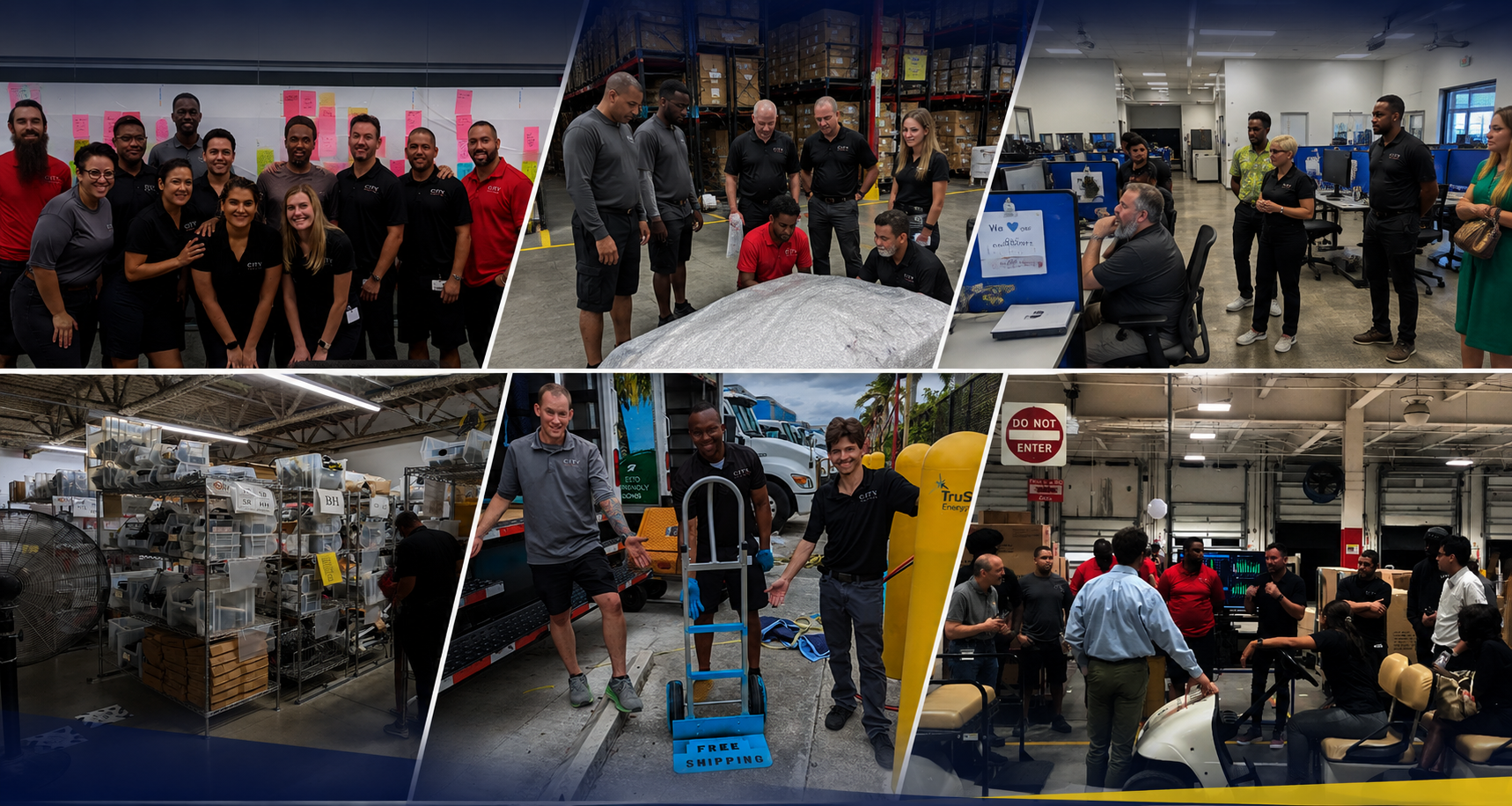
Real Manufacturing Results. One Kaizen at a Time
Explore real-world Kaizen success stories showing how manufacturing teams solved critical problems, improved performance, and created sustainable results.
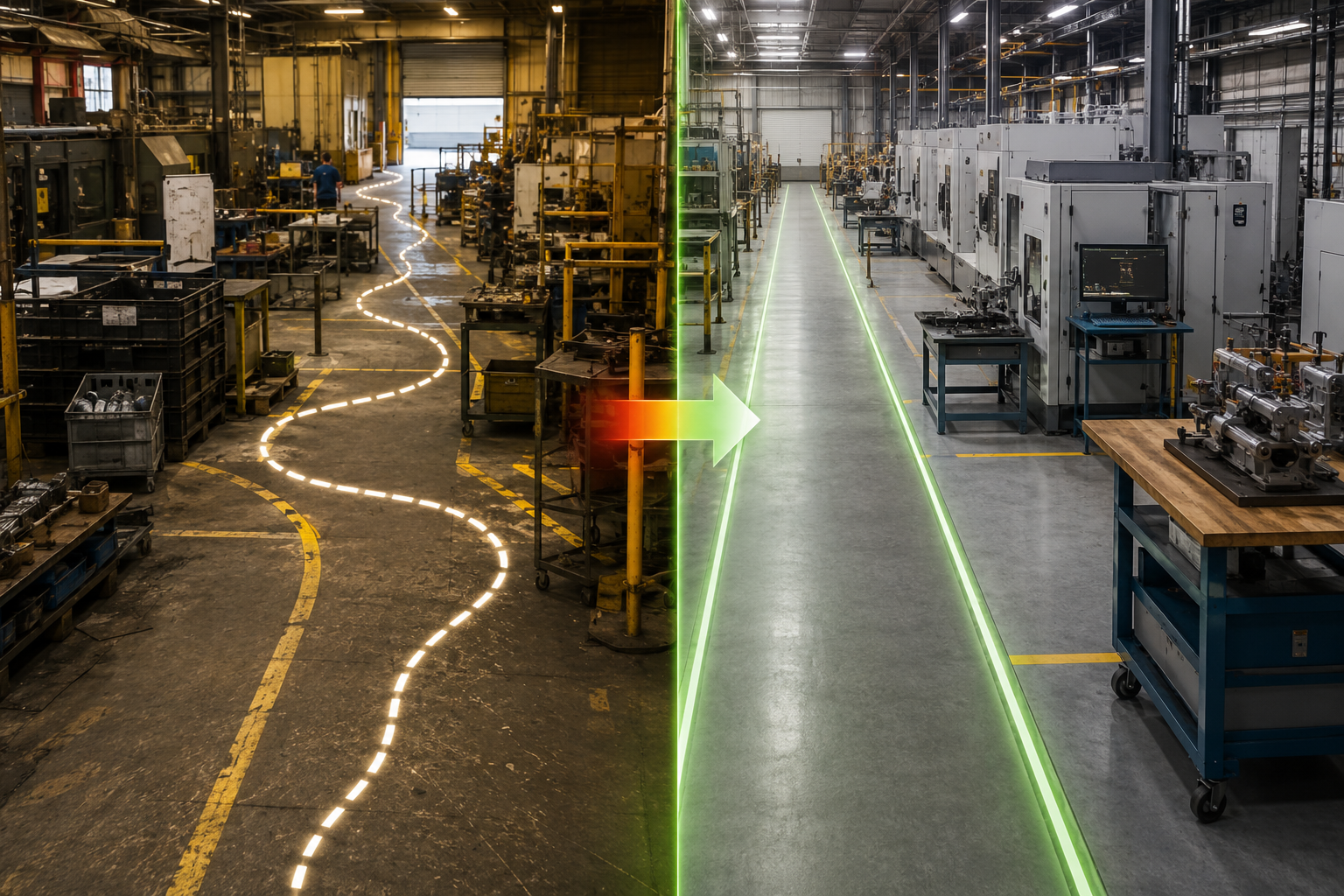
From 330 Feet to 4 Feet in 3 Days
A manufacturing team spent years living with an inefficient quality testing process. In just three days, they reduced travel distance from 330 feet to 4 feet, cut processing time in half, and uncovered a solution worth millions in additional capacity.
Kaizen Snapshot
Industry: Manufacturing
Challenge: Excessive travel, batching, safety risk, and delayed quality feedback
Approach: Kaizen Event Facilitation using rapid experimentation and team-led design
Results:
Distance traveled per part reduced from 330 feet to 4 feet
QC travel reduced from 175 feet to 4 feet
Batch size reduced from 6 pieces to single-piece flow
Processing time cut from 40+ minutes to approximately 20 minutes
Part lifts reduced from 4 to 1
More than 95% reduction in travel
More than 95% reduction in safety risk
Wastewater stream eliminated
Potential to double capacity
The Situation
A manufacturing team had been struggling with the same problem for years.
Every part required a quality test, but the process was designed around batching and distance. Parts were tested away from the production line, which meant multiple additional parts could already be in process before quality issues were identified.
The process had become accepted as "the way we've always done it," even though everyone knew it was inefficient.
The baseline measurements told the story:
330 feet of travel per part
175 feet of travel for QC per batch
Batch size of 6
More than 40 minutes of processing time
Multiple lifts of an 18-pound component
The team knew improvement was possible. They simply had not found a way forward.
What We Did
Rather than spending days discussing solutions, the team focused on building and testing them.
On Day 1, seven team members generated seven ideas each, creating forty-nine potential solutions.
The team quickly narrowed those ideas to seven concepts worth testing and immediately built prototypes using materials already available on-site.
On Day 2, the team established evaluation criteria and test procedures. They ran experiments, challenged assumptions, and narrowed the field to two leading concepts.
On Day 3, they combined the strongest elements of both approaches into a single design and implemented it directly in the production environment.
Equipment was relocated.
Material flow was redesigned.
The new process was tested using an actual production part.
The Results
The impact was immediate.
MeasureBeforeAfterDistance Traveled per Part330 ft4 ftQC Travel175 ft4 ftBatch Size61Processing Time40+ min~20 minPart Lifts41
Additional benefits included:
More than 95% reduction in travel
More than 95% reduction in safety risk
Complete elimination of waste entering the wastewater stream
Potential capacity increase worth millions annually
The Most Important Result
The numbers were impressive.
The people impact was even more powerful.
One operator, who had never participated in a Kaizen event before, looked at the redesigned process and said he couldn't believe how much easier his job had become.
At the final report-out, he stood in front of senior leadership and confidently explained what the team had accomplished.
It was the first time he had ever presented to leadership.
The pride, ownership, and confidence in the room were impossible to miss.
The team didn't just improve a process.
They proved to themselves what they were capable of accomplishing.
Key Lesson
Sustainable improvement happens when people stop talking about solutions and start building them.
In just three days, a team that had struggled with the same problem for years transformed its process, dramatically improved safety and efficiency, and created a solution they were excited to own.
That's the power of a well-facilitated Kaizen event.
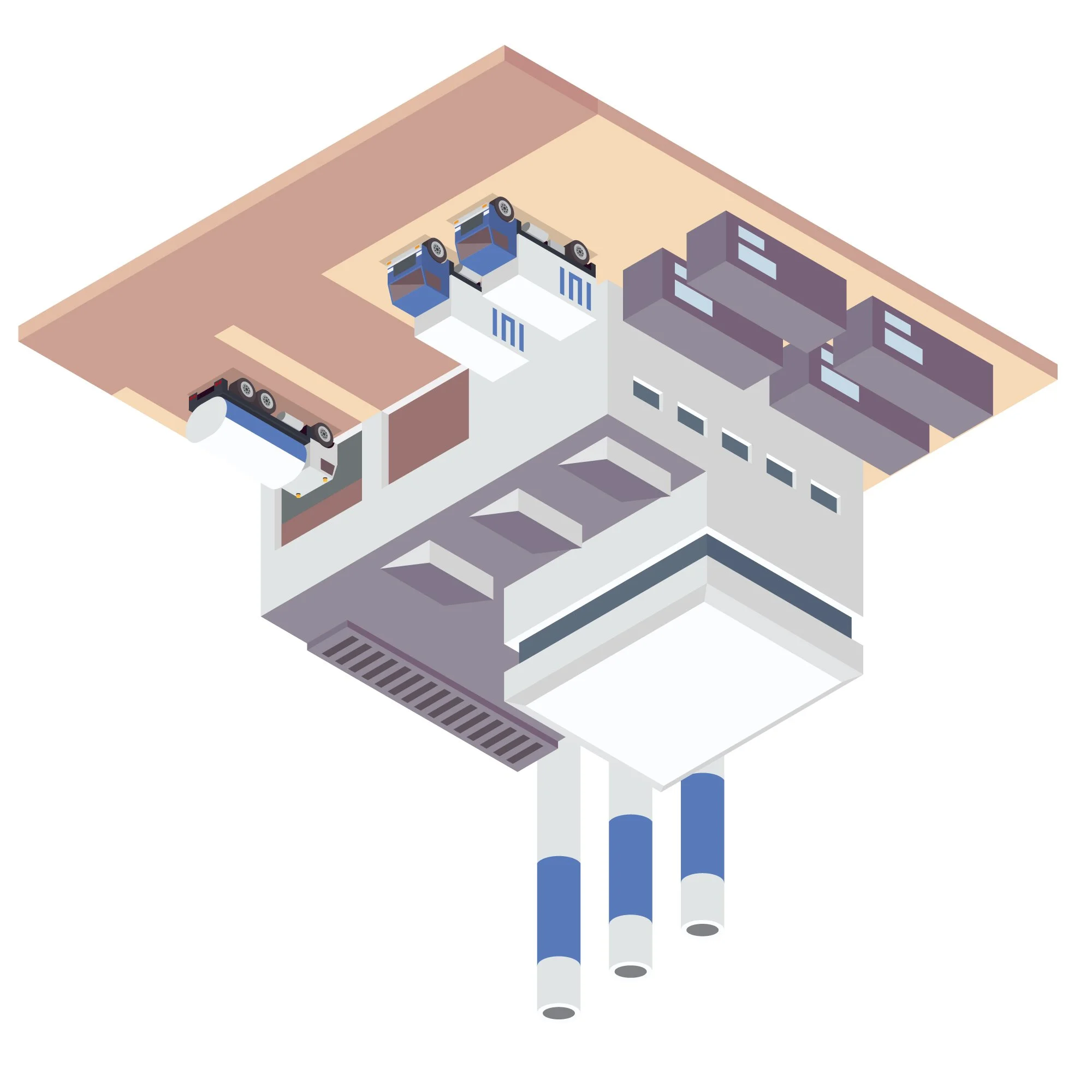
Turning the Factory Upside Down
When a packaging company reached out to me about facilitating a 3P (Production Preparation Process), I was intrigued. It’s the most advanced Kaizen approach I offer. They wanted this to be their very first experience.
Fortunately, I had an ally. Brett, a longtime colleague from my Armstrong days, had joined the company and believed 3P was the only way to address the plant’s design and operational constraints. The plant was bursting at the seams, and their lease made change feel impossible. But Brett believed they could break through.
Our goal: Develop 1–3 bold options to get the plant back on budget and positioned for growth, without relocating, if possible.
As expected, day one brought skepticism. In 3P, we ask people to suspend their constraints and imagine possibilities no one has yet seen. That’s a tall order.
The team followed the process, even when it didn’t fully make sense to them. At one point, I had to give tough love to a company veteran who wanted to skip a step and revert to his usual methods. He didn’t talk to me for a few hours, but by day three, everything changed.
The energy flipped. They saw it. They believed it. They were building something new and it could work.
By week’s end, we had two viable plans. One that reconfigured the current space and one that required a new building. Both met the business goals and sparked new thinking across the team.
At the report-out, the excitement was contagious. Brett strengthened his credibility and standing in the company. The team felt empowered. Some have since moved on, but they still reach out to say how much that 3P experience shaped them.
Breakthroughs don’t come from doing what you’ve always done. When you trust the process and your people new possibilities come into view.

Our Quest for the Holy Grail
This might sound dramatic, but in the world of suspended ceilings, we had a Holy Grail: a ceiling that looked like drywall but performed like an acoustical system. No visible grid. Total sound control. Full accessibility.
For decades, teams tried and failed. The problem? Suspended ceilings require grid for structure and access. Drywall doesn’t offer that and it also lacks acoustic performance.
Then our innovation manager had a bold idea: use the 3P Kaizen (Production Preparation Process) to tackle the problem. He knew we might not solve it in one go, but believed 3P could reveal the path forward.
I was asked to facilitate. The first sessions focused on hiding the visible grid. After many sketches and prototypes, the team landed on a clever idea: use overlapping fabric between tiles. It wasn’t perfect, but it disguised the seams better than anything we’d seen.
Some were disappointed it didn’t fully solve the challenge. But that first step revealed the next: develop a coating that could bind tiles together and create a seamless look without destroying acoustical performance.
The next 3P sessions pushed us farther. Dozens of experiments later, the team found a spray coating that did the trick. We brought in drywall contractors to test it. With their feedback, the final system was born.
After decades of struggle, we had invented a seamless, acoustical, accessible ceiling system. Within months, it hit the market. Today, that innovation drives a growing product category and is a cornerstone of the company’s success.
Breakthroughs rarely come in one giant leap. They’re built through persistence, process, and problem-solving. Sometimes the “Holy Grail” is one prototype away.

Diving into the Deep End
Armstrong World Industries was forced to open a mineral wool plant, in response to the loss of a critical supplier of this vital raw material for ceiling tile manufacture. Because of this, they relied on more outside vendors to design and build the plant than they were comfortable with. They had never spun molten stone (slag) into fibers before and therefore couldn’t use their experience to reduce the potential for errors and inefficiencies in their process.
Armstrong World Industries was forced to open a mineral wool plant, in response to the loss of a critical supplier of this vital raw material for ceiling tile manufacture. Because of this, they relied on more outside vendors to design and build the plant than they were comfortable with. They had never spun molten stone (slag) into fibers before and therefore couldn’t use their experience to reduce the potential for errors and inefficiencies in their process.
The plant started up late, over the capital budget, and at greatly lower performance than required to meet the demand of the ceiling tile plants in the network. Things got so bad that management was shuffled, project team members were removed, and highest-level management was getting involved on a daily basis.
I was “asked” to help the plant achieve budget performance. Knowing this was a politically charged situation and that people who were involved were under intense scrutiny, I convinced my manager to let me visit the facility before committing to the work.
I spent three days at the plant, getting to know the workers, managers, and the process. What I saw was a very concerned and engaged workforce, committed managers, and a process that was absolutely horrible to run. How did we get here, I wondered. I knew I couldn’t fix the past. All I could do was try to improve the future.
There were so many problems, but we identified the biggest one that was causing significant safety, quality, and productivity risk. The molten slag (rock with metal components in it) was designed to fall into a pit and then be scooped up and delivered into a bin. If the slag hit any moisture, it would superheat the water and cause small explosions within the confines of the building. And, the pit was exposed to the outside elements, which naturally allowed moisture in. Another issue was that the front-end loader used to scoop up the molten slag barely fit between the walls of the pit. I saw evidence of damage to the walls of the plant that was less than one-year old. Someday, someone was going to hit a wall with such force that the entire structure would come down.
I spoke with my sponsors and told them incremental improvement wasn’t going to help. We had to figure out a way to keep the slag from falling into the pit in the first place, eliminating the moisture and equipment issue. They looked at me in a way that felt like, “Well, duh, but how the heck can we do that?” I suggested we run a Production Preparation Process (3P) Kaizen in order to tease out and develop breakthroughsolutions to this problem. 3P is the most challenging kaizen event I facilitate. It forces structured minds to get unstructured, go to their childhood mindset (an 8-year-old can solve any problem) and use nature’s influence for ideas. Many engineers and scientists find this difficult to participate in, but their input is essential.
A month later, we assembled a team of operators, managers, engineers, and outside vendors to take the 11-step creativity journey that happens during a one-week 3P Kaizen. We framed the problem in this way: Deliver the molten slag directly to the process without any outside intervention by equipment or the environment. Initial skepticism gave way to creativity, and by the second day, everyone was in it to win it.
By the end of the week, there were two practical solutions for the business to choose from. Both looked promising and reasonably priced, and in the months that followed, one was implemented. From then on, molten slag never hit moisture and the building walls were spared further damage.
More impressive was the feeling of engagement, teamwork, and pride permeating the workforce. They solved the problem, participated fullyand even identified other possible Kaizen events to run in the future.
The plant is still operating and is now the benchmark in the mineral wool industry. Armstrong was able to produce more mineral wool than internally necessary and then sell the wool to other companies. The workforce is highly engaged and continues to drive improvement on a daily basis.
I was amazed by the feedback of the team, who took on a monumental task and slayed their dragon. To a person, they were positively inspired by the effort and ready to take on the next challenges.
You’re Never as Good as You Think You Are
Of all the Kaizen events I have facilitated, there is nothing like 3P. It’s the most exciting, energizing, and exhausting way to create breakthroughs with a team. 3P stands for Production Preparation Process. The idea is to design a new product or process with the least amount of waste possible.
Of all the Kaizen events I have facilitated, there is nothing like 3P. It’s the most exciting, energizing, and exhausting way to create breakthroughs with a team. 3P stands for Production Preparation Process. The idea is to design a new product or process with the least amount of waste possible.
Production Preparation Process uses an eleven-step method to open people’s minds to what’s possible and make them as creative as their 8-year old selves. The technique was invented by Chihiro Nakao, a legend in the Lean community.
I was first exposed to 3P by consultants in 2010. We used the technique to design a new product in half the time it would have taken us to using our standard product development methods. I had the opportunity to facilitate half a dozen 3P events and was able to achieve similar breakthroughs with other teams.
I was always curious about the thinking behind 3P and had the opportunity to participate in a 3P competition, run by Sensei Nakao’s company, Shingijutsu, in 2013. During the week, I was able to pick up the nuances and deeper thinking behind 3P. I realized I had been taking shortcuts during the events I facilitated and because of that, we were diminishing our breakthroughs and results. I didn’t get to meet Sensei Nakao at the competition, but gained a deeper respect for the man and his thinking. I decided I would have to meet him one day, if the opportunity arose.
Meeting the Sensei
In 2016, I found out there was an opportunity to meet Sensei Nakao, as Shingijutsu was running another 3P workshop at a plant in Connecticut. He was the overall sensei for the week. I convinced three other coworkers to register for the workshop and we drove up to Connecticut together. During the drive, we discussed our expectations for the session. I wanted to learn from the master, but I also decided I had to have the ultimate tourist experience: be scolded in Japanese by Sensei Nakao.
The host plant made parts for the aircraft industry. More than sixty people signed up for the workshop. We were divided into eight teams, each having a part of the process to improve using 3P. After some initial training in Japanese (with English translation) by Sensei Nakao, teams were assigned a sensei (facilitator) and toured their area of responsibility.
I had met my sensei at the 2013 competition. He chose me to be on his team for that reason. He also knew I had some experience in 3P and its facilitation, so he gave me more responsibility than the rest of the team.
We took a tour of the operation and spent many hours on the factory floor, engaging with the technicians and gaining deeper understanding of the process. By the end of a very long first day, I was exhausted and glad when the team dinner was over. I knew I would need a good amount of sleep to prepare me for the next day’s activities. I felt confident, having much experience with 3P. What could they throw at me that I hadn’t seen before, I wondered?
Go to Gemba
The next day, after a quick review, the team went back out to the factory floor to gather more data and test ideas. I was asking an operator some questions when our sensei motioned to me. He asked me to join him away from the line. He was working with another team member and wanted me to help facilitate the next step of the eleven-step method. They were drawing some pictures on a large piece of paper taped to a wall, just fifteen feet from the production line.
As I was helping my teammate at the wall, I felt a tap on my shoulder. I looked up and it was Sensei Nakao. He didn’t look happy. I got my wish. I was being scolded in Japanese! I only understood one word: Gemba. The interpreter told me that I should be spending more time in Gemba and not away from it at a wall. All learning was to be done in Gemba. There was nothing I could say, but I could see my sensei looked uneasy.
Achieving My Goal
My sensei must have said something to Sensei Nakao, as he was taken aside and spoken to in Japanese. He looked like a beaten puppy. When Sensei Nakao finished with him, he left and went to visit with the next team. I waited a few minutes and then said to my sensei, “You got scolded, didn’t you?” He looked at me sheepishly and finally admitted he had. We both laughed. I had realized my tourist objective.
The rest of the week was a blur. We were able to solve the problem we had been assigned. I learned deeper meanings of 3P and was able to bring back refined skills to my company. I continue to learn more about 3P. No matter how many 3P experiences I have, I can always do better. Sensei Nakao’s scolding reaffirmed it.

Where Is It?
In 2010, the company I used to work for decided to go Lean. They brought in consultants, who taught tools and techniques to employees all over the world. One tool I learned from them was 3P - Production Preparation Process. This technique maximizes creativity of a team by driving their thinking way beyond their comfort level.
In 2010, the company I used to work for decided to go Lean. They brought in consultants, who taught tools and techniques to employees all over the world. One tool I learned from them was 3P - Production Preparation Process. This technique maximizes creativity of a team by driving their thinking way beyond their comfort level.
Because I had extensive experience with Lean and had applied it for many years in my work, the consultants recognized my capability to facilitate and lead Kaizen events that were broad in scope and of high complexity. One consultant, who asked me to co-facilitate a 3P Kaizen, explained each step to me before and during the Kaizen. The team accomplished breakthrough results, but I didn’t fully understand how they got there. A few months later, I was asked to facilitate another 3P Kaizen, with a consultant as my co-facilitator. Once again, using the 11-step method of 3P, we were able to attain another breakthrough. Over the next two years, I used 3P a few more times and facilitated teams to breakthrough results. Something was bothering me, however. I still didn’t fully understand the meaning of the steps and why they were so powerful. I wanted to know more.
After some research, I discovered the inventor of the methodology was Chihiro Nakao, who ran a company called Shingijutsu. I also learned Shingijutsu was hosting a 3P seminar in 2013 and knew I had to go. Knowing it wouldn’t be an easy sell (costing over $6,000), I asked a higher-level manager to join me and convince our company there was immense value in attending. We were successful and made plans to attend the seminar in Muscatine, Iowa.
Shingijutsu’s World-wide 3P/Moonshine competition was a real-world problem-solving seminar hosted by Allsteel, a leading manufacturer of office furniture. Three teams of six were challenged to design, develop, and demonstrate a new chair and the process to produce it - all in one week. Each team had Allsteel members, as well as participants from outside companies. At the end of the week, our work would be judged by our “customers” and a winning chair design and manufacturing process would be selected. The prior year’s winning chair was being manufactured for the first time the week of the competition. This was going to be intense!
All of our movements before, during, and after each day’s efforts were controlled by Shingijutsu. We were picked up at the airport by them, taken to the hotel, met for breakfast, taken to the factory, and taken to dinner and back to the hotel at the end of each day. This kept us laser-focused and also provided the opportunity to get to know them during downtime each day.
On the morning of the first day of the competition, we were given an introduction to 3P and our mission for the week. We listened to expectations of the plant and our customers next. After that, we were split into three competing teams. Each team was assigned a Sensei to guide them through the process and a space to do their work. My team, made up of my co-worker, four workers from the plant, and me, was given a space above the factory floor, on a mezzanine. Our Sensei, Mike, was a retired Boeing employee, who had come out of retirement to join Shingijutsu at the behest of their founder, Sensei Nakao.
Mike quickly started the team on Steps 1 and 2 of the 11-step Nakao method, named after the inventor of 3P. In these steps, team members were challenged to understand the requirements of the customer at the deepest level. In my prior experience with 3P, I typically rushed through these steps, as they were difficult to explain to team members. Now, I realized these steps were foundational and there could be no shortcuts. The idea of 3P is to design the most waste-free product and process possible. If you don’t understand the essence of what the customer is asking for, you will design waste into the product and process. I was starting to understand – the struggle is important and teams should not be shortchanged of the experience. The day ended with my team finishing Step 2.
The next morning, we started on Steps 3 through 6. In these steps, we were challenged to think in new ways about how to solve the problem for the customer. Using nature as the model of efficiency, all of us had to come up with multiple ways nature does what we are being asked to do. Then, we were asked to sketch. This activates another part of the mind and brings out creativity. Next, we were asked to go even deeper into ways to solve the problem.
At this point, team members were engaged, enthusiastic, and excited. My team went to a meeting table to discuss how we would solve the problem. We got a bit loud and the discussion went back and forth. In less than 1 ½ minutes, Mike came over to our table and asked us what we were doing. We told him we were discussing the problem. He immediately stopped us and said to go out and find the solution, not discuss it at the table. I had never been shut down like that before, and I didn’t like it. I stood up and said, “We don’t even know what it is!” Mike said to go find it on Gemba (the real place, the place where the work is done). So, I did what any respectful student would do - I stormed off!
I went downstairs to the factory floor and started walking around the production lines. I was not happy. I didn’t know what I was looking for, but if that’s what Mike wanted, that’s what I was going to do. My mind was racing, I wasn’t focused, so I kept walking around without purpose. After about 20 minutes of walking aimlessly around the factory, I stopped at a production cell and decided to watch what they were doing. In three minutes, my mind started to relax and I was able to focus on what was going on. Ten minutes later, the activity in the work cell got me thinking about possible solutions to the problem we were trying to solve. Now I knew what Mike was trying to teach. The answer is not at a meeting table, it’s in Gemba. Open your mind and you will find the answer. Could it be that simple? The answer is yes!
I came back to the mezzanine, rejoined the other team members and was ready to solve the problem with them. My experience in Gemba reinforced how important it was to follow the 3P process fully, and not take shortcuts. The rest of the week took us through all 11 steps of the Nakao method and by the end of the week we had a new chair design and the manufacturing process to produce it at the required rate of customer demand.
Our team didn’t win the competition, but we all felt like winners. For me, it was mission accomplished. I learned 3P from the masters. I now had a better understanding of the meaning and purpose of all 11 steps. I also knew I shouldn’t shortcut any steps, they were all vital to the success of the process. But, most importantly, I learned the value of going to Gemba. All the answers are in Gemba. You just need to be willing to look for them.

A Tasty Breakthrough
A North American ceilings manufacturer was closing a plant that produced a product no other plant in the division could manufacture, due to specialized, but obsolete technology. They had a customer who was buying millions of square feet of this product annually. They knew they had to come up with an alternative the customer would approve of and keep buying after the old plant was closed.
A North American ceilings manufacturer was closing a plant that produced a product no other plant in the division could manufacture, due to specialized, but obsolete technology. They had a customer who was buying millions of square feet of this product annually. They knew they had to come up with an alternative the customer would approve of and keep buying after the old plant was closed.
The product had a heavy texture and was extremely durable and tough. None of the remaining plants in the division had the capability to produce this particular visual with the same durability and the project team was at a loss to come up with an alternative. They decided to use a Lean technique called Production Preparation Process (3P). They had very little experience with it, but the stakes were high and they were assured a breakthrough could be achieved by using it.
I was asked to facilitate the Kaizen event with help from a consultant and we would use 3P and its 11-step method to drive the creativity of the team to create, test, and develop the new product in a one-week timeframe. Needless to say, there were a lot of skeptical people in the room, including me.
The first few steps of the 3P are designed to remove all preconceived notions of what the solution should be and force the team to define the true essence of what the customer is asking for. Once done, the team identifies how nature is able to meet those customer requirements. This part of the process usually results in the relaxing of inhibitions and the start of laughter and opening of minds to what might be possible. For some teams, it is a true leap of faith that these steps will lead to something useful.
This team consisted of engineers, designers, scientists, and technicians. We had the use of all of the testing and development facilities for the company and any resource we needed was made available to us. Scientists and engineers are typically more analytical than they are free thinking. Once we got to nature, I saw the team was loosening up and they seemed willing to try something new.
Steps 6 and 7 of a 3P require the team members to come up with 7 ways of solving the problem and then trying them out in real time with available materials. This is called “Moonshining”. During Moonshining, the team members started using available materials in the testing and development facility to come up with new textures and strength properties. Nothing seemed to look like or act like what we wanted. A respected engineer with more than 35 years company experience told us he was going on a shopping trip to find what he needed. We all wondered what he would come back with.
After about an hour, he returned with many different things he bought at a local grocery store, including various cereals, cat litter, salt, and other granular materials. Curious to see what would happen next, we followed him to the testing facility and watched as he poured the various materials, mixed with adhesives, onto boards. Cat litter didn’t look right to him. Then he crushed it, and it still didn’t look right. Next was salt. No good either. Next came cornflakes. He decided to grind them up and poured them on the board. They looked promising. They had the visual texture similar to the customer’s wishes. With the right mixture of adhesives, they might be able to achieve the desired durability. About a dozen trials later, he was able to get a texture and durability the whole team liked.
The team knew it couldn’t use cornflakes in the finished product, but they now knew they could create the proper texture and durability. The rest of the 3P (steps 8 through 11) was spent developing a method to replicate the cornflake texture with materials that could be adhered to the board and painted over in the manufacturing process. At the end of the week, the team was able to provide the overall project team with a concept and method to achieve this new product in an existing manufacturing facility.
Just over a year later, the product was being manufactured in an existing facility, at a reduced cost with better properties than the original product that was manufactured in the closed facility. The customer continues to buy the product to this day, and has no idea that the inspiration for it was found at the grocery store.

The Pursuit of Creativity
In my years of running Kaizen events, I never saw anything as powerful as a creativity approach called 3P – Production Preparation Process. The goal is to eliminate waste in the design of a new or existing process or product in the maximum way possible, unlocking the creativity of the team in ways most of them have not experienced. In 2016 I was fortunate enough to experience this approach through the eyes of the man who invented it, Chihiro Nakao.
In my years of running Kaizen events, I never saw anything as powerful as a creativity approach called 3P – Production Preparation Process. The goal is to eliminate waste in the design of a new or existing process or product in the maximum way possible, unlocking the creativity of the team in ways most of them have not experienced. In 2016 I was fortunate enough to experience this approach through the eyes of the man who invented it, Chihiro Nakao. Sensei Nakao was a former Toyota employee who was sent out to help other companies at the behest of the originator of the Toyota Production System, Taiichi Ohno.
There are eleven steps to the approach, and although they may seem simple or counterintuitive on the surface, they are truly deep and complex and can lead to amazing breakthroughs. A short article will not do this justice, but perhaps it will motivate you to learn more about 3P.
A typical 3P Kaizen event takes 4 ½ days. They are long days, extremely engaging and exhausting, but at the end, the team will have a solution to an important problem that they are seeking. They will also have simulated their solution at a scale that will tell them whether or not it is truly viable.
Background – The team needs to understand certain key Lean principles and terms, such as Takt time, just in time, right sized equipment, and 5 whys prior to initiating the 11 steps of 3P. They also need to know how to use certain tools, such as the Standard Work Combination Sheet and the Fishbone Diagram.
Voice of the Customer – The team needs to hear directly from the customer to understand what is expected from them. There should be a direct exchange with the customer, so there can be no doubt about what is needed. Criteria for the solution is shared, so the team can measure their efforts against the criteria during the 3P.
Step 1 – Determine the Function of the Product or Transformational Step. As a first step, the team must identify what the customer would like them to accomplish in the simplest of terms. They will be challenged to describe this in two words, using a noun and a verb only. For example, a lightbulb does many things, but at its essence, it either “gives light” or “provides heat”. What is the product or process that the customer is most interested in? The team must avoid thinking about what is currently happening, but rather the bare essence of what the customer is willing to pay for, no more, no less.
Step 2 – Define the Essence of the Function Using Keywords. What words are the simplest way to describe what the customer is asking for? The team should generate as many key words as possible and then sketch them out on paper or sticky notes for everyone to see. The act of identifying the key words and sketching them is a way to drive the creativity of the participants forward. Some examples of key words are: drill, shear, guide, roll, and fasten.
Step 3 – Look for Examples of Keywords in Nature. In this step, team members do research and find examples in nature of the keywords. No examples should be man-made. Nature has used millions of years to perfect the simplest ways to accomplish tasks. Again, it is better to draw the examples than just list them. For example, if a key word is grip, then an example in nature could be an eagle’s talon gripping its prey. This step takes time and most team members will initially resist putting great effort into it, but with perseverance, they will make important discoveries about simple ways to perform complex tasks. Each team member should draw at least three examples, so that they expand their thinking beyond what they already know.
Step 4 – Sketch Examples and Examine “What is Happening” to Enable the Function. This next step is to examine in greater detail what allows nature to accomplish the keywords. What causes an eagle’s talon to grip its prey? Team members attempt to attain a greater understanding of the mechanism that is being utilized by nature through research and drawing. More examples are encouraged, as team members dig deep into their understanding and creativity.
Step 5 – Sketch Background and Conditions of the Function. This step takes a deeper dive at the function and the surrounding conditions that allow the function to occur in nature. More than just the eagle’s talon gripping the prey, what is happening with the muscles and nerves in the talon that allow it to grip? What interactions are occurring, and how are they able to do so?
Step 6 – Combine Ideas from Nature and Create Sketches. Each team member is challenged to come up with at least seven ways of solving the original problem using what they have learned from nature and other ideas that they may have. People generally have three alternatives in mind, so getting to seven causes them to think beyond their normal approach and have a bit of fun. It is not unusual to hear laughter during this step as people start to relax their creative minds and let go of their paradigms of what is possible.
Step 7 – Rapid Prototyping (Moonshine). This is the step that brings everything together and turns the ideas into reality. By reviewing, grouping, and prioritizing all of the many ideas shared across the team, the team picks two or three ideas to build. The team should break up into sub-teams so that each idea can be worked on simultaneously. The team is encouraged to use any materials available to them to demonstrate their concepts. The team assesses their prototypes against customer criteria and the
Seven Flows: Flow of People, Flow of Material, Flow of Parts, Flow of Products, Flow of Equipment, Flow of Information, and Flow of Engineering. They learn and improve as they go and are expected to make multiple iterations as they build. This build should be in three dimensions, so it is critical to have enough space and materials for team members to work. The term “Moonshine” refers to the historical practice of building stills in the woods by the light of the moon during Prohibition and using any available materials.
Step 8 – Conduct Trials and Gather Real Data. After building prototypes, they must be tested. Data is collected and compared to the customer criteria. As the comparisons are made, improvements are identified but not yet implemented. Often, the team identifies a better way to approach the problem and plans out the improvements for the next round of prototyping and moonshining.
Step 9 – Select the Three Best Designs Based on Criteria. During all of the prototyping and moonshining, it is not unusual to create variations on the original ideas and have many options to choose from. In this step, the team uses the original customer criteria to score all options and narrow down to three best designs to continue working on.
Step 10 – Continue Simulating and Gather and Evaluate Data on the Top Three Proposals. The team continues to do work on their proposals, learning about them, simulating them, and improving them. Any problems that occur are fixed on the spot, with as little discussion as possible. The act of building rather than discussing expands the creative process. At some point in this step, time will run out, so the team should set a target time to get all information and simulate how their idea will work.
Step 11 – Presentation of Solutions. The team demonstrates to the customer how each option works and shares the data and criteria evaluation. It is similar to a high school science fair, in that the customer acts like the judge and delivers constructive criticism and asks deep questions to the team. Rather than a Power Point presentation, this is a demonstration in 3D, with physical activity, so it’s easier to understand what the team is presenting.
The 3P approach is a highly engaging way to drive breakthrough creativity in teams that have the opportunity to participate. It has been shown to save precious project time and drive cost out of the finished product or process. Some teams saved 6 months in their Innovation cycle time by using 3P. Other teams have said that using 3P revealed viable options that they would never have pursued otherwise. I encourage you to consider this approach and learn more about it.