
Kaizen Success Stories
Real Manufacturing Results. One Kaizen at a Time
Explore real-world Kaizen success stories showing how manufacturing teams solved critical problems, improved performance, and created sustainable results.
From Compliance to Confidence
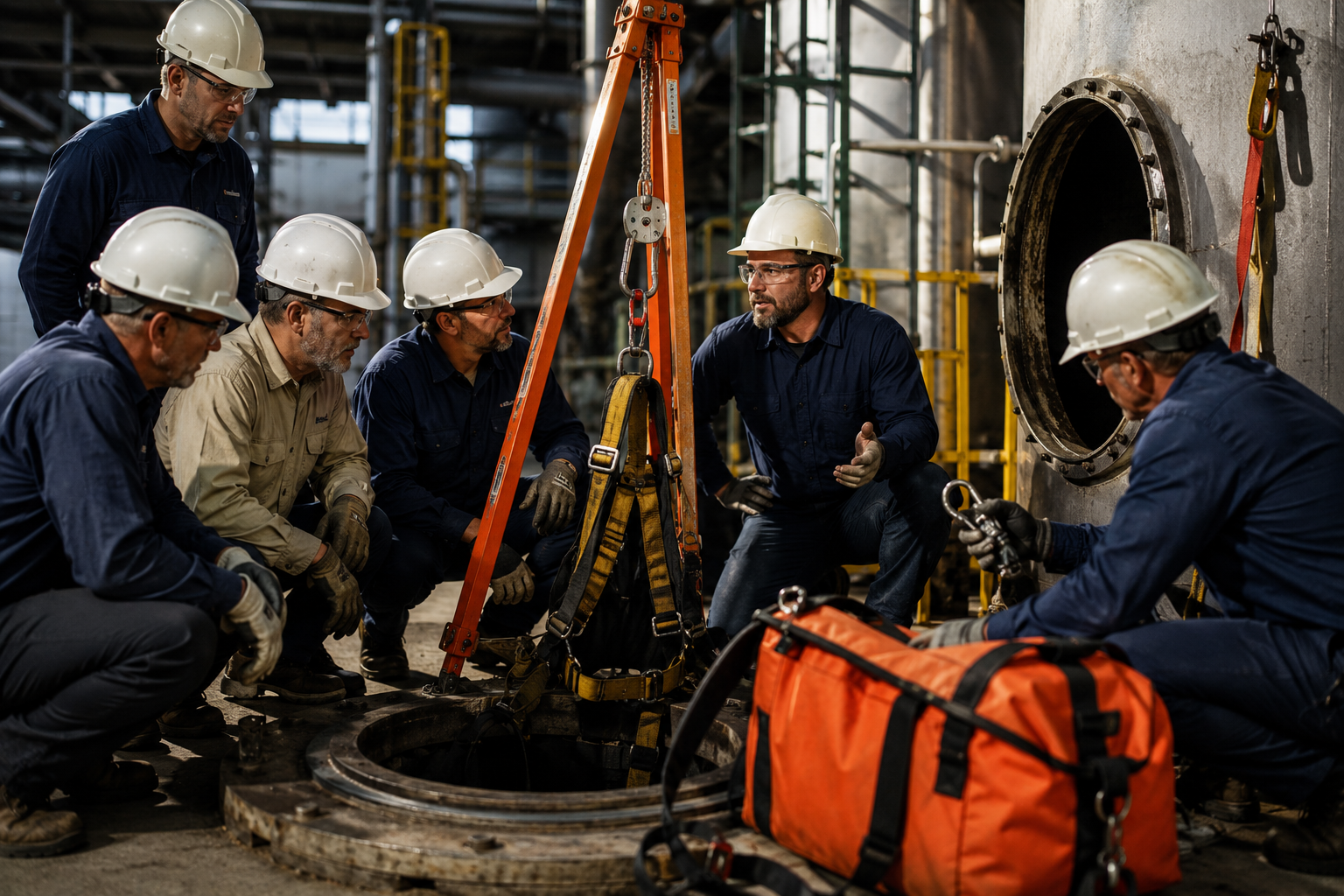
How a paper mill eliminated critical safety risks and created a sustainable confined-space system in one week
Kaizen Snapshot
Industry: Paper Manufacturing
Challenge: Confined Space Entry and Rescue Compliance
Approach: Kaizen Event Facilitation focused on standardization, risk reduction, and rapid implementation
Results:
90 confined spaces identified and brought into compliance
Approximately 15 previously unidentified confined spaces discovered
Standardized signage developed and installed
Training requirements defined and implemented
Hazard identification standards created for every confined space
Rescue capability improved for all employees, including specialized equipment for a 300+ pound team member
Rescue equipment organized using 5S for rapid access
The Situation
A paper mill in Oklahoma faced a significant safety challenge.
The facility needed to ensure that every confined space met entry and rescue requirements.
Before the Kaizen event began, the team believed they had identified between 75 and 80 confined spaces throughout the mill.
The goal seemed straightforward: verify compliance and close any gaps.
What the team discovered was something very different.
What We Found at the Gemba
After learning the fundamentals of Lean thinking and waste identification, the ten-person Kaizen team headed to the floor.
The facility consisted of two major operations:
The paper mill
The converting operation that produced tissue, paper towels, and toilet paper
The Oklahoma summer heat was relentless.
Temperatures exceeded 90 degrees as the team spent nearly four hours walking the entire facility.
They inspected every area, questioned assumptions, and challenged the existing inventory.
By the end of the walk, they realized the actual number of confined spaces wasn't 75 or 80.
It was 90.
Approximately 15 confined spaces had never been included in the official inventory.
The challenge had just become much larger.
What We Did
The team quickly identified three elements that were essential for compliance:
Signage
Every confined space needed clear, consistent visual identification and entry requirements.
Training
Employees needed a standardized understanding of confined space entry procedures and rescue expectations.
Hazard Identification
Each confined space required a clear understanding of the risks associated with entry.
The team divided into three focused sub-teams and developed standards for each area simultaneously.
Rather than tackling one confined space at a time, they built systems that could be applied across the entire facility.
The Hidden Safety Risk
As the team worked through compliance requirements, another issue surfaced.
One employee regularly worked in confined spaces and weighed more than 300 pounds.
The existing rescue equipment could not safely recover him in the event of an emergency.
Fortunately, a rescue had never been required.
But everyone recognized that hoping nothing would happen was not an acceptable safety strategy.
The team immediately addressed the issue.
They identified rescue equipment with a 500-pound capacity, secured approval, and purchased the equipment during the Kaizen event.
Before the week ended, the equipment had arrived on-site and was stored in a location where it could be accessed quickly if ever needed.
The team also applied 5S principles to organize all rescue equipment, making emergency response faster and more reliable.
The Results
By the end of the week:
MeasureResultConfined Spaces Identified90Previously Unidentified Spaces Found~15Confined Spaces Brought into Compliance90Standardized Signage Implemented100%Training Standards DevelopedCompleteHazard Identification Standards CreatedCompleteRescue Equipment UpgradedCompleteRescue Equipment Organized Using 5SComplete
What appeared to be an overwhelming challenge on Monday became a completed mission by Friday.
The Most Important Result
The biggest accomplishment wasn't compliance.
It was confidence.
At the beginning of the week, the team viewed the challenge as nearly impossible.
The scope was unclear.
The inventory was incomplete.
Critical rescue gaps existed.
Yet by working together, dividing responsibility, and focusing on solutions instead of obstacles, the team achieved something that initially seemed out of reach.
They didn't just identify problems.
They solved them.
And they left behind systems that would protect employees long after the event was over.
Key Lesson
Safety improvement doesn't happen because organizations care about safety.
It happens when teams translate good intentions into clear standards, proper equipment, and disciplined execution.
In one week, a team of ten people transformed an overwhelming compliance challenge into a sustainable safety system.
That's what becomes possible when the right people are empowered to solve the right problem.

Safety Taken to the Extreme
What a four-day asbestos audit taught me about discipline, resilience, and what safety really means.
Kaizen Snapshot
Setting: Dal-Tile manufacturing plants (Southern U.S.)
Challenge: Asbestos sampling under extreme conditions
Stakes: Worker safety, compliance, personal resilience
Approach: Strict protocols, long-duration sampling, extreme heat exposure
Outcome: Complete audit, deeper respect for safety discipline
Key Lesson: True safety work demands discipline, endurance, and respect for risk
The Situation
During my time at Dal-Tile, I worked as the environmental, safety, and mining liaison for 12 manufacturing plants.
There was little trust between the plants and the corporate safety group, so I was assigned to shadow a corporate environmentalist during asbestos audits.
His name was Richard. He wasn’t exactly customer friendly, but he was meticulous.
What Was Getting in the Way
Asbestos sampling wasn’t done during normal shifts.
We worked nights, weekends, and off-hours, when plants were quiet.
Richard wore a full Tyvek suit in the middle of summer in the South.
I was told to stay at least 30 feet away.
Even from 30 feet, I was uncomfortable.
Going Where the Risk Was
At one plant, Richard climbed on top of a ceramic tile dryer, hundreds of feet long and extremely hot.
I followed him.
The surface temperature was between 120 and 140 degrees. He was sealed in Tyvek. I was not. I have no idea how he tolerated the extreme heat. I was melting.
We worked 14–16 hours per plant. In four days, we slept less than 12 hours total.
What Changed
Richard never slowed down.
He followed every protocol.
He documented everything precisely.
It was one of the most physically demanding and disciplined safety efforts I’ve ever witnessed.
And I learned something important about myself.
The Takeaway
I gained a deep respect for the rigor behind real safety work and clarity that this wasn’t my long-term path.
Safety isn’t a slogan. It’s discipline under pressure.
Why This Matters
Many organizations talk about safety. Few truly understand the rigor required to protect people in high-risk environments.
Discipline saves lives.
Want Safety That Actually Sticks?
If safety feels reactive instead of disciplined, Kaizen can help build systems that protect people consistently.

Don’t be afraid to ask for help
I had many stops in my corporate career. I worked in furniture, ceiling grid, ceiling tile, ceramic tile, and vinyl flooring all over the world. My most challenging assignment was working for Dal-Tile in Dallas Texas. I was the environmental, health, safety, mining, and industrial engineering liaison for the twelve manufacturing locations around the country.
I had many stops in my corporate career. I worked in furniture, ceiling grid, ceiling tile, ceramic tile, and vinyl flooring all over the world. My most challenging assignment was working for Dal-Tile in Dallas Texas. I was the environmental, health, safety, mining, and industrial engineering liaison for the twelve manufacturing locations around the country.
It was challenging for many reasons, not the least of which was the negative environmental history Dal-Tile had in the state of Texas. In the 1980’s, they were given the highest environmental fine in the history of the state. The next reason was I had no background in environmental, health, and safety (EHS). The final reason was that the corporate EHS department didn’t want to help me, my boss, or the facilities with compliance. It was an extremely difficult situation to navigate.
My boss and I decided to tour all of the plants, establish relationships with their staff, and identify areas where we could help. Most of our visits started out the same way. Plant leadership would be wary of us, having been “burned” by the corporate EHS staff in the past. Once we showed we were genuinely interested in helping them stay compliant, they warmed to us and let us see the critical issues they were facing. Wayne, my boss, was exceptionally adept at getting people to warm to us. He was a true gentleman who cared about the people he served.
We realized we needed to understand the various rules and regulations governing the plants, especially in Texas. Instead of reading many books, we decided to travel to seminars hosted by OSHA and the EPA. I was in Austin Texas at an EPA seminar when the presenter asked each of us our names and who we worked for. When I introduced myself from Dal-Tile, the room fell silent. I felt a bit embarrassed, so I blurted out, “but we’re trying to get better!”
At a break, another participant introduced himself to me and told me he used to work for Dal-Tile many years before. He said, “don’t feel bad, when I used to go to seminars, they used to hold up the front page of the Dallas Morning News that showed the headline, ‘Dal-Tile fined millions for environmental transgressions.’ Then, they’d say, ‘don’t let this happen to you.’ They’d go around the room with introductions and I’d get booed!” I felt bad for him and me too, but I was resolute in my belief we could do better and improve the company’s reputation, even with all of the obstacles from the past.
After many more seminars, research, and building relationships with plant leadership, I started to get pulled in to help plants resolve environmental issues and even prevent them. This was a breakthrough.
One day, Al, the Dallas plant manager, called me and asked for my help. I went to the plant to find out what was going on. He showed me a letter saying they were being fined for too much zinc in the wastewater. We walked the inside process to see where the zinc could be coming from. In raw material form, there was less zinc in the product than they were being fined for.
We walked outside to look at the water that was being treated before going into the drains. It looked clear and had no debris in it. The EPA testing point was about 100 yards from the outflow point and the treatment process. Somehow zinc had to be entering the water between the treatment process and the testing point. Where could it be coming from, I wondered?
Then, I saw it. The fence separating our property from the factory next door was shiny for most of its surface, except for a 50-yard length that was a dark brown. It was a drastic difference. Al told me that the neighbor was an electroplating company and they always turned off their smokestacks whenever they were being inspected by the EPA.
I knew what I had to do. I would invite the EPA to visit the plant and help us solve our “zinc problem.” When I shared my idea, Al looked worried. I said, “Al, do you trust me?” He said, “you haven’t let me down yet. Don’t let me down this time!”
I scheduled a visit from the EPA for two weeks from our conversation and they seemed surprised that someone from Dal-Tile would invite them to the plant to help resolve an issue. I guess they were used to defensiveness, rather than cooperation. This gave us time to get everything in the plant in the best possible condition and find all of the materials information that might be requested during the visit.
Edward, the EPA inspector, joined me and met the leadership team early in the morning. I took him on an inside plant tour, showing him all of the possible locations where zinc could be coming from. He agreed with me it was highly unlikely our materials were causing the unusually high zinc levels in the wastewater.
Taking his cue, I took him outside to the wastewater treatment process and showed him how clear the water was. He agreed it didn’t make sense to have high zinc in the water. I then asked him if he could help me clear up a mystery. He seemed intrigued. I showed him the fence, with the shiny and brown areas and asked him what could be causing it? He looked at the fence, then saw the neighboring factory. Once the realization of what was happening hit him, he told me, “Adam, the zinc isn’t coming from your plant. I’ll rescind the fine and the EPA will deal with the real cause of the problem.”
Relieved, I thanked him for his help. I found Al and told him what had happened. Al responded, “Adam, you had me worried, but I was hopeful you would pull it off.” Al then invited me to have a beer with him and it was the coldest and tastiest one I ever had.
Blow It Up
Here’s a mining story from my time at Dal-Tile that involves blowing up a hill!
Here’s a mining story from my time at Dal-Tile that involves blowing up a hill!
We were invited to an annual mining training event (required MSHA training) at our talc mine in Van Horn, Texas. To get there, we had to fly to El Paso and then drive 120 miles in the middle of nowhere to our mining operations. Once we got there, we met Junior, the mining operator. He had spent his life out in the hot Texas sun and you could tell it by the condition of his skin. He lived on the mining property with his wife in a trailer and was one of the nicest people I have ever met.
After a day of training, we went out to dinner and spent the evening sharing stories, drinking, and dancing. Wayne, my boss, tried a shot of vodka with tabasco sauce on top and forgot to open his lips wide enough to avoid the burn. We all had a laugh at that.
On the second day, after a few hours of training, we were treated to a mining demonstration. We were going to clear some overgrowth on a hill by blowing it up. The only things I had blown up in the past were fireworks on the Fourth of July, so I was excited to see how it was done.
When we got to the hill, we were told there were 159 sticks of dynamite placed in three rows. They would be used to clear the growth and expose the talc for mining. Wayne and I got the opportunity to string the fuse through some of the sticks, while being assured by the mining operator we were perfectly safe to do so. I strung two sticks. Wayne was having such a good time, he strung around a dozen.
Then we were asked if we wanted to light the fuse to blow up the hill. I knew I did, and Wayne deferred to me. Since I had never blown anything up of this magnitude, I asked the operator what safety precautions we should follow. He pointed out the two vans with the motors running. Each one had enough capacity to take all of us away, should one of the vans fail.
Next, he told me the fuse between the sticks of dynamite took milliseconds to burn, but the main fuse I would be lighting had enough time on it to get us into the vans and approximately ½ mile away, where we would be safe.
I was a bit nervous, but I told myself the mining operator had done this many times before, so I would try to hide my anxiety. My natural inclination was to run as soon as the fuse was lit, but I thought that would make me look silly. So, I decided to do whatever the mining operator did. If he walked, I would walk. If he ran, well then …
He lit a cigarette, took two puffs and handed it to me. I bent down, held the cigarette to the fuse, and watched it light. Time stood still. I cleared my head and saw the mining operator walking slowly to the van. And that’s what I did. Wayne ran like a scared child and jumped into the van.
Once we were all in the van, we drove to the other side of the site and watched as the 159 sticks of dynamite exploded with a precision that took the face of the hill down exactly as planned.
We got back to the training room and poked fun at Wayne and any of the other folks who ran to the van. I would have too, but I had convinced myself to not panic. Was this the right call? I don’t know, but at least I had some fun at my boss’ expense!
These days, I work with teams to develop standard work to keep them safe and productive. To be sustainable, it needs to make sense to them. Although I don’t recommend lighting a fuse with a cigarette, it worked for the mining operator in Van Horn Texas.

If you can’t stand the heat, get out!
I was the Industrial Engineering manager at a ceramic tile factory in western New York for two years. During that time, I participated in many improvement projects. As a member of staff, I was responsible for various administrative and plant coverage duties. One of the most critical responsibilities I had was holiday coverage for the tile firing and curing process.
I was the Industrial Engineering manager at a ceramic tile factory in western New York for two years. During that time, I participated in many improvement projects. As a member of staff, I was responsible for various administrative and plant coverage duties. One of the most critical responsibilities I had was holiday coverage for the tile firing and curing process.
Our tile was mosaic, meaning the color went all the way through. After the raw materials were combined, they were pressed into 1 x 1-inch or 2 x 2-inch squares and placed into ceramic containers with sand. The containers were loaded onto cars that travelled through a kiln. The kiln cars, which weighed hundreds of pounds, spent 36 hours travelling through extreme heat (>1900 degrees Fahrenheit). At the end of their journey, the tiles were fully cured.
Sometimes, cars jumped off of the tracks and got stuck in the kiln. Someone had to get them back on track, so they could exit the kiln. We had personnel who were able to get the cars back on track before there was a major pile-up or wreck in the kiln. If they weren’t able to, we would have to let the kiln cool down to room temperature, which took days and caused most of the tile to be scrapped.
These pile-ups were rare and unpredictable. As a member of staff, I had a responsibility to assist the team while they were trying to get things back to normal, during times when there was no coverage at the plant, such as a major holiday.
On Thanksgiving I was responsible for kiln coverage. I got a call late in the afternoon that one of the cars had jumped off the tracks in the pre-heat section. Fortunately, that’s where it’s just two hundred degrees, rather than thousands. Still, that’s pretty hot.
I dropped what I was doing at home and drove to the plant. When I got there, I met the team that was going to go into the pre-heat section and put the car back on the track. They were gearing up, putting on Tyvek suits, gathering pry-bars and a cooler of water and Gatorade.
My job was this:
1. Keep them alive
2. Keep them hydrated
3. Limit their exposure to the heat
4. Stay out of their way
The team went into the pre-heat section and started using the pry bars to put the car back on the track. They walked in like it was no big deal. After three minutes of effort, I thought they should take a break. I tried to walk into the pre-heat section to tell them to come out. As soon as I did, the intense heat physically pushed me out of the area. I’d never felt anything so hot in my life. And there was the team: fully inside, wearing Tyvek suits, and using pry bars to move the massive kiln car back onto the tracks. Unbelievable!
I decided it would be better just to yell to get their attention. After two more minutes, I was able to convince them to stop what they were doing and take a break and hydrate. After two more attempts in the pre-heat section, they got the kiln car back on the tracks.
As I think back on this experience, I am amazed at how people are able to adapt to the most challenging conditions and work as a team to solve the most difficult problems.

Fix It and Make a Difference
In 2005, I was working in the central engineering group for Armstrong in Lancaster PA. One day, while I was sitting in my cubicle, the CEO of our division came up to me and told me that he needed my help at our newly acquired cabinet plant in Auburn Nebraska. I asked him what help I could provide. He looked at me and said, “Fix it – you’ll know what I mean when you get there.”
In 2005, I was working in the central engineering group for Armstrong in Lancaster PA. One day, while I was sitting in my cubicle, the CEO of our division came up to me and told me that he needed my help at our newly acquired cabinet plant in Auburn Nebraska. I asked him what help I could provide. He looked at me and said, “Fix it – you’ll know what I mean when you get there.” I was told I would have a small team travelling with me and our first visit to the plant would be for 2 weeks. During that time, we were to evaluate the things we could improve, make quick improvements, and develop plans for future efforts.
I have been to hundreds of factories in my career, and have seen some well-run factories and some poorly run ones. When we arrived, I saw what was clearly the poorest run facility in my experience. There was no organization or order. Equipment was in disrepair. People looked like they had been beaten down. Many had evidence of prior injuries. It was hard to find a safe walkway in the entire plant. It made me immediately angry that people had to work in these conditions. In fact, one of my team members was so angry, we had to take him outside to calm him down.
“What the hell are they thinking?” he asked, “How can they get away with this?” We talked for a while and eventually came to the conclusion that we couldn’t fix the past, but we could damn sure improve the future for these folks. Luckily, the company had hired a new plant manager, who had arrived at the plant about a week before we did.
We spent some time with him on our first days at the plant and believed he wanted to improve conditions for his people as much as we did. We felt he would support our efforts to make real positive change for the employees at the plant. We knew we needed his support to get critical work done.
Thousands of opportunities
Everywhere we looked, we saw things that could and should be improved. Early on, we reorganized a panel cutting area and made it easier and safer to get the materials needed to be cut. We also created some signage for the area, so finished parts could be easily found. We were also able to get much needed repairs for the equipment that was being used daily. We realized we couldn’t fix everything, even though we wanted to. We had to prioritize and decided to work on things we could immediately fix in order to give the employees hope for a better place to work.
Miles to go
One day I was watching the flow of material to different parts of the factory. I saw a large man take a pallet jack and transport cabinet parts from one area of the plant to another. He had to physically pull the material, which probably weighed 250 pounds, over a quarter of a mile. I followed him to his destination and then watched him pick up another pallet of parts, and manually pull it to another part of the plant. This looked really difficult to me, and I wanted to know more.
I introduced myself to him and he told me his name was Roy and that he had been doing this type of work for more than 5 years. I asked him if he knew how far he moved material in a day. He told me he was given a pedometer by the health and safety manager and found out he was pulling materials more than 17 miles in a day on average! Seeing how physically difficult this work was, I asked him, “What do you do when you go home at night?” His response was, “Adam, I sit down in my recliner, fall asleep, get up the next morning, and go back to work.” This was no way to live. I knew we had to help him.
I assembled my small team and we talked about what we could do to help Roy. In my mind, if we didn’t help him, he would soon be injured, and probably had been in the past. We did our research and found out there was a battery-operated pallet jack that would allow the operator to ride on when moving materials. We found a used one in the area that cost less than $5000. It was time to convince the plant manager to buy this unit immediately.
Sealing the deal
We asked the plant manager for an opportunity to review our findings and share our plan for further improvements. We had 12 improvement projects we wanted to implement before we left at the end of our 2-week assignment. We told him we thought there was nothing more important than buying the battery powered pallet jack for Roy. When we explained our reasoning, he realized how critical this would be for the health and well-being of one of his employees and also how much it mattered to us. He immediately gave us approval and called in his purchasing manager to help us buy it.
In 3 days, we had our new battery powered pallet jack and gave it to Roy to test out. He did and was so happy, he gave rides to some of his co-workers. The next day, I followed up with Roy and he told me he had some of the best sleep he had in months. We made a real difference for one person, and that made all of our efforts a resounding success!
Breaking Through - The Edge
In 2005, I was asked to help a team reduce the changeover time of a painting operation at a ceiling tile manufacturing plant in Oregon. The approach I used was SMED – Single Minute Exchange of Die. The goal was to reduce the existing changeover time by 50% or more, while improving the safety of the work.
In 2005, I was asked to help a team reduce the changeover time of a painting operation at a ceiling tile manufacturing plant in Oregon. The approach I used was SMED – Single Minute Exchange of Die. The goal was to reduce the existing changeover time by 50% or more, while improving the safety of the work.
After training the team, we took a walk on the factory floor to observe a changeover in progress and see if we could generate any improvement ideas. As with most SMED events, we saw a ton of improvement opportunities related to the existing changeover and the team was excited they would be able to help everyone in the process.
Towards the end of the walk, we stopped at the quality testing station and saw something that didn’t look right to us. The Quality Technician was using a box knife to cut four 2-foot edges of the ceiling tile off by hand. It looked difficult, unsafe, and extremely inefficient. When we asked her more about it, she told us she was required to measure the color of the face and edges of the ceiling tiles. The only way to get the colorimeter to read the edge of the ceiling tile was to make these cuts, allowing the tester to be placed directly on the edges. She also told us it made her wrists hurt. On a break, I verified with plant leadership they were also very concerned about this requirement. It was their number one safety concern in the facility and a number of engineers had studied the issue with no practical solution.
Following the walk, the team went back to their meeting room and listed all of the improvement ideas they had. They then prioritized the ones they wanted to work on to reduce changeover time. During the next two days, many of the highest priority ideas were implemented and the team was extremely excited about the improvements they were able to make.
At a break, a mechanic on the team came up to me and asked if it would be ok for him to work on something outside of the prioritized list of improvements the team had identified. I could tell something was bothering him, so I asked him to tell me more about what he was thinking. “Adam, I can’t get that edge cutting process out of my mind. It’s not right that we are putting our people at risk. I think I have a solution, and if you give me an hour to work on it, I can come right back to the team to help out with the other efforts.”
Kaizen is a team sport, and the team needs to be aligned around what everyone is doing. I asked the team what they thought. They enthusiastically supported the mechanic’s efforts. So much so that one of the operators volunteered to help him work on his idea. We couldn’t wait to see what they would come up with.
About an hour and half later, both team members came back with grins a mile wide. They brought a contraption that looked like a standard vise with a two-foot wide angle iron attached to each jaw. Curious, we stopped our other work to watch a demonstration of their invention. They put a 2-foot ceiling tile into the vise vertically, with the edge of the tile in the jaws and closed the vise carefully. Then, with a swift tap, the ceiling tile broke off cleanly at the edge, across the entire 2-foot length. We were stunned. One of our team members stepped up and tried the next of the four edges, and it broke off just as cleanly. One by one, we all tried it and saw how quick and easy it was to break off the edges. Now, we gave it the ultimate test – we brought it to the Quality Technician and showed her how to use it. She easily broke off the edge and immediately gave the mechanic a hug in a show of gratitude. It was probably the only hug the mechanic ever got at the plant!
We were so proud, but knew we had to finish our other work and gain alignment from plant leadership that our new method would meet the quality testing requirements. During the rest of the Kaizen, we implemented as many of our improvement ideas as possible, then created an overall changeover procedure that we verified, practiced, and used to train the rest of the operators on the line. The changeover time had been reduced significantly, but we wouldn’t feel like we had won until we implemented the new edge breaking process. So, we decided to build a final report to win over the plant leadership.
We invited plant leadership to see the new changeover procedure, which the team demonstrated for them. Some of the leadership team even participated, to see for themselves how much easier and safer it had become. They were extremely pleased, but we had saved the best for last.
Our creative mechanic invited the Quality Technician to join him in front of the group of plant leaders. Then, another team member brought out the vise and handed a ceiling tile to the Quality Technician. She put it in the vise, gave it a tap, and the edge broke right off, as clean as could be. In my life, I have never seen a collective group of people’s jaws drop at the same time, but it happened right then. After they got over their initial shock, the Operations Manager said, “Let me try that.” He did, and got the same result.
Everyone wanted a turn, and when it was over, the Safety Manager said, “This has been our number one safety risk. We have spent over 6 months trying to solve it the conventional way and haven’t been able to do so. Your team worked together and solved it so quickly. We need more teams to help us solve our problems in this way. Thank you!” Then, she gave the mechanic the second hug he had ever received in the plant. After blushing, he admitted to the group that in all of his years working at the plant, he had never done anything as impactful as this. He also reminded everyone that this was a prototype, so there may be an improved way of doing the work. Many years later, the original vise was being used in the plant without a complaint.