
Kaizen Success Stories
Real Manufacturing Results. One Kaizen at a Time
Explore real-world Kaizen success stories showing how manufacturing teams solved critical problems, improved performance, and created sustainable results.

Not Everyone Thinks the Same
I’m an engineer. Please don’t hold that against me. I’d like to believe I think logically, solving problems in a scientific way. I was taught this way as I was growing up. I assumed everyone else thinks this way. How wrong I was!
I’m an engineer. Please don’t hold that against me. I’d like to believe I think logically, solving problems in a scientific way. I was taught this way as I was growing up. I assumed everyone else thinks this way. How wrong I was!
My first job out of college was as an Industrial Engineer for Thomasville Furniture. After many job changes and promotions within Armstrong, I ended up as a Senior Industrial Engineer at the corporate office in Lancaster PA.
I was having a lot of success helping teams solve critical manufacturing problems all over the world, using my own brand of facilitation techniques. Feedback on my approach was mostly positive, but there were some who thought I was a bit heavy-handed and not listening to team members as much as I should.
Our project managers were all required to attend a problem solving and facilitation course in Buffalo NY. It was highly regarded. My boss thought it would be a good idea for me to attend. I was happy to have the opportunity, and it also sounded like a nice week away from the office.
On the first day of the course, 25 people sat at tables of 4 or 5 and introduced themselves. We were told we would learn dozens of problem-solving and facilitation techniques. Before we did, we had to understand how people think. That seemed reasonable. But didn’t everyone think in a logical, straight-line way, like me?
We were instructed to draw a picture illustrating how we solve a problem. After we had a few minutes to complete our task, we were asked to share our results with others at our table. Being the logical engineer, I drew a series of boxes and arrows showing the steps I took from problem identification to resolution. It was essentially a straight line and made a lot of sense to me.
When I reviewed my process with the group, a few looked at my picture with concern in their eyes. Then, one member of the group showed her drawing. It looked like a dust cloud, with an unhappy face on one side and a sunny day on the other side. She described how when a problem comes to her, she goes to a dark place to think until the answer presents itself on the other side, which made her happy.
This couldn’t be a more opposite approach to mine. But it was hers. It’s how she dealt with problems and it worked for her. I realized for possibly the first time that not everyone thinks like I do. I now knew the purpose of the exercise. We can’t assume everyone thinks in the same way. If we do, we won’t be sensitive to their needs and therefore can’t help them through our facilitation efforts.
I became more open to learning as many different facilitation and problem-solving techniques as I could possibly use. Having a full arsenal allows me to modify my approach to the needs of the people I am working with. This simple exercise opened my eyes to the obvious. I’d like to think it made me a better facilitator and someone who can help anyone solve problems.

Good Things Can Come from a Tough Situation
My first supervisory assignment was at a ceiling grid factory in Franklin Park Illinois. We had eleven operating lines at one end of the plant and a distribution center at the other end. It wasn’t unusual to produce grid in the morning and ship it out the same day. Sometimes, due to inefficiencies, we produced finished goods for customers whose trucks were waiting to be loaded on our shipping docks.
My first supervisory assignment was at a ceiling grid factory in Franklin Park Illinois. We had eleven operating lines at one end of the plant and a distribution center at the other end. It wasn’t unusual to produce grid in the morning and ship it out the same day. Sometimes, due to inefficiencies, we produced finished goods for customers whose trucks were waiting to be loaded on our shipping docks.
In early December, people in suits came to our plant and took a tour. They spent time on the factory floor and in the offices with our plant management. I was told they were “investors.” I didn’t know enough to question this, and went about my business, trying to produce grid as safely and productively as possible.
Our Vice President of Operations came to the plant in the middle of December and took the staff and their dates out to a nice dinner. He told us how impressed he was with us and that he was committed to the long-term viability of the plant.
Our performance was improving and the team was feeling good about their future. Early in the spring, we planned a recognition luncheon and invited employees from all three shifts to join in the celebration.
As we sat down to the meal, our Plant Manager summarized the performance improvements made over the past year. He congratulated many by name and shared how proud he was of what we had accomplished. Then, he introduced the “investors.” Everyone clapped. We had no idea what was about to happen.
One of the investors got up and added his congratulations. Then, he told us that even though we had made such great progress, our company had entered into a joint venture with his. Our plant had become redundant. We would be shut down in the next three months.
I was stunned. Good thing too. The moment the announcement was made, employees looked at me to see if I knew about the plant closure ahead of time. The look on my face told them I didn’t.
Over the next three months, we did everything possible to keep everyone safe and productive while we were preparing the plant to shut down. We lost many good crew members who found jobs in the area. But something happened that surprised me (in addition to the shock of the announcement). Performance improved beyond the levels it had reached prior to the luncheon. I think most people wanted to stay busy, rather than focusing on the eventual plant closure.
The remaining team members became closer and seemed to appreciate me more than they had before. I’m almost certain my ignorance of what was coming made them feel like I was in the same situation as them and that I hadn’t hidden anything from them.
As we shut off the lights and locked the doors on the final operating day at the plant, employees hugged each other and said their heartfelt good-byes. Our team rallied in the face of adversity and stayed strong until the end.
One Size Doesn’t Fit All
Early in my career, I worked at Thomasville Furniture. I supported the veneering operations. We were building a new plant for the plywood pressing operations. I was asked to design and purchase a storage system for the heavy wood blocks that were used to create shaped plywood in a special press.
Early in my career, I worked at Thomasville Furniture. I supported the veneering operations. We were building a new plant for the plywood pressing operations. I was asked to design and purchase a storage system for the heavy wood blocks that were used to create shaped plywood in a special press.
I had two critical problems to solve:
1. Improve the organization of the blocks and make them easy to find.
2. Reduce the effort and safety risk of moving the blocks into and out of the press.
In the existing veneer plant, the blocks were stored on pallets on the floor. When needed, they were carried to the press and slid into place. The blocks weighed 40 to 400 pounds. The heaviest block was used to create bed canopies. All other blocks weighed 100 pounds or less. One person carried the lighter blocks to the press. Four people carried the bed canopy blocks. Clearly this wasn’t a safe practice. I knew I could improve this situation.
The first thing I did was follow the process in the old plant. I walked with the operators and helped them carry blocks to the press. They were heavy, bulky and difficult to transport safely. They were stored all over the plant. Finding them often took more time than carrying and sliding them into the press.
I was given a set amount of space in the new plant. I wanted to design a rack system to store blocks in any location on the rack, to allow for flexibility. I quickly realized that if I did this, I would need a rack that was five times bigger than the space I was given. What could I do, I wondered?
Then I had an idea: create a special rack location for the heaviest block. This location would have rollers to make it easier to move the block into and out of the rack. The rest of the shelves in the rack had wire decking which was more than adequate to safely slide the lighter blocks into and out of the rack. Using this concept, I was able to store all of the blocks into the allocated space.
Now I needed to create a system to safely move the blocks from the rack to the press. Working with a material handling vendor, we designed a cart with rollers on it and a front plate to keep the blocks from falling off. One worker was able to take the cart to the rack, slide the block from the rack to the cart, and use the front plate to keep the block in place. Once the cart was rolled to the press, the front plate was lowered and the block was moved into the press safely and with low effort.
We established a procedure for one person to safely handle any block, except for the bed canopy block. For that, we required two people to work together. This project taught me the valuable lesson that you have to understand the full problem to be solved before coming up with a solution. One size doesn’t fit all.

Alternate History
Recognition is a key element in the Wheel of Sustainability. It refers to the telling of stories to lock in commitment to a critical change. Once someone tells a story as if they were there, it’s an indication of their commitment to the change. Recognition happens in many places. Sometimes it’s in a business setting, other times it’s personal. This is a story of personal Recognition.
Recognition is a key element in the Wheel of Sustainability. It refers to the telling of stories to lock in commitment to a critical change. Once someone tells a story as if they were there, it’s an indication of their commitment to the change. Recognition happens in many places. Sometimes it’s in a business setting, other times it’s personal. This is a story of personal Recognition.
In my family, when one family member takes credit for something that everyone else remembers someone else doing, we call that “alternate history.”
My mother was really good at creating alternate history. The thing is, we never argued about it, because it was always a fond memory. Why spoil her fun and Recognition of a story she treasured? Here’s an example:
I met my Peggy, my wife, on a blind date, well before the days of online dating. People actually knew someone they thought you might like going out with. I worked with her sister, who set us up. How could I say no? Our first date was fun and we got along very well. We dated for over a year and people started to wonder if we would take our relationship to the next level and get married.
Peggy and I were happy to live independently. We never talked about marriage. We felt fortunate to have someone with whom we could be ourselves and enjoy being around. We had many adventures we still talk about to this day.
My parents loved Peggy and made it clear they were happy we found each other. One day they were visiting me in North Carolina. My father, who didn’t typically get too involved in my personal business, took me aside.
He was a man of few words, but I’ll never forget what he said: “Can you imagine your life without Peggy?” I couldn’t, and it wasn’t many hours later when I proposed marriage. The words came out in the middle of the mulch aisle of a hardware store. We decided to not tell anyone until we had a few days to confirm we were serious.
Over the years, the story changed. My mother took credit for saying those words to me. She was so proud she was able to influence her son, the confirmed bachelor. Peggy and I laughed about it. We never corrected Mom. Dad didn’t either. Her Recognition of her influence on me showed how much she treasured our relationship. Mom and Dad are gone now, but this fond memory remains. It’s my Recognition of the love they shared. Now I’m sharing it with you.

Peggy’s Toolbox
I’m always organizing things around the house. One winter, I cut the shapes of my tools into foam and lined the drawers of my tool box. It looked so nice, I showed it to my family so they could admire it too. They humored me, but didn’t seem very impressed.
On a trip to Costco, I bought a labeler. It seemed like something that might come in handy for one of my home organization projects. Peggy, my wife, asked me what I needed with one. I wasn’t sure, but it was inexpensive. What was the harm in having one?
I’m always organizing things around the house. One winter, I cut the shapes of my tools into foam and lined the drawers of my tool box. It looked so nice, I showed it to my family so they could admire it too. They humored me, but didn’t seem very impressed.
On a trip to Costco, I bought a labeler. It seemed like something that might come in handy for one of my home organization projects. Peggy, my wife, asked me what I needed with one. I wasn’t sure, but it was inexpensive. What was the harm in having one?
Eventually, I went through the tubs stored in our basement and consolidated and disposed of things. From time to time, I got Peggy’s permission to donate or throw things away. After each tub was completed, I put a label on it to identify contents and the date it was reviewed. That way, I wouldn’t feel the need to do it again for a few years. I showed off my work. Once again, I was met with a less than excited reaction.
I took some grief for being so organized, but Peggy and I laughed about it often. She was also quietly organizing the kitchen. We’d go to a store and come back with plastic containers of various sizes.
One morning, while taking out my breakfast cereal, I noticed labels on the plastic containers in the pantry. All of a sudden, the labeler had purpose. The idea of organizing and making things visible, was beneficial to Peggy. More than that, she was committed to the idea.
I help out in the kitchen after dinner. Peggy washes the dishes and I dry and put them away. I always forget which Pyrex goes where and must be reminded often. One day, I asked why the Pyrex goes where it does and wouldn’t it be better to store it differently? I was met with this explanation:
“Don’t mess with my toolbox and I won’t mess with yours.”
From then on, I haven’t questioned Peggy’s system. I get well fed and meals always come out on time, regardless of the number of ingredients or side dishes. I don’t question the need for another container, pot, pan, or utensil. I reap the rewards.
Peggy’s fully committed to her system. She sees the value of organization and ensures everyone knows and follows the standard. And as a family, we receive Clear Benefits through the use of her toolbox!

Go With the Flow
I was engaged to help an electronics manufacturer improve the safety and productivity of a testing lab at their Breinigsville, PA location. The problem they were trying to solve was that it took too long from the time the equipment was received to the time the test report was delivered to the customer.
We took a Gemba walk of the lab. I knew that the lack of organization and visualization of the process were key contributors to the less than acceptable performance. George, the lab owner, had worked for the company for many years and had a system that worked for him, but others had no idea what was going on and how they could help.
I was engaged to help an electronics manufacturer improve the safety and productivity of a testing lab at their Breinigsville, PA location. The problem they were trying to solve was that it took too long from the time the equipment was received to the time the test report was delivered to the customer.
We took a Gemba walk of the lab. I knew that the lack of organization and visualization of the process were key contributors to the less than acceptable performance. George, the lab owner, had worked for the company for many years and had a system that worked for him, but others had no idea what was going on and how they could help.
I proposed conducting a modified 5S Kaizen event, with a focus on improving the safety, productivity, and flow in the lab. Once the charter was approved, we planned a three and a half day workshop.
I arrived the day before the event. Rich, the team leader, informed me that George had cleaned up the lab the week before. Rich was disappointed and thought it would limit what our team could accomplish. I assured him that what George thought was “cleaning” would just give us a bit of a head start on the first day of the Kaizen. It wouldn’t limit the safety, productivity or flow improvements to be made. Rich wasn’t so sure.
What’s Not Part of the Customer Experience is Waste
On the first day of the event, I taught the team Lean principles and helped them understand how to look at processes from the lens of the customer. Anything that didn’t directly impact the experience for the customer was “waste.” Our job was to eliminate as much waste as possible, so the customer could receive their results in the simplest, safest, and most expedient way. I then showed them how 5S (Sort, Set in Order, Shine, Standardize, Sustain) could help us eliminate waste in a simple way.
Next, we took a team Gemba walk of the lab. Team members were feverishly writing ideas on their post-it notes. They were seeing things in a new way. George even admitted he hadn’t realized how much clutter existed in the lab. This initial recognition seemed to assuage Rich’s concerns.
We started removing unnecessary tools, equipment, and supplies on the afternoon of the first day. This continued through the second day. In all, we removed approximately 75% of everything that had been in the lab. Now we could see what was really going on and how we might rearrange things to improve the flow of material through the lab.
There was one critical piece of testing equipment. Before we started our work, it was surrounded by clutter and other equipment. Now, it had much-needed space to work. The team identified the things that would help the testing go through the critical equipment efficiently.
Focusing on Flow
On the third day, it looked like we had a nice arrangement of materials and information in the lab. The team was ready to put up signage and label everything in its optimal position. I knew we were better off than when we started, but there had been no evaluation of the flow. This was my opportunity to teach another technique to evaluate flow: spaghetti diagramming. Team members use a paper layout of the area and trace the movements of people with their pencil or pen as they do their work. When they’re done, the picture looks like spaghetti.
George took us through the fourteen steps of testing, from receipt of the materials to be tested to final report writing. We asked him to move around the lab as he would normally do. When he was done, there was a bunch of spaghetti on the papers. This told us there were many opportunities to reduce the amount of motion and effort in the process. With just a few, simple changes in the positioning of tools and other equipment, we were able to reduce the motion by half, as evidenced by the new spaghetti diagrams. This was a breakthrough.
At the report out, team members noted that by focusing on flow in the lab, they were able to make significant improvements in safety and productivity. Ultimately their customers would see and feel the improvements they implemented. Two weeks later, George was still identifying improvements he could make without any team support. He was now a true believer in the power of Kaizen.

How do you measure knowledge?
If you produce a physical product, it’s easy to see things being created. You can count them, measure them, and identify the cost to produce them. But what happens when you create knowledge or a new product idea. How do you measure your output? More importantly, how do you measure your effectiveness and identify when you need help?
If you produce a physical product, it’s easy to see things being created. You can count them, measure them, and identify the cost to produce them. But what happens when you create knowledge or a new product idea. How do you measure your output? More importantly, how do you measure your effectiveness and identify when you need help?
The technology group of a global ceiling tile manufacturer that I worked for decided it was time to figure this out. For many years, our leaders requested resources and money for projects based on anecdotal evidence and gut feelings. In the business world, you must show a return. If you can’t, somebody else will get the resources and investment.
Resources had become scarce and there wasn’t a clear way to show the return on investment, when requests for money or people were made. We needed to come up with a metric of contribution for our group.
We had four distinct Value Streams: Innovation, New Product Development, Capital Engineering, and Business and Operations Support. Each one worked at different points in the business cycle. Innovation was at the very beginning, when an idea was generated. Business and Operations Support engaged after a project was complete. Was there any way to create a metric that made sense for all four Value Streams?
Developing a New Way to Measure Value
Our plants had a single metric of performance, called Plant Reliability. It measured final output against the maximum output achievable during a defined timeframe. This number, measured as a percentage, could be anywhere from 0 to 100. Each percentage point was worth a defined amount of value to the business, depending on the size and complexity of the plant. When the number went up, cost per unit went down and customer satisfaction rose. It was difficult to “game the system” and each plant could be compared to itself and other locations. Plant Reliability helped the business choose where to invest money and resources to improve performance.
After much discussion, I was able to get alignment of the leadership team to develop a metric based on the concept of Plant Reliability. The twist was that the four value streams would use the same metric to compare performance to themselves and to the other value streams. Then, we would make investments based on the opportunity identified. But only if we could somehow tie the metric into financial results.
Our value stream leaders were talking in terms of Net Present Value (NPV) when they discussed the efforts and results of their teams. In Innovation, for example, they would assign a team to work on a product idea with the expectation that it would generate future revenue. This information could be entered into a spreadsheet and the Net Present Value of the project was determined. These numbers were estimates, but the only way a project could be approved to proceed was using the analysis that determined the NPV.
Measure, Communicate, Adjust, Repeat
We decided to give NPV a try. Each value stream figured out how they would calculate it for their part of the business cycle. Once we approved the calculations, we needed to figure out a way to display it in a meaningful way and determine a target to achieve.
We created an overall NPV display board and each value stream incorporated NPV into their individual team display boards. Once this was done, we educated our teams, customers, and suppliers. Then, we started using NPV as a key discussion point when evaluating work and investment of resources. Instead of gut feel and emotion, we were now using facts and data. The allocation of resources and investment across value streams became a simpler decision to make. The business ultimately got a boost in outcomes from the results-focused behavioral change.

Words Matter
Training and Review is the second spoke on the Wheel of Sustainability. The basis for Training and Review is Training Within Industry, which was developed at the onset of World War II to quickly train inexperienced workers to produce all the necessary armaments and supplies in support of the war effort. It’s one of the reasons the US and its allies won the war.
Training and Review is the second spoke on the Wheel of Sustainability. The basis for Training and Review is Training Within Industry, which was developed at the onset of World War II to quickly train inexperienced workers to produce all the necessary armaments and supplies in support of the war effort. It’s one of the reasons the US and its allies won the war.
Training Within Industry (TWI) is an extremely disciplined approach to ensure that the person doing a job learns it in the safest and productive way and never forgets the right way to do things. Recently, I had the opportunity to help a team apply TWI to a new laundry detergent line that was being installed in their factory in Ohio. The goal was to use this training approach to ensure the line started up at high-performance rates.
I had limited experience with TWI, so I did research and found a book and other materials to prepare me to deliver a winning experience for the team and the company. After reading the book about a dozen times and practicing the exercises to reinforce TWI, I was ready to facilitate my first TWI Kaizen event. The team leader and I agreed that we would follow TWI exactly as designed and not take any shortcuts.
We had 24 team members, mostly from the production floor, with a few support staff sprinkled in. On the first day, I taught the TWI approach and its key principles, including:
· Focus must be on the learner to maximize their experience
· Words matter
· All training is presented from the perspective of the person doing the work, not the equipment
· The simpler the instruction, the easier it is to follow
The Value of Different Perspectives
We practiced building standard work by making paper airplanes. This exercise illustrated how much we take for granted when we’re trying to explain what to do. From time to time, I had to correct errors in approach, as team members were getting different elements of TWI confused.
After the team successfully completed the exercise, we took a Gemba walk to identify real-life plant activities to build TWI standard workaround. As the TWI method was time-intensive, the team was directed to pick work elements that took one minute or less to accomplish.
We created six four-person sub-teams. I rotated through and coached them as they built their standard work. Because TWI was brand new to everyone on the team, each team member needed personal attention to properly build the standard work. Some caught on faster than others, and by the end of the first day, I was mentally exhausted from the coaching. I know many of the team members were tired too.
After the standard work was completed on day two, sub-teams were instructed to practice training each other using the TWI method. I planned to rotate through each sub-team to coach them through the training process. With four members on each of the six teams, they were instructed to conduct four rotations, where each team member would be able to participate as one of the four positions:
1. Trainer – responsible to use the TWI method exactly as designed
2. Learner – fully focused on the Trainer’s instructions and coaching
3. Auditor – responsible to ensure the training process was followed properly
4. Improver – responsible to look for improvements to the standard work
On my first team rotation, it was apparent that TWI wasn’t as natural as it appeared, and it took more than 40 minutes to get through one round of training (for one minute of work content). I had to step in and coach many times, as the Auditor wasn’t catching the nuances of the training process. After I completed my time with the first sub-team, I was then able to coach the second and third sub-teams before the end of the afternoon.
Knowing that I couldn’t complete all rotations before the end of the day, I brought the full team back to the meeting space and gathered their feedback. Many team members noted that it would have been nice to be corrected immediately around the TWI method, rather than waiting for me to rotate to them when available. I apologized and said I hoped that they were learning what “right” and “wrong” felt like, especially from the perspective of the Learner.
Do you really understand?
On the morning of the third day, I met with the fourth sub-team. I was in for a wake-up call, and so were they. Matt was the Trainer and Roy was the Learner. Just like the Trainers on the other three sub-teams, Matt had difficulty with the structure of the TWI. I stepped in and corrected him, and asked him if he understood my instructions. He said he did, but then made the exact same mistake in the next attempt. This went on for forty minutes. I must have corrected Matt half a dozen times. Each time, he said he understood my instructions. But he truly didn’t. I knew I had to do something, but what? Then it dawned on me.
Me: “Time out. Let’s move away from the equipment.”
Matt: “Sure thing, what’s up?”
Me: “Look, you keep telling me that you understand what I’m asking you to do.”
Matt: “Sure, I get it.”
Me: “Clearly you don’t. We need to get this right and we’re going to stay here until we do this right, even if it takes the rest of the day.”
They all looked at me as though a light had turned on – this was serious! Once I gained agreement from all four members to follow the method exactly, we started the training process again.
Focused Practice Makes Perfect
Matt was now focused. He followed the TWI method to the letter, and the training proceeded without any issues. Roy was able to concentrate on the training and demonstrated his knowledge very well. The rest of the team was able to see the value of the approach and why the words mattered. I could finally move on to the fifth and sixth sub-teams.
The rest of the event proceeded without major issues and by the end, we had not only created twenty-four TWI believers, but also developed a strategy for TWI implementation that could be supported and audited by the team and plant leadership.
When it came time to get feedback from all team members, I was pleased to hear that they appreciated the personal coaching that I provided and that my “tough love” wasn’t so tough! More than that, they realized that words really do matter, and by being focused and disciplined, they would be able to efficiently and safely train the rest of the workforce.

The Vortex
Sometimes we don’t see what’s right in front of us. We just do what we do and deal with the problems that inevitably arise.
I facilitated a Kaizen event for a non-profit. Contributions were declining significantly. After taking a Gemba walk through the process, we identified the need to improve donor engagement. It was taking up to two months to acknowledge the highest value donations. No wonder donors were leaving in droves. Recognition was slow and not meaningful.
Sometimes we don’t see what’s right in front of us. We just do what we do and deal with the problems that inevitably arise.
I facilitated a Kaizen event for a non-profit. Contributions were declining significantly. After taking a Gemba walk through the process, we identified the need to improve donor engagement. It was taking up to two months to acknowledge the highest value donations. No wonder donors were leaving in droves. Recognition was slow and not meaningful.
Two months before, I ran a workshop and donated the proceeds to Feeding America. I received a thank-you note less than thirty minutes after I sent my credit card payment. It felt good to be recognized so quickly.
We brought together a team and mapped out the donation acknowledgment process end to end. There were many points in the process where the information stalled. Of those, the worst was in the office of the VP of Finance. Information could sit in his office for weeks before anything happened. If he was busy with other duties, he might forget to take any action. A call from a disgruntled donor would restart the process.
It was so bad his office was nicknamed “The Vortex”. Things came in and were lost to the world. This Recognition of poor performance had to be turned around.
The rest of the week, the team worked on ways to eliminate The Vortex. Time was reduced from two months to six days. Unfortunately, major damage had already been done to donor trust. It will take immense effort to reverse the negative Recognition for the organization.

If Everyone’s Responsible, Nobody’s Responsible
I visited a consumer goods factory in Pennsylvania. They were profitable, but concerned their ability to service customer orders was deteriorating. I met with plant leadership and took a Gemba walk through the distribution center.
I visited a consumer goods factory in Pennsylvania. They were profitable, but concerned their ability to service customer orders was deteriorating. I met with plant leadership and took a Gemba walk through the distribution center.
They were proud of their efforts to apply 5S. I asked Angela, the Distribution Center Manager, how they used 5S to help them service their customers. She was unsure of my question, so I posed it in a different way:
Me: “What benefits do you get by using 5S?”
Angela: “It’s cleaner in the distribution center than before we used 5S.”
Me: “It does look clean. Well done. How does that help you?”
Angela: “We don’t spend time cleaning up behind each other.”
Me: “How do you ensure it stays clean?”
Angela: “I remind our employees to use 5S and clean up after themselves daily. Sometimes they need additional reminding.”
Me: “Can you show me an example?”
We walked to a tool board. There were spaces for seven different tools. The shape of each was painted on the board. It was apparent where things were to be placed, except all tools weren’t on the board. Only two of the seven were present.
Me: “Where are the other five tools?”
Angela: “I’m not sure. People are probably using them right now.”
Me: “Can we take a look or is there someone we can ask to find out?”
Angela: “We should be able to ask anyone here. Everyone’s responsible for keeping the tool boards filled.”
Me: “I’d like to find out how that’s working.”
We found a distribution center employee and asked him if he knew where the missing tools were. He wasn’t sure. We walked to four other tool boards. Freshly painted, all were missing tools. Without an owner for the boards, there was no Accountability to keep them filled and ready for use. This led to less than effective cleaning.
During the rest of our Gemba walk, we found many more examples of how the lack of Accountability kept performance at low levels. When everyone’s responsible, nobody’s responsible. Once we identified systemic lack of Accountability as the underlying cause of low customer service levels, Angela and I chartered a Kaizen event to resolve the situation.

The Five Whys
The Five Whys is a method that can be used to understand why a change isn’t being followed. It helps you get to the root cause of any resistance or problem you observe. If you find someone doing something in a non-standard manner, ask why until you get to their motivation for doing it differently. It may take five or more whys. It could take less. Here’s a sample conversation:
The Five Whys is a method that can be used to understand why a change isn’t being followed. It helps you get to the root cause of any resistance or problem you observe. If you find someone doing something in a non-standard manner, ask why until you get to their motivation for doing it differently. It may take five or more whys. It could take less. Here’s a sample conversation:
Sue (Joe’s manager): “I notice you’re adjusting the equipment differently than the new procedure. Can you tell me why you are doing it this way?”
Joe: “From my many years of experience, I have found that it’s better to adjust the equipment in the order I’m doing it.”
Sue: “I know you think it’s better. Can you tell me why you think it is?”
Joe: “It’s the most comfortable and stress-free approach I know.”
Sue: “It can be uncomfortable doing something differently and it takes time to get used to something new. Can you tell me why you’re more comfortable doing it the old way?”
Joe: “It doesn’t make sense to do step 3 after step 2. Step 3 should come after step 4.”
Sue: “Why do you think step 3 should follow step 4?”
Joe: “If I do it my way, I don’t have to search for the wrench when I get to step 3. I took it out of my tool box and used it when I did step 4. Then I can carry it to do step 3.”
Sue: “Are you aware the team mounted required tools at each step? You don’t have to carry them with you anymore.”
Joe: “I didn’t know that. I guess I forgot.”
Sue: “Let me show you. See, the tools are right where you need them for each step.”
Joe: “I can’t believe I missed that. Thanks for showing me.”
Sue: “You’re welcome. Now that you know, I need you to follow the prescribed order. When you do, please let me know what you think.”
Joe: “I’ll give it a try and let you know how it goes.”
In this case, it took four whys to uncover the root cause of the issue. What else happened? Sue listened to Joe. She helped him understand the proper procedure. She reinforced the requirement to follow it, identified the benefits, and made the commitment to get his feedback.
Sue demonstrated Accountability. Joe is likely to do the right thing from now on and may communicate what happened to his co-workers. Holding yourself accountable is not always easy and can be time consuming, but the benefits outweigh the effort.

Saving Is Not Saving
We were building a ceiling tile manufacturing plant in Russia. Like most projects, the engineering team was directed to save money, as long as it didn’t negatively impact safety or productivity. As most were unfamiliar with doing business in Russia, they used their experience with known vendors to acquire equipment for the plant. If there wasn’t enough capacity to fill equipment needs, the project team worked with local consultants to identify the “best” options for equipment purchases.
We were building a ceiling tile manufacturing plant in Russia. Like most projects, the engineering team was directed to save money, as long as it didn’t negatively impact safety or productivity. As most were unfamiliar with doing business in Russia, they used their experience with known vendors to acquire equipment for the plant. If there wasn’t enough capacity to fill equipment needs, the project team worked with local consultants to identify the “best” options for equipment purchases.
A few years earlier we had shuttered a plant in Alabama. Equipment was stored in the hopes it might be used for future projects. The project team identified equipment they thought they could use and had it shipped to a contractor, who was responsible to inspect it and bring it up to optimal operating condition. This was done to save more than $1 million for the project.
Two weeks before plant start-up, I traveled to Russia to assess and optimize the flow of ceiling tiles through the new production line. I had done this work many times in other manufacturing plants and was known as the flow “expert”.
When I arrived, I was assigned a team of two mechanics and one production operator. We were going to send ceiling tiles through various parts of the line and make adjustments and corrections where necessary to improve the flow.
Very few tools were available for our use. I packed string, levels, and flat steel bars to help us with the work. Our initial assessment and work through the line went smoothly. We identified conveyers that were out of level, causing the ceiling tiles to skew and jam. Fixing these problems was simple enough. Soon we had tiles flowing smoothly through the first half of the line. Until we reached the equalizer.
The equalizer is a large panel saw. Its purpose is to cut ceiling boards into finished ceiling tiles. The board goes through a first set of saws, strikes a transfer, and then is driven through a second set of saws positioned at a right angle.
Boards were going through the saws at an angle. Instead of tiles looking like rectangles, they looked like trapezoids. They weren’t going to fit into ceiling grid that way.
There were many possible reasons for the angled cuts. After resolving many issues, the tiles still weren’t correct. What was going on? Normally, fixes happen independently of the saw assemblies. Saws are typically located in a level and square way on a frame. Everything else controls how the boards come to the saws in a square or angled fashion.
In this case, the problem was in the saw assembly. We locked out and climbed up on the equipment to take a closer look. The equalizer was freshly painted and made to look as if it was new. But it was far from new. There were many missing or broken parts. Because of that, we couldn’t control the boards as they were being cut. Broken motor mounts caused the saw blades to rotate in an elliptical fashion. How did the contractor miss this critical detail? How did we miss this during equipment inspection?
We spent the rest of our time repairing or replacing broken parts. Some things couldn’t be fixed immediately. We ordered parts and equipment from other locations. Some had to be air-freighted from the United States at considerable cost. All fixes were completed prior to the official plant start-up, but took valuable resources away from other critical work. All of this could have been avoided had the project team recognized the critical influence of the equalizer and chosen to invest in the right tools for the new plant. Expected savings disappeared due to the lack of All Tools Available.
Status Indicators
During a Kaizen event, teams identify projects to work on and then go off and do the work, hoping to return with a finished product. In my early experience, I allowed team members to work on their own. I hoped they would complete their work in a reasonable amount of time. It didn’t always turn out that way. Hope is not a plan.
During a Kaizen event, teams identify projects to work on and then go off and do the work, hoping to return with a finished product. In my early experience, I allowed team members to work on their own. I hoped they would complete their work in a reasonable amount of time. It didn’t always turn out that way. Hope is not a plan.
They rarely completed their work on time. More often, they lost time and progress because they got stuck and no one knew about it. I started to rotate through groups to assess progress. That relied on one person: me. After a time, I realized there was a better way to track progress, make it visible, and create engagement. The answer: Status Indicators.
Here’s how Status Indicators work:
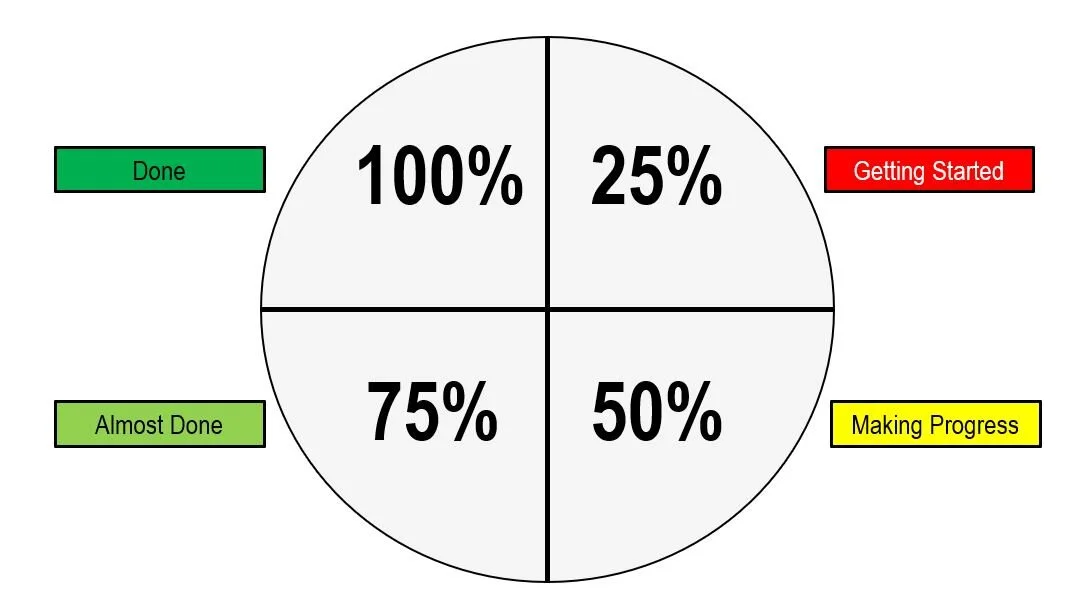
Draw a circle. Break it into quadrants. Fill in each quadrant using a marker, indicating progress towards completion. It doesn’t have to be scientific or pretty, it just has to work.
25% = Getting started – initial progress has been made or a plan has been created.
50% = Making progress – things are moving along and people know what to do and how to do it.
75% = Almost there – we can see the light at the end of the tunnel. We can finish the work.
100% = Done – we’re finished and ready to move on to something else.
There’s no need to break status down into smaller elements. That would cause the team to spend more time updating status and less time doing work. When properly updated, it’s powerful and simple to understand. I use flip chart paper to draw Status Indicators during Kaizen events. Flip chart paper is large enough to allow others to see the status from twenty feet away or more.
To give you a sense of the value and impact of Status Indicators, use the following example. Four teams are working on separate projects.
Project 1 is Almost there, Project 2 is Done, Project 3 is Getting started, Project 4 is Making progress, and Project 5 hasn’t been started. It’s clear who needs help and who can help. Team members from Project 2 can help Projects 3 and 4, depending on their skills and interests. If there are more resources than Projects 3 and 4 need, those resources can start on Project 5. Anyone else, even if they’re not on the team, can assess the status and help those who need it.
The value of Status Indicators has been reinforced to me many times, never more than when I forgot to use them. After a particularly busy day during a Kaizen event, some team members said they were frustrated because they didn’t know what to do next. Others said the day felt chaotic and disorganized. I realized I hadn’t trained the team to use Status Indicators. I immediately showed them how to use them. The next day, much more work got completed. At the end of the day, the team related how much easier it was to manage their work.
From a supervisor’s or manager’s point of view, Status Indicators make it simpler and more efficient to keep track of work going on in many areas. Hours of effort to track progress are reduced to minutes or seconds.

Attention to Detail
In 2007, I moved my family across country to take a new role as Production Manager for a ceiling tile plant in Oregon. The plant had a strong team-based culture. People genuinely wanted to help each other work in as safe and productive manner as possible. It wasn’t unusual to see the Plant Manager on the factory floor, assisting the technicians with their work or helping them stay safe.
In 2007, I moved my family across country to take a new role as Production Manager for a ceiling tile plant in Oregon. The plant had a strong team-based culture. People genuinely wanted to help each other work in as safe and productive manner as possible. It wasn’t unusual to see the Plant Manager on the factory floor, assisting the technicians with their work or helping them stay safe.
Plant performance had deteriorated over the years and we were operating at less than budgeted levels. I was determined to identify the reasons and work with the technicians to turn things around.
The first two months of my time at the plant, I spent more time on the factory floor than in meetings or in my office. I came into the plant at any hour of the day or night, trying to assess and understand the reasons for the lowered performance. People had the right attitude. They wanted to win. What was holding them back?
The Team Managers had strong relationships with their people. The equipment was in generally good condition and there was an established preventive maintenance program. Something was missing and I had to find out what it was.
One morning, while taking a walk around the plant, I noticed papers on clipboards at each operating station on the line. They were titled “While Running Tasks.” Taking a closer look, I saw operations checks to be completed and signed off by the technicians on shift. There were many blank spaces on the papers, meaning that checks weren’t completed during the week.
I reviewed these papers and found that less than half of the checks had been completed and signed off. The Team Managers told me the checks were defined as critical to the performance and safety of the line. Teams of technicians had identified and agreed to the tasks. They met every three months to review and update the “While Running Tasks” as new issues arose.
I reviewed the forms to see if there was any correlation between tasks not completed and downtime or scrap events. In a two-month sample, more than one-third of the downtime and scrap events could have been prevented if the checks were completed properly and on time. I now knew what had to be done.
Working with my three Team Managers, we came up with a plan to rapidly improve performance. We would rededicate ourselves to the “While Running Tasks.” Nothing less than a 100% completion rate was acceptable. Technicians would be accountable to complete and sign off on all tasks during their shift. Team Managers would audit the tasks on every shift, and I’d audit randomly every day and do a complete audit at the end of every week.
My Team Managers wanted to conduct crew meetings and share the new requirements with their crews. I told them I wanted to be a part of every meeting, sharing my logic and belief in our new requirement. They agreed and we planned crew meetings for the next day at 6:30 am, 3:30 pm, and 10:30 pm.
I kicked off each meeting. I told the crews how impressed I was by the teamwork I had observed. I also talked about the honesty of people working there. No one ever signed off on anything unless they had actually completed a task. Now, it was time to use our teamwork and honesty to improve performance at the plant.
I reviewed my findings about the “While Running Tasks.” I shared examples of line failures and scrap events directly impacted by the incompletion of the critical work they had identified and agreed to. We owed it to each other to perform the work we agreed to. Next, I laid out the principles and expectations moving forward:
1. Attention to detail will improve performance and keep everyone safe.
2. While Running Tasks are the first line of defense to prevent problems and reduce safety risk.
3. We must achieve 100% compliance to While Running Tasks – anything less increases risk for downtime and injuries.
4. Completing While Running Tasks is a condition of employment.
I then handed the meeting to the Team Manager, who described how he would work with his crew to attain 100% compliance. He described how he would hold himself and each crew member accountable to their “While Running Tasks.” Crews were also encouraged to review their “While Running Tasks” and verify they were practical and designed to prevent problems.
We received many questions. It was easy to answer any concerns. We truly believed this approach was going to keep everyone safer and more productive. People were worried they were going to be fired if they forgot a task once in a while. We understood and put in levels of discipline. We didn’t want to fire anyone. We did believe that 100% compliance was the best strategy to improve performance at the plant. We couldn’t compromise our beliefs.
During the first two weeks, there were a few “forgotten” tasks. There was some discipline recorded. No one was fired. The first month, compliance reached 90%. Plant performance was noticeably improved. The second month, compliance was 98%. The third month, we achieved 100% compliance. Everyone could tell the difference. The plant was running significantly better. For the next year and a half, compliance stayed at 100%. During that time, the plant attained company records for performance. Attention to detail cost us nothing; except time, focus, and commitment.
A Wakeup Call
In 2001, I was the Business Unit Manager at a Vinyl Flooring Plant in Pennsylvania. Responsible for the one of four business units on site, I had a unionized workforce of 160 employees, three supervisors, and eight technical staff. My job was to turn the shrinking business around and keep my employees safe and productive.
In 2001, I was the Business Unit Manager at a Vinyl Flooring Plant in Pennsylvania. Responsible for one of the four business units on site, I had a unionized workforce of 160 employees, three supervisors, and eight technical staff. My job was to turn the shrinking business around and keep my employees safe and productive.
With many layoffs over the years, the shortest tenured hourly employees had more than twenty-five years of service. They had seen many Business Unit Managers come and go over the years and were determined to outlast me. All three supervisors had been promoted from the ranks and were also of the mindset to survive until the next Business Unit Manager arrived.
This wasn’t the best situation to drive change, but we had to do many things better, and fast. One such change was to do a better job protecting the safety of our employees. We instituted a stronger safety program with improvements in the way employees interacted with and locked-out (an OSHA mandated program) their equipment. Although we were convinced that we were doing the right thing, we had major pushback from the union and even the supervisors, who saw all of the new requirements as a waste of time and effort. After much discussion, my staff and supervisors agreed as a team to be consistent in our safety message, approach, and accountability. At least that’s what I thought.
One day I overheard one of the supervisors telling his crew they needed to follow the new safety protocols because, “The company is making me do this.” Much to my concern and disappointment, this statement confirmed he didn’t believe in what we were doing. At that moment, I knew he would never hold himself or his crew accountable to keep themselves safe.
I couldn’t let this continue and immediately stepped in. I corrected the situation and sent him packing. It sounds harsh. There’s much more to this story. He had been demonstrating a pattern of subversive and destructive behavior for many months. This was the final straw. I was unwilling to put my employees at risk and knew a change had to be made.
Although firing someone is a life changing event for them and for those they work with, it ended up turning out fairly well for everyone involved. The remaining supervisors and crew took safety more seriously and the fired supervisor later admitted this was a wakeup call for him, as he was able to take a renewed commitment to safety to his next employer.

Let’s See How Things Go
During my tenure as Production Manager at a ceiling tile plant in Oregon, I implemented strict rules around changeovers: No one is allowed in the breakroom during a changeover without Team Manager approval; Everyone is available to help during the changeover; Everyone is at their stations when the line is ready to start up; One Best Way changeover procedures are followed to the letter. No deviations. The procedures were developed by the technicians. There was no reason not to follow them.
During my tenure as Production Manager at a ceiling tile plant in Oregon, I implemented strict rules around changeovers:
· No one is allowed in the breakroom during a changeover without Team Manager approval.
· Everyone is available to help during the changeover.
· Everyone is at their stations when the line is ready to start up.
· One Best Way changeover procedures are followed to the letter. No deviations. The procedures were developed by the technicians. There was no reason not to follow them.
These rules came from my observations the first two months after I arrived at the plant. Those not directly involved in the changeover used that time to go to the break room. We lost vital minutes waiting for technicians to return from break when a changeover was completed. Sometimes help was needed to verify changeover settings prior to starting the line back up. If resources weren’t available, things took longer. Technicians were frustrated when they had to wait for help.
Technicians didn’t like the “no break during changeover” rule. I explained changeovers were the most critical activity during the production run and everyone should be helping to execute the safest, most accurate changeover possible. It couldn’t be done from the breakroom.
Some argued they wouldn’t be able to get their breaks under these new rules. I felt they’d have more flexibility around their breaks once changeover performance improved.
Immediately after the new rules were implemented, employees came to my office to express their displeasure. After listening to their arguments, I explained why I felt the rules were necessary. The plant had a culture of teamwork and help. There was no way to help teammates from the breakroom. Then, I told them, “let’s give it a chance and see how things go.” They didn’t like my answer. I was firm in my convictions and sent them on their way.
At the beginning of every changeover, I took a walk to the break room to ensure people were following the changeover rules. I didn’t want to put all of the burden on my Team Managers. I held myself accountable for rule enforcement. From time to time, I found people in the break room during a changeover. I always asked if their Team Manager had approved the break. Most of the time, they got up and went back to the line, indicating they hadn’t.
After four weeks, changeover time was reduced by 33%. Not only was the time reduced, it was more predictable. Just by having everyone available to help with the changeover and in place when the line was ready to start up. My team noticed the results. Visits to my office by “dissatisfied customers” came down significantly.
Team Managers felt more comfortable enforcing the changeover rules. They knew I had their back and they were seeing results. They were able to explain the rules and the reasons for them. It was no longer “Adam’s rules for changeovers”.
Two weeks later, a technician came to my office. He said, “Adam, I know you’re just going to tell me ‘let’s give it a chance and see how things go.’ I just wanted to tell you how I feel about the changeover rule anyway.” I thanked him for the feedback. He knew what I was going to say. There was no point repeating it.
Changeovers became a source of pride across all of the crews. Teamwork strengthened and performance continued to improve. What was once difficult and frustrating was now safe, simple, and predictable.

This Stuff Works
At a gummy vitamin manufacturer in Pennsylvania, I was asked to facilitate a team of mechanics responsible for supporting and maintaining the manufacturing operation. They had difficulty keeping their maintenance area compliant with strict food production regulations. Our goal was to develop a system to guarantee compliance, while improving their ability to service their customers.
At a gummy vitamin manufacturer in Pennsylvania, I was asked to facilitate a team of mechanics responsible for supporting and maintaining the manufacturing operation. They had difficulty keeping their maintenance area compliant with strict food production regulations. Our goal was to develop a system to guarantee compliance, while improving their ability to service their customers.
On the morning of the first day of the Kaizen event, I taught Lean principles and how 5S is used to optimize safety and productivity in a space. It all sounds good in a classroom. The team wondered how it applied to their situation. After training, we took a Gemba walk through their workspace. They thought they were in pretty good shape. The space was cluttered and lacked any hint of organization. They had nothing to compare to and hadn’t been exposed to other examples of 5S in the facility. After generating ideas in their work area, I took them to two locations in the plant that had used 5S: a production line and the Weld shop.
Our first stop was the production line. I asked one of the technicians operating the line to give the team a tour and point out what they had done and the benefits he had seen. He obliged and described 5S and its benefits as best he could. Team members were paying attention to what he was saying, but asked few questions and wrote fewer notes. I thanked the technician and took the team to the Weld shop.
On our way to the Weld shop, I asked team members what they thought of the production line. Feedback fell into two categories:
1. It looks pretty good.
2. I can’t see how it applies to our area.
I knew the next tour stop would be more inspiring. I was intimately familiar with what was done in the area. I could provide a more compelling review for the team.
When we got to the Weld shop, I noticed Jimmy working on a project. He was the team leader when we applied 5S to the Weld shop.
Jimmy: “What are you doing here?”
Me: “This is the Kaizen team from the gummy vitamin maintenance area. I’m giving them a tour of the Weld shop and showing them what your team accomplished.”
Jimmy: “Okay, just don’t get in the way. I’ve got lots of work to do.”
Me: “Thanks Jimmy. If you want to give the tour or share your thoughts, please do.”
Jimmy: “That’s fine. You can give the tour.”
Jimmy is not someone who likes to speak in front of groups or work with teams. Jimmy is also one of those folks who isn’t a fan of management or consultants. But, if he believes in something, it’s useful and helpful to him and others. He doesn’t give out compliments often (ever?) and doesn’t fall in line and do whatever he’s told.
I started the tour pointing out various ideas and improvements the Weld shop Kaizen team made six months earlier. Jimmy was paying attention to what we were doing, but didn’t say a word. I think he was interested to see how I’d describe the work of the Weld shop team. I did my best to represent their efforts and as I did, you could see the pride grow in Jimmy’s face.
My next stop on the tour was at the tool board created by the team during the Kaizen event. As I started describing and demonstrating the use of the tool board to the team, Jimmy got more and more interested. My new team was asking many questions and taking notes on my responses and their observations.
Rob (team leader): “This looks good and all. Does it really stay this way?”
Me: “I don’t think they cleaned up for us.”
Ben (team member): “Does this really work?”
Jimmy: “Look, this may sound silly and it may sound stupid. This $#*% works!”
This was the moment of clarity and credibility for the team. If Jimmy thought so, it must be so. I stopped the tour. The team had seen everything they needed.
I thanked Jimmy and took the team back to the meeting room to review their observations and ideas. On the way back, I challenged them to beat the results of the production line and the Weld shop. They told me they were up for the challenge.
The rest of the week, the team did amazing work, identifying the critical tools needed (All Tools Available), giving them the most visible and logical homes (Visible Evidence) and even telling the leadership team what they needed them to do to sustain the efforts from now on (Layered Audits and Accountability). I am not sure their area was any nicer or better thought out than the Weld shop or the production line, but they thought so, and that’s all that matters.

You’re Never as Good as You Think You Are
Of all the Kaizen events I have facilitated, there is nothing like 3P. It’s the most exciting, energizing, and exhausting way to create breakthroughs with a team. 3P stands for Production Preparation Process. The idea is to design a new product or process with the least amount of waste possible.
Of all the Kaizen events I have facilitated, there is nothing like 3P. It’s the most exciting, energizing, and exhausting way to create breakthroughs with a team. 3P stands for Production Preparation Process. The idea is to design a new product or process with the least amount of waste possible.
Production Preparation Process uses an eleven-step method to open people’s minds to what’s possible and make them as creative as their 8-year old selves. The technique was invented by Chihiro Nakao, a legend in the Lean community.
I was first exposed to 3P by consultants in 2010. We used the technique to design a new product in half the time it would have taken us to using our standard product development methods. I had the opportunity to facilitate half a dozen 3P events and was able to achieve similar breakthroughs with other teams.
I was always curious about the thinking behind 3P and had the opportunity to participate in a 3P competition, run by Sensei Nakao’s company, Shingijutsu, in 2013. During the week, I was able to pick up the nuances and deeper thinking behind 3P. I realized I had been taking shortcuts during the events I facilitated and because of that, we were diminishing our breakthroughs and results. I didn’t get to meet Sensei Nakao at the competition, but gained a deeper respect for the man and his thinking. I decided I would have to meet him one day, if the opportunity arose.
Meeting the Sensei
In 2016, I found out there was an opportunity to meet Sensei Nakao, as Shingijutsu was running another 3P workshop at a plant in Connecticut. He was the overall sensei for the week. I convinced three other coworkers to register for the workshop and we drove up to Connecticut together. During the drive, we discussed our expectations for the session. I wanted to learn from the master, but I also decided I had to have the ultimate tourist experience: be scolded in Japanese by Sensei Nakao.
The host plant made parts for the aircraft industry. More than sixty people signed up for the workshop. We were divided into eight teams, each having a part of the process to improve using 3P. After some initial training in Japanese (with English translation) by Sensei Nakao, teams were assigned a sensei (facilitator) and toured their area of responsibility.
I had met my sensei at the 2013 competition. He chose me to be on his team for that reason. He also knew I had some experience in 3P and its facilitation, so he gave me more responsibility than the rest of the team.
We took a tour of the operation and spent many hours on the factory floor, engaging with the technicians and gaining deeper understanding of the process. By the end of a very long first day, I was exhausted and glad when the team dinner was over. I knew I would need a good amount of sleep to prepare me for the next day’s activities. I felt confident, having much experience with 3P. What could they throw at me that I hadn’t seen before, I wondered?
Go to Gemba
The next day, after a quick review, the team went back out to the factory floor to gather more data and test ideas. I was asking an operator some questions when our sensei motioned to me. He asked me to join him away from the line. He was working with another team member and wanted me to help facilitate the next step of the eleven-step method. They were drawing some pictures on a large piece of paper taped to a wall, just fifteen feet from the production line.
As I was helping my teammate at the wall, I felt a tap on my shoulder. I looked up and it was Sensei Nakao. He didn’t look happy. I got my wish. I was being scolded in Japanese! I only understood one word: Gemba. The interpreter told me that I should be spending more time in Gemba and not away from it at a wall. All learning was to be done in Gemba. There was nothing I could say, but I could see my sensei looked uneasy.
Achieving My Goal
My sensei must have said something to Sensei Nakao, as he was taken aside and spoken to in Japanese. He looked like a beaten puppy. When Sensei Nakao finished with him, he left and went to visit with the next team. I waited a few minutes and then said to my sensei, “You got scolded, didn’t you?” He looked at me sheepishly and finally admitted he had. We both laughed. I had realized my tourist objective.
The rest of the week was a blur. We were able to solve the problem we had been assigned. I learned deeper meanings of 3P and was able to bring back refined skills to my company. I continue to learn more about 3P. No matter how many 3P experiences I have, I can always do better. Sensei Nakao’s scolding reaffirmed it.

It’s Better to Beg Forgiveness than Ask Permission
In 1998, I was invited to Hoogezand, the Netherlands, to help a team make improvements to their ceiling tile production line. Little did I know it would be the longest Kaizen event in my life. I had been to the plant three months before and identified significant changeover time reduction potential. It was time to put my money where my mouth was. In advance of the trip, we identified members of the team and the need for an interpreter. I didn’t speak Dutch and still don’t. We’d have two weeks to work on the line and were to coordinate with the Production Manager any time we needed to shut the line down to work on or test the equipment.
In 1998, I was invited to Hoogezand, the Netherlands, to help a team make improvements to their ceiling tile production line. Little did I know it would be the longest Kaizen event in my life. I had been to the plant three months before and identified significant changeover time reduction potential. It was time to put my money where my mouth was. In advance of the trip, we identified members of the team and the need for an interpreter. I didn’t speak Dutch and still don’t. We’d have two weeks to work on the line and were to coordinate with the Production Manager any time we needed to shut the line down to work on or test the equipment.
I arrived in the Netherlands on Sunday and met with the team in a conference room on Monday morning. After introducing myself, getting to know each of the team members, and providing some Lean and changeover reduction training, we took a tour of the line to identify the highest priority areas to improve and also to get a sense for the team’s interests.
The line wasn’t running very well and I was informed this was typical. Most of the equipment was in need of repair and the maintenance department wasn’t in tune with the needs of the production organization. I told the team I wanted to meet the Maintenance Manager. They looked at me like I had asked for something outrageous. When he came out to the line, I could see why they were a bit apprehensive.
Progress vs. Paperwork
Ullrich was a very tall German man, perhaps six foot eight (I am five foot seven on a good day). With a shaved head, hands twice the size of mine, and a very low and stern voice, he introduced himself by grabbing my hand and saying, “You vill not touch or modify any equipment without filling out the proper paperwork!” Taking my hand back before it was crushed, I assured him we would follow the rules. Although he didn’t seem satisfied, he left to go to the maintenance office.
Realizing we couldn’t fill out paperwork while we were making our improvements, I promised the team I would fill out the forms at the end of each day. The team didn’t look like they believed me, but knew I didn’t want any broken fingers. There were so many problems on the line. Two weeks weren’t enough time to fix everything. With focus, dedication, and proper prioritization, I was sure we’d make significant progress.
The top priority of the team was to improve the reliability of the equalizer, which cut the ceiling boards into finished tile dimensions. Operators had a difficult time setting up the proper cutting sizes. It took hours for them to get the proper cuts. We asked the Lead Operator to shut down the line, to allow us to assess the situation and find out why it was so difficult to set up to the proper size.
Five minutes later, the Production Manager came by to find out why the line was shut down. We told him we were trying to figure out what was keeping the equalizer from being set up consistently. He reminded us we were supposed to let him know any time we were going to shut down the line. I apologized and said it wouldn’t happen again. Knowing it probably would happen again; I advised the team to remind me to let the Production Manager know our intentions before shutting the line down. They promised they would. I wasn’t so sure.
Asking the Right Questions
The equalizer used precision screws to guide the saws to their final positions on the cutting bed. Operators turned a handle to move the saws on the screws. Watching the saws move as the handle was turned, I could see the saws weren’t moving consistently. With the first full turn of the handle, it appeared the saw moved twice as far as it did with the second full turn of the handle. This situation had to be resolved. First, we had to figure out why things were acting in this way.
We tracked down a dial indicator with a magnetic base. We wanted to see how much variation was occurring when we tried to move the saws. On our first test, the handle was turned one full revolution and the saw traveled 0.020”. We turned it one full turn in the opposite direction and the traveled just 0.005”.
The team was convinced the precision screw had worn down, causing variation in movement. Thinking about this, I knew this should not be the case, but I also know what my eye had seen. Then I asked the question, “What is riding on the precision screw?” It turns out it was a brass bushing. My next question was, “Which component is more likely to wear down, the brass bushing or the hardened steel precision screw?” It had to be the brass bushing. My next question was, “When was the last time the brass bushings were replaced?” No one remembered it ever happening.
We tracked down Ullrich, explained the situation and found enough brass bushings to replace all of the assemblies on the equalizer. Four hours later, we had replaced bushings worn down to the nub with brand new brass bushings. After, we tested out changes and now had saws able to repeat their locations within 0.001”. Ullrich reminded me to fill out the proper paperwork, but was impressed enough to shake my hand. This time, he didn’t crush it.
Making Progress and Earning Trust
Over the rest of the first week, we made similar improvements to all areas of the line. We never filled out the paperwork in advance, but our earlier success at the equalizer reduced the pressure on me, the team, and my hands. We also made a game of shutting down the line and then betting on how long it would take the Production Manager to show up to see what we were doing. We were improving so many things so quickly he also gave us the leeway to shut the line down without approvals, but kept playfully reminding us to follow the rules.
The team enjoyed the work so much they decided to work on Saturday and then take Sunday off. I took Sunday to go sightseeing and got lost in the village of Makkum, 80 miles to the west, known for their ceramic tile craftsmen. That’s a story for another time.
Monday, the team was ready to make more improvements to the line. We improved almost every part of the production line by Friday morning. Our report out was scheduled for Friday afternoon. The entire plant staff showed up at the production line and listened to the team explain and show their improvements in Dutch. At the end of the report out the team said, “Adam leerde ons dat het beter is om vergeving te smeken dan om toestemming te vragen!” After much laughter and clapping by the staff, Ullrich, and Production Manager, I was told the translation was: “Adam taught us that it is better to beg forgiveness than ask permission!”

Let It Go
In 2010, Armstrong World Industries emerged from bankruptcy. A minority stake of the company was bought by a private equity firm. This firm knew there were many improvement opportunities and brought in consultants to help create a culture of continuous improvement across the global organization. Their approach was to hold many Kaizen events on a weekly basis, exposing as many people to the principles of Lean as quickly as possible.
In 2010, Armstrong World Industries emerged from bankruptcy. A minority stake of the company was bought by a private equity firm. This firm knew there were many improvement opportunities and brought in consultants to help create a culture of continuous improvement across the global organization. Their approach was to hold many Kaizen events on a weekly basis, exposing as many people to the principles of Lean as quickly as possible.
Having recently completed my assignment as the St. Helens Oregon Operations Manager, I was asked to provide support to the consultants. Sometimes I co-facilitated Kaizen events with the consultants. Other times, I was asked to facilitate Kaizen events independently of the consultants. This story is about one of the first Kaizen events held at the Marietta, Pennsylvania ceiling tile plant.
Paired with a consultant, I co-facilitated a team using 5S to improve the safety and productivity of their packaging area. 5S stands for: Sort, Set in Order, Shine, Standardize, and Sustain. Using this methodology, teams take a step by step approach as they make quick and meaningful changes to a target area. Lean was new at the plant, so we provided extensive Lean training to the team. The team was comprised of line operators, mechanics, a supervisor from the area, and a few staff members.
After the training, we took the team out to Gemba (the place where the work is done) to assess the materials that were no longer needed in the area. This is the first S, Sort. During Sort, the team is to decide what is absolutely necessary and what is clutter. The clutter is then disposed of or removed from the area. Once done, the team then moves on to Set in Order. The packaging area was built twelve years earlier and it was apparent most things in the area were from the first days of production.
A Case of Clutter
Many of the team members were having a difficult time finding things to dispose of. When something was found that didn’t look current or relevant, people would say things like, “We may need it in the future.” Or, “If we fixed it, we could use it.” After a few hours in the area, it didn’t look the team was willing to take a leap of faith and remove much of the unused and unusable equipment and materials.
The consultant and I stepped away from the team to discuss a strategy. “Adam,” he said, “we need to demonstrate it’s alright to remove and dispose of the clutter. Let’s pick a few things to remove, do it ourselves, and see if we can get others to join in.” I agreed, knowing we had to demonstrate it was okay to do something drastic to get breakthrough results. We took a walk around the area and found a few items that looked like they didn’t belong and then happened upon something that definitely needed to go.
Underneath a platform was an old rolling toolbox, covered in dust. Except it was unable to roll. One of the wheels was missing. When we looked through the drawers, all we saw were various nuts and bolts covered with years of grease and grime. The toolbox hadn’t been used in years and it looked to be an ideal candidate for the dumpster. It was pretty heavy, so we asked one of the team members to assist us as we pulled it out from under the platform. After getting it out, we placed it on a skid, ready to be taken away by a forklift.
A Toolbox Road Block
Except we couldn’t. Just as soon as we had called for the forklift, the supervisor on our team came at us with an angry look in his eyes. “What do you think you’re doing?” We explained what and why we were doing what we were doing. His face turned red. “I bought that toolbox for $300 and it’s served us well. I can’t believe you would just throw it out. We could fix it and use it.” When we pointed out the three new, clean rolling toolboxes in use in the packaging area, he stormed off.
We decided to talk with the rest of the team members. They told us no one had used the toolbox in years, the other toolboxes were sufficient, and the materials inside the old toolbox were of no use to them. They agreed to dispose of it and started to find other things in a similar condition to be removed as well.
The supervisor didn’t return that day. At the end of the day, the consultant and I were called to the Plant Manager’s office to talk about what had happened. The supervisor had stopped by the office earlier. After describing what we had done and the reaction of the supervisor and the team, we were told to tone down our approach. Lean was new to the plant and the people working there, and not everyone was on board. The supervisor was very proud of his accomplishments, helped design the packaging area, and took ownership for everything in the area, even the broken-down toolbox.
The Plant Manager told us it was more important to get the whole team engaged, rather than take extreme measures to prove a point. We agreed, and after leaving what felt like the principal’s office, we developed our strategy to reengage the team and improve relations the next day.
Taking a New Approach
The next morning, with the full team in a meeting room, we apologized for taking such drastic actions. We promised to get full team approval before making any more changes. When the team went back to the packaging area, they were energized. The consultant and I were able to step back and let the team make all of the organizational decisions in the packaging area. By the end of the week, the team removed more than 80% of the supplies, tools, equipment, and materials in the area. What remained was logically organized, in pristine condition and very visual. It was easy to see the condition of the area and if anything was out of place.
After a tour of the area, plant leadership remarked how much better everything looked and felt. Team members talked about the impact of the work and how it would benefit them in their normal jobs. This was the first of hundreds of Kaizen events at the Marietta ceiling plant over the next decade. Everyone learned valuable lessons. But I may have learned the most valuable lesson of all – pay strict attention to the team and understand what engages and motivates them. Even small changes are important; you don’t have to shoot for the moon every time. As long as the team owns the change, it will be sustained.